. 2005 Sep 27;102(39):13873-8.
doi: 10.1073/pnas.0506441102. Epub 2005 Sep 6.

A force-dependent state controls the coordination of processive myosin V

Affiliations

A force-dependent state controls the coordination of processive myosin V

Thomas J Purcell et al. Proc Natl Acad Sci U S A. .

Abstract

Myosin V is an efficient processive molecular motor. Recent experiments have shown how the structure and kinetics of myosin V are specialized to produce a highly processive motor capable of taking multiple 36-nm steps on an actin filament track. Here, we examine how two identical heads coordinate their activity to produce efficient hand-over-hand stepping. We have used a modified laser-trap microscope to apply a approximately 2-pN forward or backward force on a single-headed myosin V molecule, hypothesized to simulate forces experienced by the rear or lead head, respectively. We found that pulling forward produces only a small change in the kinetics, whereas pulling backward induces a large reduction in the cycling of the head. These results support a model in which the coordination of myosin V stepping is mediated by strain-generated inhibition of the lead head.


Figures

Fig. 1.
Fig. 1.
The myosin V catalytic cycle. (A) A prestroke myosin V head (red) is shown binding to an actin filament. Once the trailing head unbinds from actin, it is stroked forward by the bound head that transitions from its prestroke state (red) to a poststroke state (green). Once the head has stroked, it can complete the catalytic cycle by first releasing ADP, and then binding a new ATP molecule. ATP binding causes the head to release from the actin to be advanced to the next actin-binding site. While unbound, the head also hydrolyzes its ATP, cocking the head into a prestroke geometry. A, actin; M, myosin. (B) The prestroke-to-poststroke transition is part of an equilibrium that could be influenced by external force (F) on the molecule.
Fig. 2.
Fig. 2.
Experimental setup and operation. (A) Experimental setup. An actin dumbbell held in a dual-beam laser trap is brought into contact with a myosin molecule adsorbed onto a bead on the surface of the flow cell. The flow cell is mounted on a piezoelectric stage that is oscillated along the axis of the actin dumbbell. Bead position is monitored by quadrant photodiode detection. Binding of the myosin to the actin dumbbell causes a displacement of the beads.A computer monitors the bead position and stops the stage oscillation when binding occurs. (B) Stage and bead position after displacement. The stage (green) rapidly moves 190 nm, with a 500-Hz damped oscillation caused by the mechanical resonance in the piezoelectric stage. Initially, the dumbbell (blue) is also displaced because of hydrodynamic interaction with the surface but it is pulled back to its baseline position in the trap within 5 ms. The blue trace is an average of 100 events to remove the effects of random thermal noise. (C) Example data showing a series of binding events for MV-6IQ-S1 in 10 μM ATP. The bead positions for both beads in the dumbbell are shown. (D) The red traces show example traces of binding events after an upward or downward displacement of the stage.
Fig. 3.
Fig. 3.
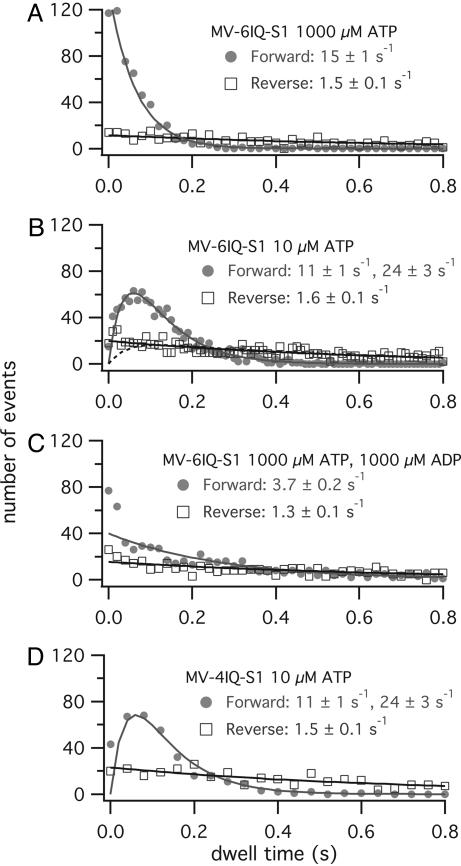
Dwell-time histograms for MV-6IQ-S1. Data are shown for both pulling forward (•, mimicking a trailing head) or pulling backward (□, mimicking a leading head). Data are fit as two sequential rates fk1,k2(t) = {k1 k2/(k1k2)} × (ek2tek1t) or fit as a single exponential rate f(t) = kekt. (A) At 1,000 μM ATP, the forward pulling is fit to a single rate of 15 s–1 (n = 532). The backward-pulling distribution fits to a single rate of 1.5 s–1 (n = 398). (B) At 10 μM ATP, the forward pulling is fit to two rates (n = 1,071), and the backward pulling is fit to a single rate (n = 1,222). The dashed line is a fit to two rates, 1.7 and 24 s–1. The deviation shows that any other steps other than the 1.6-s–1 observed off rate must be ≫24 s–1. (C) At 1,000 μM ATP, the forward pulling is fit to a single rate of 3.7 s–1 (n = 662) and the backward pulling is fit to 1.3 s–1 (n = 553). (D) Dwell-time histogram for MV-4IQ-S1 at 10 μM ATP.
Fig. 4.
Fig. 4.
Force and ATP dependence for MV-1IQ-S1. Rates shown are derived from a maximum-likelihood fit of the dwells to two sequential rates. Rates from different ATP concentrations are plotted on a log-log scale. The fits are estimates based on one ATP-independent rate (k1) and one saturating ATP-dependent rate (k2).
Fig. 5.
Fig. 5.
Off-axis strain accelerates ADP release. Cartoon representation of MV-4IQ-HMM attached to a segment of actin. The lead head is shown bound at the second, sixth, seventh, and 11th actin subunit, corresponding to a span of 5.5, 16.5, 19.3, and 30.3 nm between the two heads. The intermediate distances require the myosin to twist around the actin helix, as shown by the arrows indicating the orientation of each myosin head. Processive steps from MV-4IQ-HMM at 10 μM ATP were collected into 4-nm bins, and the times for the preceding and following dwells were fit to two rates. Closed symbols show the two rates that best-fit prestep dwells, and open symbols show the rates derived from poststep dwells.
Fig. 6.
Fig. 6.
A model for how force coordinates the kinetics of the myosin V head. Energy profile for a head bound to actin subjected to an external force. Under unloaded conditions (black curve) the transition between an intermediately bound state (AMD) to a strongly bound state (AM*D) is rapid and strongly biased to formation of the strongly bound state. After the myosin reaches this state, there is a rate-limiting transition where the motor releases ADP. If a motor experiences a forward force (green curve, mimicking a trailing head), the free energy is reduced as a function of the position along the reaction coordinate (28). The reaction remains limited by the final ADP release step, which is sped up very little because of a small change in the relative free energies between AM*D and the ADP release transition state. If the motor is working against a backward force (red curve, mimicking a leading head), the free energy increases as a function of reaction coordinate. The forward transition to AM*D becomes significantly slower and the reverse transition is favored compared with the release of ADP from the AM*D state. If the initial state is populated, the weakly bound myosin head might release from the actin because of an off-pathway dissociation of the AMD to A + MD (blue arrow). In a two-headed walking motor, the lead head experiences an increasing backward force as it tries to swing its lever arm because of the attachment to the stationary trailing head (black dashed line), locking the lead head in the initial AMD state.

Comment in

  • Holding the reins on myosin V.
    Olivares AO, De La Cruz EM. Olivares AO, et al. Proc Natl Acad Sci U S A. 2005 Sep 27;102(39):13719-20. doi: 10.1073/pnas.0507068102. Epub 2005 Sep 19. Proc Natl Acad Sci U S A. 2005. PMID: 16172373 Free PMC article. Review. No abstract available.

References

    1. Cheney, R. E., O'Shea, M. K., Heuser, J. E., Coelho, M. V., Wolenski, J. S., Espreafico, E. M., Forscher, P., Larson, R. E. & Mooseker, M. S. (1993) Cell 75, 13–23. - PubMed
    1. Vale, R. D. (2003) Cell 112, 467–480. - PubMed
    1. Mehta, A. D., Rock, R. S., Rief, M., Spudich, J. A., Mooseker, M. S. & Cheney, R. E. (1999) Nature 400, 590–593. - PubMed
    1. Sakamoto, T., Amitani, I., Yokota, E. & Ando, T. (2000) Biochem. Biophys. Res. Commun. 272, 586–590. - PubMed
    1. Sakamoto, T., Wang, F., Schmitz, S., Xu, Y., Xu, Q., Molloy, J. E., Veigel, C. & Sellers, J. R. (2003) J. Biol. Chem. 278, 29201–29207. - PubMed

MeSH terms