


Health-related quality of life is related to COPD disease severity
- PMID: 16153294
- PMCID: PMC1215504
- DOI: 10.1186/1477-7525-3-56
Health-related quality of life is related to COPD disease severity
Abstract
Background: The aim of this study was to evaluate the association between health-related quality of life (HRQL) and disease severity using lung function measures.
Methods: A survey was performed in subjects with COPD in Sweden. 168 subjects (70 women, mean age 64.3 years) completed the generic HRQL questionnaire, the Short Form 36 (SF-36), the disease-specific HRQL questionnaire; the St George's Respiratory Questionnaire (SGRQ), and the utility measure, the EQ-5D. The subjects were divided into four severity groups according to FEV1 per cent of predicted normal using two clinical guidelines: GOLD and BTS. Age, gender, smoking status and socio-economic group were regarded as confounders.
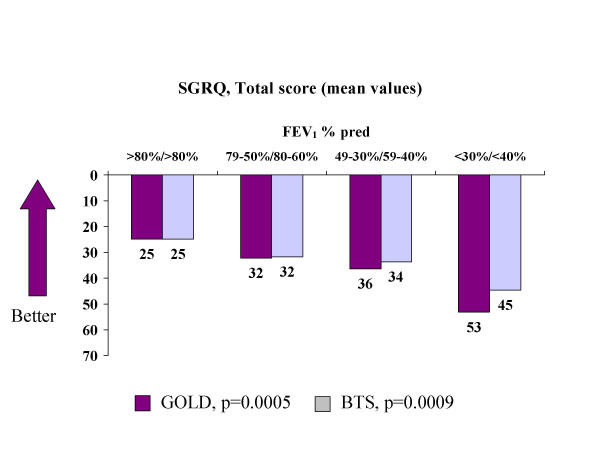
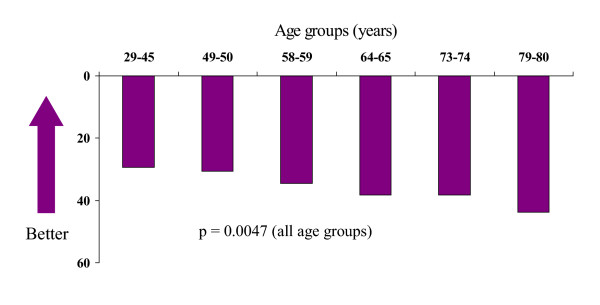
Results: The COPD severity grades affected the SGRQ Total scores, varying from 25 to 53 (GOLD p = 0.0005) and from 25 to 45 (BTS p = 0.0023). The scores for SF-36 Physical were significantly associated with COPD severity (GOLD p = 0.0059, BTS p = 0.032). No significant association were noticed for the SF-36, Mental Component Summary scores and COPD severity. Scores for EQ-5D VAS varied from 73 to 37 (GOLD I-IV p = 0.0001) and from 73 to 50 (BTS 0-III p = 0.0007). The SGRQ Total score was significant between age groups (p = 0.0047). No significant differences in HRQL with regard to gender, smoking status or socio-economic group were noticed.
Conclusion: The results show that HRQL in COPD deteriorates with disease severity and with age. These data show a relationship between HRQL and disease severity obtained by lung function.
Figures
References
-
- Vollmer WM, Osborne ML, Buist AS. 20-year trends in the prevalence of asthma and chronic airflow obstruction in an HMO. American Journal of Respiratory & Critical Care Medicine. 1998;157:1079–1084. - PubMed
-
- Pauwels RA, Buist AS, Calverley PMA, Jenkins CR, Hurd SS. Global strategy for the diagnosis, management, and prevention of chronic obstructive pulmonary disease: NHLBI and WHO Global Initiative for Chronic Obstructive Lung Disease (GOLD): executive summary. Respiratory Care. 2001;46:798–825. - PubMed
-
- Ray D, Abel R, Selvaraj KG. A 5-yr prospective epidemiological study of chronic obstructive pulmonary disease in rural south India. Indian Journal of Medical Research. 1995;101:238–244. - PubMed
Publication types
MeSH terms
LinkOut - more resources
Full Text Sources
Medical
