


doi: 10.1110/ps.051516405.
Epub 2005 Sep 9.
Crystal lattice as biological phenotype for insect viruses
Affiliations
- PMID: 16155202
- PMCID: PMC2253309
- DOI: 10.1110/ps.051516405
Item in Clipboard
Crystal lattice as biological phenotype for insect viruses
Protein Sci.
2005 Oct.
Abstract
Many insect viruses survive for long periods by occlusion within robust crystalline polyhedra composed primarily of a single polyhedrin protein. We show that two different virus families form polyhedra which, despite lack of sequence similarity in the virally encoded polyhedrin protein, have identical cell constants and a body-centered cubic lattice. It is almost inconceivable that this could have arisen by chance, suggesting that the crystal lattice has been preserved because it is particularly well-suited to its function of packaging and protecting viruses.
Figures
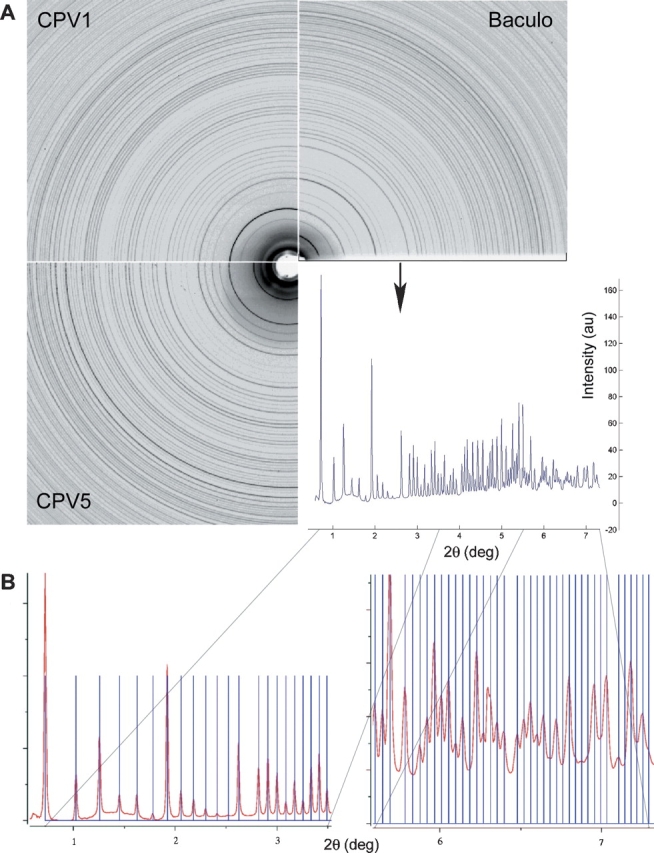
(A) Part of powder diffraction patterns for polyhedra of AcMNPV, CPV1, and CPV5. The nearly identical spacing of the intensity rings with a small opening angle shows the similarity of lattice constants of the different samples. Comparing the rings of CPV1 and CPV5, the small difference in the lattice constants is clearly visible, emphasising the precision of powder diffraction analysis. (B) The predicted peak positions for a cubic body-centered lattice of 103.7 ± 0.05 Å lattice constant, agree very well with the powder pattern measured for AcMNPV polyhedrin.
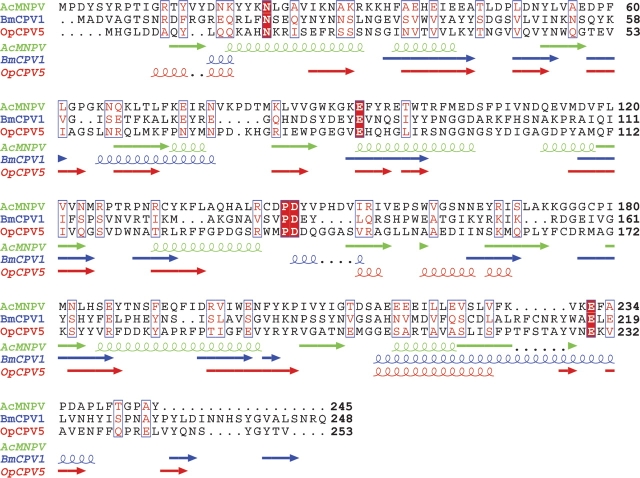
Alignment of the amino acid sequences for the polyhedrin gene of Autographa californica baculovirus (AcMNPV), Bombyx mori CPV type 1 (BmCPV1), and Orgyia pseudosugata CPV type 5 (OpCPV5) with predicted secondary structure assignments drawn underneath. Fully conserved residues are shown on a red background, and similar residues are highlighted red in a blue box (global similarity score as defined by Risler et al. [1988] > 0.7). The sequences were aligned with ClustalW and visualized using ESPript (Gouet et al. 1999), and the secondary structures were predicted by PROFsec (Rost and Sander 1993).
References
-
- Berman, H.M., Battistuz, T., Bhat, T.N., Bluhm, W.F., Bourne, P.E., Burkhardt, K., Feng, Z., Gilliland, G.L., Iype, L., Jain, S., et al. 2002. The Protein Data Bank. Acta Crystallogr. D Biol. Crystallogr. 58: 899–907. - PubMed
-
- Di, X., Yu-Kun, S., McCrae, M.A., and Rossmann, M.G. 1991. X-ray powder pattern analysis of cytoplasmic polyhedrosis virus inclusion bodies. Virology 180: 153–158. - PubMed
-
- Gouet, P., Courcelle, E., Stuart, D.I., and Metoz, F. 1999. ESPript: Analysis of multiple sequence alignments in PostScript. Bioinformatics 15: 305–308. - PubMed
-
- Hill, C.L., Booth, T.F., Stuart, D.I., and Mertens, P.P.C. 1999. Lipofectin increases the specific activity of cypovirus particles for cultured insect cells. J. Virol. Methods 78: 177–189. - PubMed
-
- Moscardi, F. 1999. Assessment of the application of baculoviruses for control of Lepidoptera. Annu. Rev. Entomol. 44: 257–289. - PubMed
Publication types
MeSH terms
Substances
LinkOut - more resources
Full Text Sources
Other Literature Sources
