. 2005 Oct;14(10):2744-50.
doi: 10.1110/ps.051665905. Epub 2005 Sep 9.

Structure of the nuclease domain of ribonuclease III from M. tuberculosis at 2.1 A

Affiliations

Structure of the nuclease domain of ribonuclease III from M. tuberculosis at 2.1 A

David L Akey et al. Protein Sci. 2005 Oct.

Abstract

RNase III enzymes are a highly conserved family of proteins that specifically cleave double-stranded (ds)RNA. These proteins are involved in a diverse group of functions, including ribosomal RNA processing, mRNA maturation and decay, snRNA and snoRNA processing, and RNA interference. Here we report the crystal structure of the nuclease domain of RNase III from the pathogen Mycobacterium tuberculosis. Although globally similar to other RNase III folds, this structure has some features not observed in previously reported models. These include the presence of an additional metal ion near the catalytic site, as well as conserved secondary structural elements that are proposed to have functional roles in the recognition of dsRNAs.


Figures
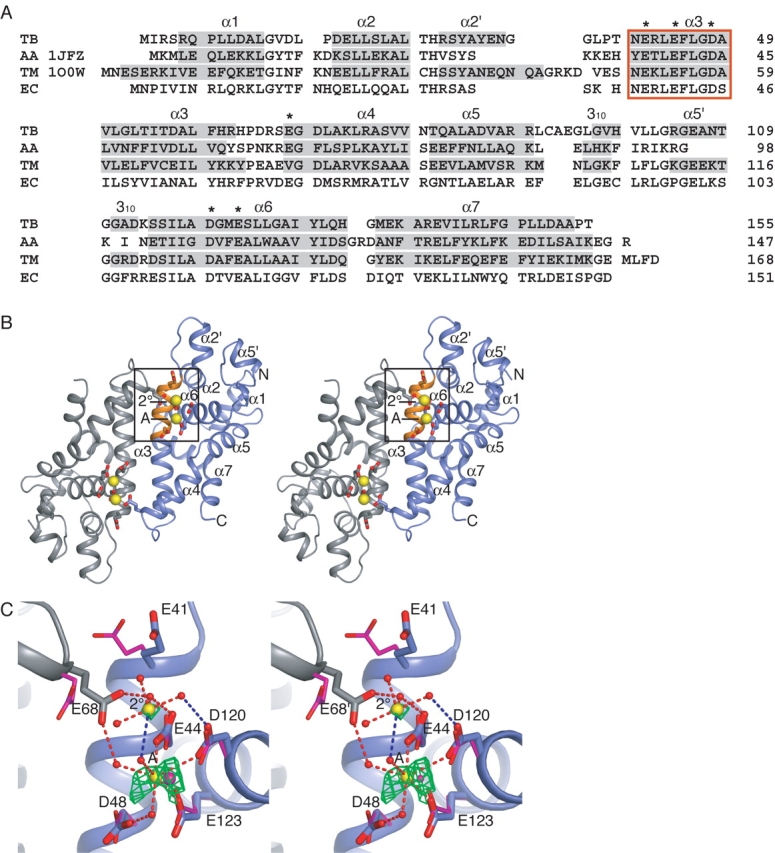
Figure 1.
Figure 1.
(A) Sequence and secondary structure of the nuclease domains from M. tuberculosis (TB), A. aeolicus (AA), T. maritima (TM), and E. coli (EC) RNase III. Secondary structure assignments (shaded gray) were assigned using the STRIDE server (Frishman and Argos 1995). The RNase III signature sequence is enclosed in the orange box. Residues marked with an asterisk (*) are referred to in the text. (B) Stereo diagram of RNase III dimer. The active site residues coordinate the A- and 2°-site metal ions (yellow spheres). The signature sequence (orange), which includes three of the active site residues, is contained within helix α4. The box encloses one of the two symmetry-related active sites shown in C. (C) Stereo diagram showing coordination of metal ions in the active site. Interactions indicated by red dashes are 3.2 Å, and shorter interactions indicated in blue are 3.2–3.5 Å. The A-site ion is directly coordinated by residues Glu44, Asp120, and Glu123, and to Asp48 and Glu68′ through water molecules. The 2°-site ion is coordinated through its hydration shell to residues Glu44 and Asp120 and to Glu68′ from the adjacent monomer. Fo-Fc positive difference electron density map (green) contoured at 3σ was calculated from a model in which the Ca2+ ions were replaced with water molecules, and the resultant structure was subjected to CNS simulated annealing and positional and B-factor refinement. In magenta are the active site residues and A-site metal ion from the A. aeolicus Mn2+-bound structure (PDB ID 1JFZ; Blaszczyk et al. 2001).
Figure 2.
Figure 2.
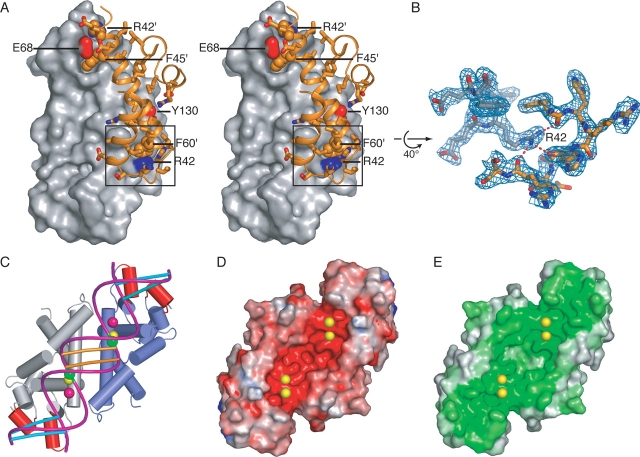
(A) Stereo diagram of dimer interface showing the surface of one monomer and the interacting region from the adjacent monomer. The surface regions corresponding to the polar side-chain atoms which bridge the interface are colored: Glu68 OE1 and OE2, red; Tyr130 OH, red; and Arg42 NH1 and NH2, blue. The box outlines the region shown in B. (B) 2Fo-Fc refined electron density map contoured at 1.5σ detailing the interaction between Arg42 and backbone carbonyls of residues Phe60′ through Ser67′ of the dimermate. (C) A-form dsRNA modeled on the TB nuclease domain so that the scissile phosphates (green spheres) lie adjacent to the A-site metal ions (yellow spheres). The 2°-site ions are shown in magenta. The bases forming the two-nucleotide overhang product are indicated with orange bars. This arrangement places the minor groove corresponding to the distal box “anti-determinant” bases (cyan) (Zhang and Nicholson 1997) in close proximity to helices α2′ and α5′ (red). Surface electrostatics calculation using APBS (D) (Baker et al. 2001) and surface conservation (E) (Glaser et al. 2003) show negatively charged and conserved surface residues which align with the proposed dsRNA binding region.

References

    1. Baker, N.A., Sept, D., Joseph, S., Holst, M.J., and McCammon, J.A. 2001. Electrostatics of nanosystems: Application to microtubules and the ribosome. Proc. Natl. Acad. Sci. 98 10037–10041. - PMC - PubMed
    1. Beese, L.S. and Steitz, T.A. 1991. Structural basis for the 3′-5′ exonuclease activity of Escherichia coli DNA polymerase I: A two metal ion mechanism. EMBO J. 10 25–33. - PMC - PubMed
    1. Blaszczyk, J., Tropea, J.E., Bubunenko, M., Routzahn, K.M., Waugh, D.S., Court, D.L., and Ji, X. 2001. Crystallographic and modeling studies of RNase III suggest a mechanism for double-stranded RNA cleavage. Structure (Camb) 9 1225–1236. - PubMed
    1. Blaszczyk, J., Gan, J., Tropea, J.E., Court, D.L., Waugh, D.S., and Ji, X. 2004. Noncatalytic assembly of ribonuclease III with double-stranded RNA. Structure (Camb) 12 457–466. - PubMed
    1. Brunger, A.T., Adams, P.D., Clore, G.M., DeLano, W.L., Gros, P., Grosse-Kunstleve, R.W., Jiang, J.S., Kuszewski, J., Nilges, M., Pannu, N.S., et al. 1998. Crystallography & NMR system: A new software suite for macromolecular structure determination. Acta Crystallogr. D Biol. Crystallogr. 54 (Pt. 5) 905–921. - PubMed

Publication types

MeSH terms

Associated data

LinkOut - more resources