


Expression of the immunoregulatory molecule FcRH4 defines a distinctive tissue-based population of memory B cells
- PMID: 16157685
- PMCID: PMC2212938
- DOI: 10.1084/jem.20050879
Expression of the immunoregulatory molecule FcRH4 defines a distinctive tissue-based population of memory B cells
Abstract
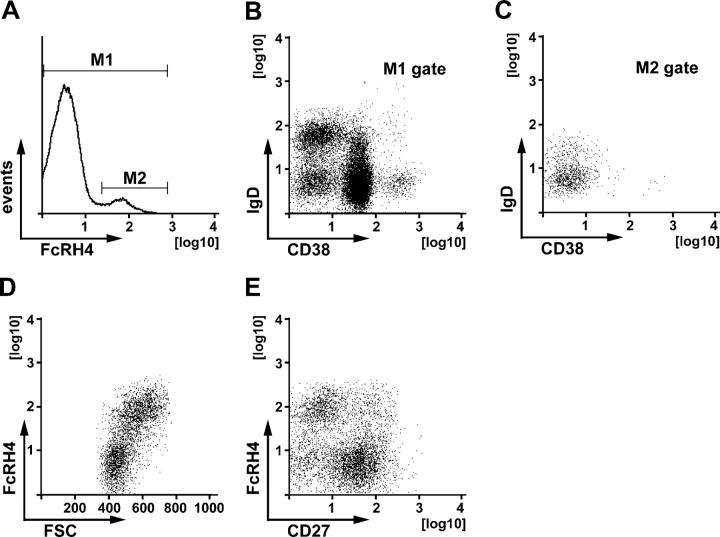
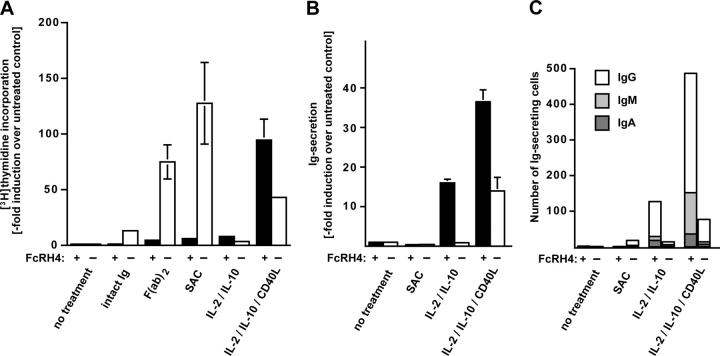
The FcRH4 transmembrane molecule, a member of the Fc receptor homologue family, can potently inhibit B cell receptor (BCR) signaling. We show that cell surface expression of this immunoregulatory molecule is restricted to a subpopulation of memory B cells, most of which lack the classical CD27 marker for memory B cells in humans. The FcRH4+ and FcRH4- memory B cells have undergone comparable levels of immunoglobulin isotype switching and somatic hypermutation, while neither subpopulation expresses the transcription factors involved in plasma cell differentiation. The FcRH4+ memory cells are morphologically distinctive large lymphocytes that express the CD69, CD80, and CD86 cell activation markers. They are also shown to be poised to secrete high levels of immunoglobulins in response to stimulation with T cell cytokines, but they fail to proliferate in response either to BCR ligation or Staphylococcus aureus stimulation. A heightened expression of the CCR1 and CCR5 chemokine receptors may facilitate their preferential localization in lymphoid tissues near epithelial surfaces. Cell surface FcRH4 expression thus marks a unique population of memory B cells with distinctive morphology, functional capabilities, and tissue localization.
Figures


References
-
- Nunez, C., N. Nishimoto, G.L. Gartland, L.G. Billips, P.D. Burrows, H. Kubagawa, and M.D. Cooper. 1996. B cells are generated throughout life in humans. J. Immunol. 156:866–872. - PubMed
-
- Rossi, M.I., T. Yokota, K.L. Medina, K.P. Garrett, P.C. Comp, A.H. Schipul Jr., and P.W. Kincade. 2003. B lymphopoiesis is active throughout human life, but there are developmental age-related changes. Blood. 101:576–584. - PubMed
-
- LeBien, T.W. 2000. Fates of human B-cell precursors. Blood. 96:9–23. - PubMed
-
- Hardy, R.R., and K. Hayakawa. 2001. B cell development pathways. Annu. Rev. Immunol. 19:595–621. - PubMed
-
- Jacobs, H., and L. Bross. 2001. Towards an understanding of somatic hypermutation. Curr. Opin. Immunol. 13:208–218. - PubMed
Publication types
MeSH terms
Substances
Grants and funding
LinkOut - more resources
Full Text Sources
Other Literature Sources
Molecular Biology Databases
Research Materials
