. 2005 Sep 12;170(6):889-93.
doi: 10.1083/jcb.200504156.

A novel mechanism of actin filament processive capping by formin: solution of the rotation paradox

Affiliations

A novel mechanism of actin filament processive capping by formin: solution of the rotation paradox

Tom Shemesh et al. J Cell Biol. .

Abstract

The FH2 domains of formin family proteins act as processive cappers of actin filaments. Previously suggested stair-stepping mechanisms of processive capping imply that a formin cap rotates persistently in one direction with respect to the filament. This challenges the formin-mediated mechanism of intracellular cable formation. We suggest a novel scenario of processive capping that is driven by developing and relaxing torsion elastic stresses. Based on the recently discovered crystal structure of an FH2-actin complex, we propose a second mode of processive capping-the screw mode. Within the screw mode, the formin dimer rotates with respect to the actin filament in the direction opposite to that generated by the stair-stepping mode so that a combination of the two modes prevents persistent torsion strain accumulation. We determine an optimal regime of processive capping, whose essence is a periodic switch between the stair-stepping and screw modes. In this regime, elastic energy does not exceed feasible values, and supercoiling of actin filaments is prevented.


Figures
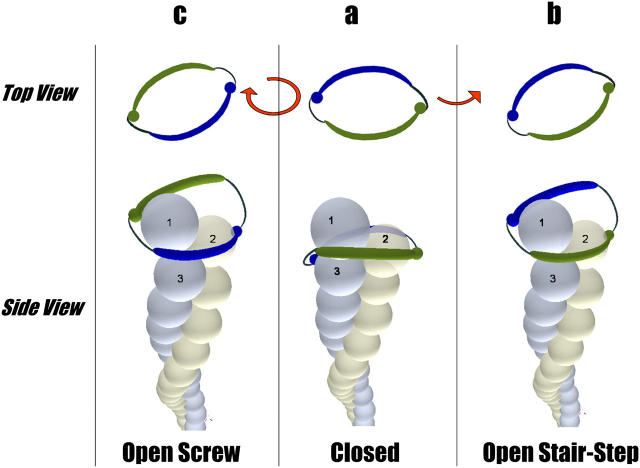
Figure 1.
Figure 1.
Two modes of processive capping of actin filaments by a dimer of formin homology domain FH2. The model is based on the structure of an FH2–formin complex that was established crystallographically (Otomo et al., 2005). Spheres represent the actin monomers. The formin bridges are shown as blue and green elongated bodies winding around the actin filament. Red arrows indicate the directions of FH2 rotation with respect to the filament bulk. (a) The closed state of the formin–actin complex, which is unavailable for insertion of new actin monomers. The green bridge binds the protruding (actin 1) and penultimate (actin 2) subunits, whereas the second, blue bridge binds actins 2 and 3 subunits. (b) The stair-stepping mode of processive capping. The blue bridge migrates from actins 2 and 3 to actin 1 and exposes its post domain for insertion of a new actin monomer. The FH2 dimer rotates by ∼14° in the direction of twist of the long-pitch actin helix. (c) The screw mode of processive capping. The two bridges undergo a screwlike motion around the filament until they bind in the new position corresponding to the open state of the filament end. The FH2 dimer rotates in the direction of the short-pitch actin helix, which is opposite to the rotation direction of the stair-stepping mode. Rotation angle in the screw mode is approximately −166°.
Figure 2.
Figure 2.
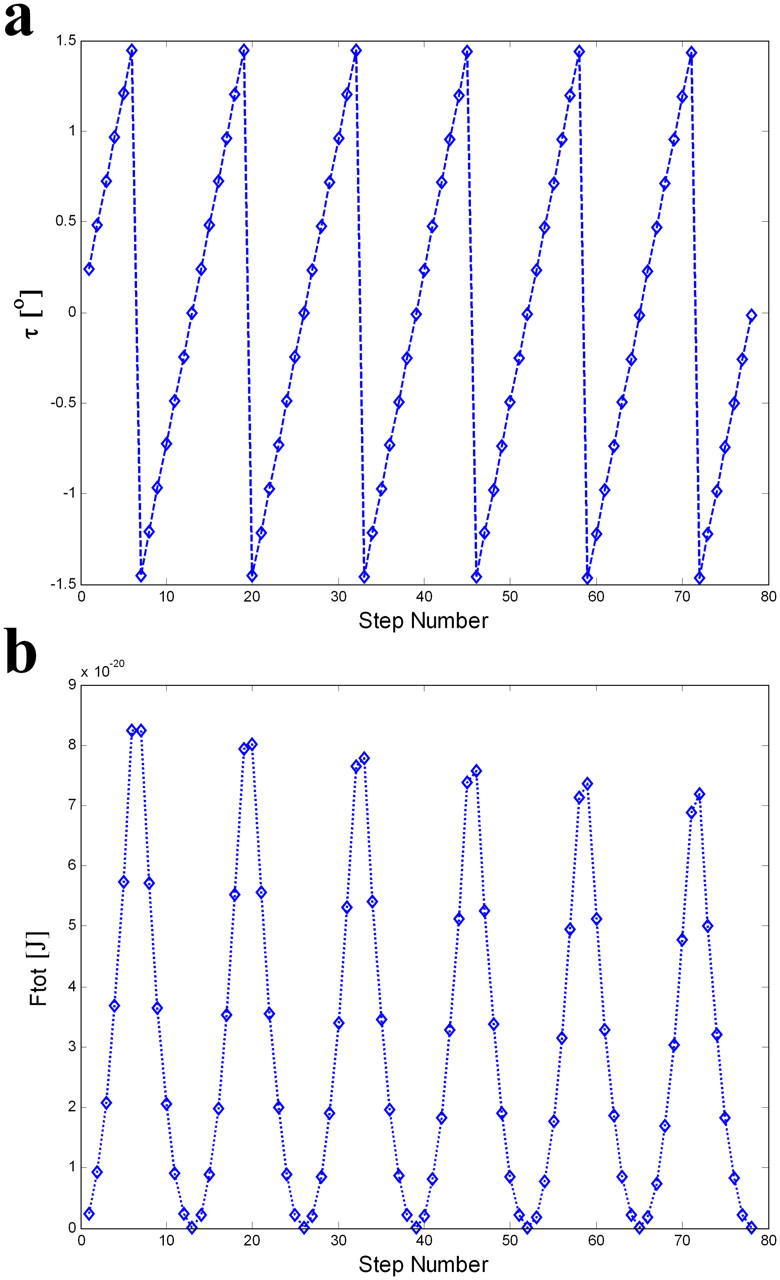
The optimal regime of processive capping, consisting of repeated sequences of12 stair-stepping steps followed by one screw step. (a) The torsion strain as a function of the number of polymerization steps after the beginning of elastic stress accumulation. The torsion strain changes periodically between the values of approximately −83° and 83°. Regions of the positive slope correspond to the stair-stepping mode, whereas regions of the negative slope represent the screw mode. (b) Change of elastic energy (Ftot) in the course of stair stepping. The elastic parameters used in the calculation are the actin filament torsion modulus C ≈ 8 × 10⁻²⁶ J × m (Tsuda et al., 1996) and bending modulus K ≈ 3.6 × 10⁻²⁶ J × m (Gittes et al., 1993; Isambert et al., 1995). It is also assumed that the torsion energy starts to accumulate after the filament reaches a length of 1 μm, which corresponds to the experimental design of Kovar and Pollard (2004). The energy changes periodically with slowly decreasing amplitude. Maximal energy is reached in the first cycle and does not exceed ∼20 kBT, where kBT ≈ 0.6 kcal/M is the product of the Boltzmann constant and absolute temperature.

References

    1. Gittes, F., B. Mickey, J. Nettleton, and J. Howard. 1993. Flexural rigidity of microtubules and actin filaments measured from thermal fluctuations in shape. J. Cell Biol. 120:923–934. - PMC - PubMed
    1. Higashida, C., T. Miyoshi, A. Fujita, F. Oceguera-Yanez, J. Monypenny, Y. Andou, S. Narumiya, and N. Watanabe. 2004. Actin polymerization-driven molecular movement of mDia1 in living cells. Science. 303:2007–2010. - PubMed
    1. Higgs, H.N. 2005. Formin proteins: a domain-based approach. Trends Biochem. Sci. 30:342–353. - PubMed
    1. Holmes, K.C., D. Popp, W. Gebhard, and W. Kabsch. 1990. Atomic model of the actin filament. Nature. 347:44–49. - PubMed
    1. Isambert, H., P. Venier, A.C. Maggs, A. Fattoum, R. Kassab, D. Pantaloni, and M.F. Carlier. 1995. Flexibility of actin filaments derived from thermal fluctuations. Effect of bound nucleotide, phalloidin, and muscle regulatory proteins. J. Biol. Chem. 270:11437–11444. - PubMed

Publication types