


Gender differences in the risk of ischemic stroke and peripheral embolism in atrial fibrillation: the AnTicoagulation and Risk factors In Atrial fibrillation (ATRIA) study
- PMID: 16157766
- PMCID: PMC3522521
- DOI: 10.1161/CIRCULATIONAHA.105.553438
Gender differences in the risk of ischemic stroke and peripheral embolism in atrial fibrillation: the AnTicoagulation and Risk factors In Atrial fibrillation (ATRIA) study
Abstract
Background: Previous studies provide conflicting results about whether women are at higher risk than men for thromboembolism in the setting of atrial fibrillation (AF). We examined data from a large contemporary cohort of AF patients to address this question.
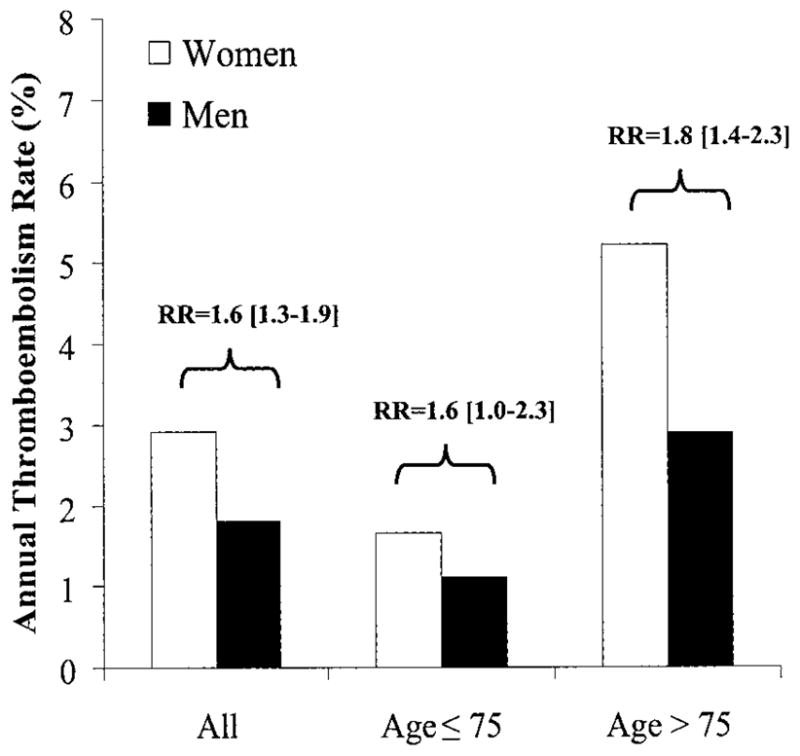
Methods and results: We prospectively studied 13,559 adults with AF and recorded data on patients' clinical characteristics and the occurrence of incident hospitalizations for ischemic stroke, peripheral embolism, and major hemorrhagic events through searching validated computerized databases and medical record review. We compared event rates by patient sex using multivariable log-linear regression, adjusting for clinical risk factors for stroke, and stratifying by warfarin use. We identified 394 ischemic stroke and peripheral embolic events during 15,494 person-years of follow-up off warfarin. After multivariable analysis, women had higher annual rates of thromboembolism off warfarin than did men (3.5% versus 1.8%; adjusted rate ratio [RR], 1.6; 95% CI, 1.3 to 1.9). There was no significant difference by sex in 30-day mortality after thromboembolism (23% for both). Warfarin use was associated with significantly lower adjusted thromboembolism rates for both women and men (RR, 0.4; 95% CI, 0.3 to 0.5; and RR, 0.6; 95% CI, 0.5 to 0.8, respectively), with similar annual rates of major hemorrhage (1.0% and 1.1%, respectively).
Conclusions: Women are at higher risk than men for AF-related thromboembolism off warfarin. Warfarin therapy appears be as effective in women, if not more so, than in men, with similar rates of major hemorrhage. Female sex is an independent risk factor for thromboembolism and should influence the decision to use anticoagulant therapy in persons with AF.
Figures
References
-
- Wolf PA, Abbott RD, Kannel WB. Atrial fibrillation as an independent risk factor for stroke: the Framingham study. Stroke. 1991;22:983–988. - PubMed
-
- Atrial Fibrillation Investigators. Risk factors for stroke and efficacy of antithrombotic therapy in atrial fibrillation: analysis of pooled data from five randomized controlled trials. Arch Intern Med. 1994;154:1449–1457. - PubMed
-
- Hart R, Pearce L, McBride R, Rothbart R, Asinger R. Factors associated with ischemic stroke during aspirin therapy in atrial fibrillation: analysis of 2012 participants in the SPAF I–III clinical trials. Stroke. 1999;30:1223–1229. - PubMed
-
- Gage BF, Waterman AD, Shannon W, Boechler M, Rich MW, Radford MJ. Validation of clinical classification schemes for predicting stroke: results from the National Registry of Atrial Fibrillation. JAMA. 2001;285:2864–2870. - PubMed
-
- Wang TJ, Massaro JM, Levy D, Vasan RS, Wolf PA, D’Agostino RB, Larson MG, Kannel WB, Benjamin EJ. A risk score for predicting stroke or death in individuals with new-onset atrial fibrillation in the community: the Framingham Heart Study. JAMA. 2003;290:1049–1056. - PubMed
Publication types
MeSH terms
Substances
Grants and funding
LinkOut - more resources
Full Text Sources
Medical
