. 2005 Sep 20;102(38):13634-9.
doi: 10.1073/pnas.0504583102. Epub 2005 Sep 12.

How adeno-associated virus Rep78 protein arrests cells completely in S phase

Affiliations

How adeno-associated virus Rep78 protein arrests cells completely in S phase

Carole Berthet et al. Proc Natl Acad Sci U S A. .

Abstract

Adeno-associated virus Rep78 protein has antiproliferative effects on cells. It inhibits cell cycle progression, and, in particular, Rep78 induces a complete arrest within S phase, a response rarely seen after cell DNA damage. We examined how Rep78 achieves such an efficient S phase block. Rep78 inhibits Cdc25A activity by a novel means in which binding between the two proteins stabilizes Cdc25A, thus increasing its abundance, while at the same time preventing access to its substrates cyclin-dependent kinase (Cdk) 2 and Cdk1. This effect alone does not induce a complete S phase block. In addition, Rep78, as well as Rep68, produces nicks in the cellular chromatin, inducing a DNA damage response mediated by ataxia telangiectasia mutated (ATM) leading to G(1) and G(2) blocks. Mutational analysis shows that the zinc finger domain and nuclease activity of Rep78 are both required for the S phase block. The results suggest that a true S phase block cannot be achieved through a single pathway, and that adeno-associated virus Rep78 protein arrests cells within S phase by interfering with two pathways that would normally lead to an S phase slow-down.


Figures
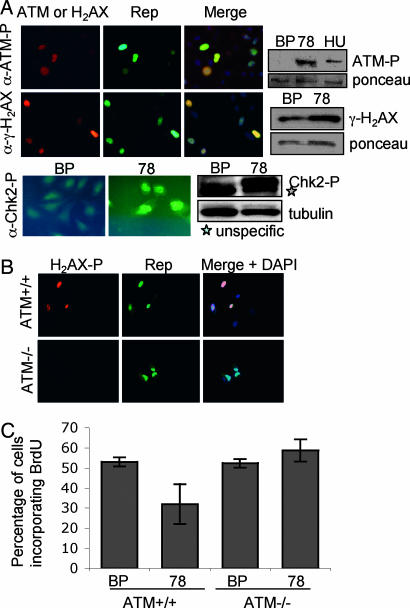
Fig. 1.
Fig. 1.
Rep78 induces a DNA damage response. (A) Cells were transfected with the Rep78-expressing plasmid BP78 (78) or its empty version BP. As positive control for DNA damage response, cells were treated with hydroxyurea (HU). DNA damage protein activation was monitored in HeLa and U-2-OS cells by immunofluorescence staining and Western blot with phosphospecific antibodies. ATM and H2AX activation were monitored 2 days posttransfection without selection, and Chk2 activation at 3 days posttransfection after complete selection. Ponceau staining is used as loading control. (B) Analysis of H2AX phosphorylation in ATM-/- Rep78 transfectants that were not selected. Rep is in green and γ-H2AX in red. (C) Percentages of ATM+/+ and ATM-/- cells incorporating BrdUrd in the presence or in the absence of Rep78. The results are based on four independent bivariate flow cytometry analyses of cells without selection.
Fig. 2.
Fig. 2.
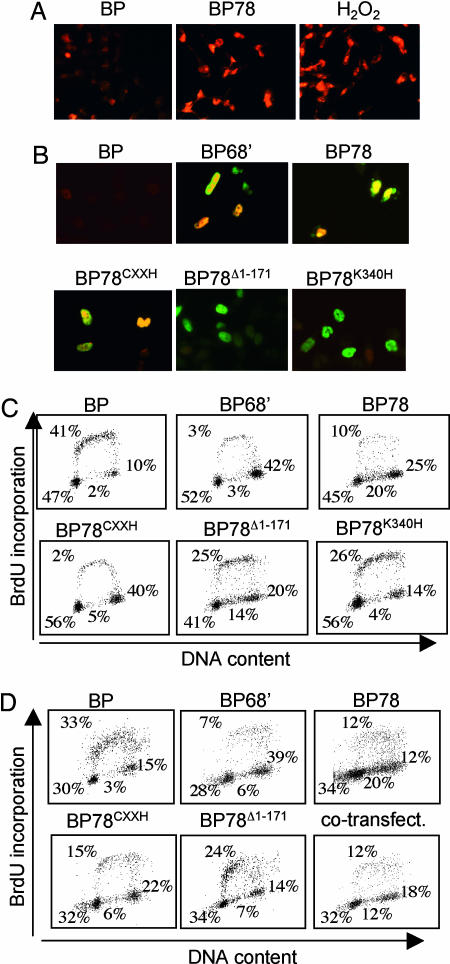
Nicking of cellular DNA by Rep78 is not sufficient to completely block cells in S-phase. (A) Nick translation assay in HeLa cells transfected with Rep78. H2O2 treatment was used as a positive control. (B) H2AX activation (red) in cells transfected with different forms of Rep (green). (C) Cell cycle analysis by bivariate flow cytometry of 3T3 cells infected with different forms and mutants of Rep, 5 days postinfection with selection. (D) Cell cycle analysis of HeLa cells transfected with different forms and mutants of Rep, 2 days posttransfection, with selection. Co-transfect., BP78CXXH plus BP78Δ1-171.
Fig. 3.
Fig. 3.
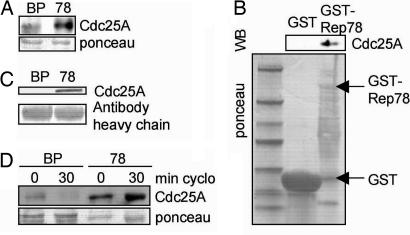
Rep78 increases Cdc25A levels by binding and stabilizing it. In A, C, and D, cells were transfected with BP78 or BP. (A) Cdc25A levels were detected in U-2-OS cells by Western blot after 2 days selection. (B) GST and GST-Rep78 were produced in bacteria and used in pull-down assays with total HeLa cell extract. (C) Coimmunoprecipitation of Cdc25A with an anti-Rep78 antibody from HeLa cells. (D) Rep78 stabilizes Cdc25A protein. Shown is Western blot analysis of Cdc25A in U-2-OS cells after 0 or 30 min of cycloheximide treatment (min cyclo). Ponceau staining is used as loading control.
Fig. 4.
Fig. 4.
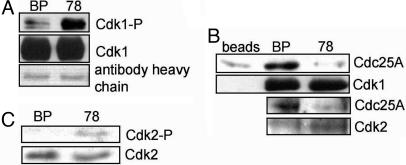
Rep78 binding to Cdc25A inhibits its phosphatase activity. Cells were transfected with BP78 or BP. (A) In vitro phosphatase assay was performed by mixing cyclinB-Cdk1 immunoprecipitated from HeLa cells treated with doxorubicin, with Cdc25A immunoprecipitated from HeLa cells either expressing Rep78 or not. (B) Coimmunoprecipitation of Cdc25A from HeLa cells with anti-Cdk2 or anti-Cdk1 antibodies. (C) Western blot analysis of Cdk2 and its phosphorylated form in U-2-OS cells.
Fig. 5.
Fig. 5.
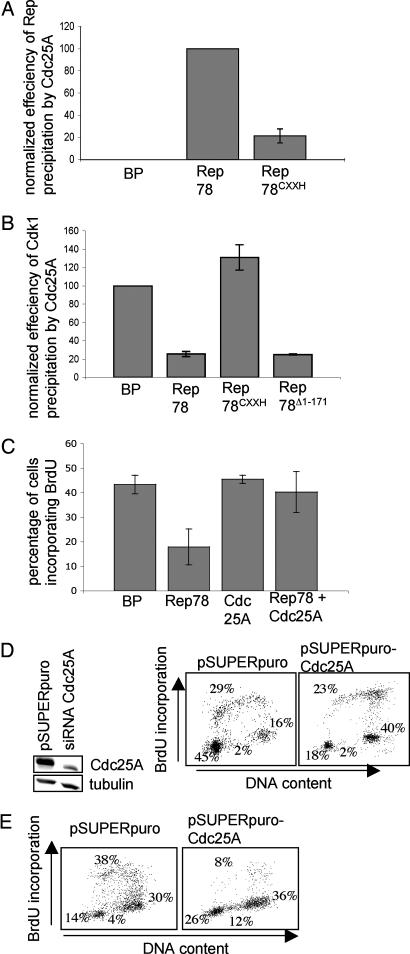
Rep78 lacking the zinc-finger domain is defective in binding and inhibition of Cdc25A activity. (A) Measurements of Rep78 or Rep78CXXH protein that coimmunoprecipitated with Cdc25A. (B) Measurement of Cdk1 that coimmunoprecipitated with Cdc25A either in the absence or presence of Rep78, Rep78CXXH, or Rep78Δ1-171. Error bars represent standard deviations of three experiments. (C) Percentages of HeLa cells incorporating BrdUrd in the presence of Rep78 and Cdc25A overexpression. Cells transfected with Rep78 were not antibiotic-selected before analysis. The error bars represent the standard deviations from four independent experiments. (D Left) Western blot analysis of Cdc25A levels in HeLa cells transfected with pSuperpuro or pSuperpuroCdc25A 2 days after transfection and antibiotic selection. (Right) Bivariate flow cytometry analysis of these cells after a 30-min BrdUrd pulse, 2 days after transfection and antibiotic selection. (E) Rep78-induced cell cycle block can be mimicked by H2O2 treatment of cells expressing siRNA against Cdc25A. Both cell populations were H2O2-treated and either expressed siRNA against Cdc25A or not.

References

    1. Rommelaere, J. & Cornelis, J. J. (1991) J. Virol. Methods 33, 233-251. - PubMed
    1. Schlehofer, J. R. (1994) Mutat. Res. 305, 303-313. - PubMed
    1. Berns, K. & Linden, R. (1995) Bioessays 17, 237-245. - PubMed
    1. Winocour, E., Callaham, M. F. & Huberman, E. (1988) Virology 167, 393-399. - PubMed
    1. Hermanns, J., Schulze, A., Jansen-Db1urr, P., Kleinschmidt, J. A., Schmidt, R. & zur Hausen, H. (1997) J. Virol. 71, 6020-6027. - PMC - PubMed

Publication types

MeSH terms