


Simian immunodeficiency virus infection in free-ranging sooty mangabeys (Cercocebus atys atys) from the Taï Forest, Côte d'Ivoire: implications for the origin of epidemic human immunodeficiency virus type 2
- PMID: 16160179
- PMCID: PMC1211554
- DOI: 10.1128/JVI.79.19.12515-12527.2005
Simian immunodeficiency virus infection in free-ranging sooty mangabeys (Cercocebus atys atys) from the Taï Forest, Côte d'Ivoire: implications for the origin of epidemic human immunodeficiency virus type 2
Erratum in
- J Virol. 2006 May;80(9):4645
Abstract
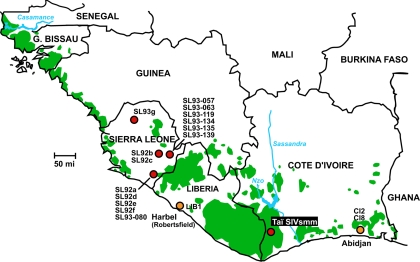
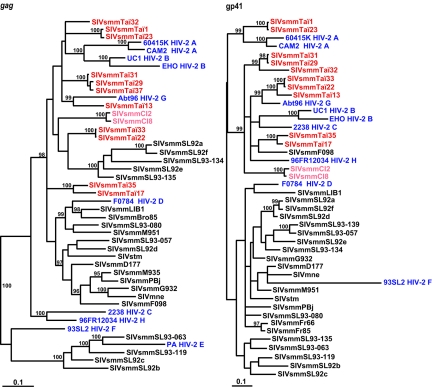
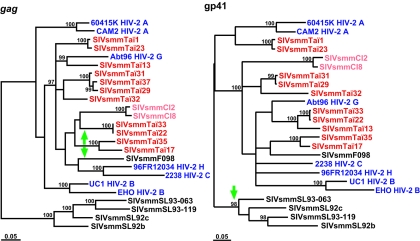
Simian immunodeficiency virus of sooty mangabeys (SIVsmm) is recognized as the progenitor of human immunodeficiency virus type 2 (HIV-2) and has been transmitted to humans on multiple occasions, yet the epidemiology and genetic diversity of SIVsmm infection in wild-living populations remain largely unknown. Here, we report the first molecular epidemiological survey of SIVsmm in a community of approximately 120 free-ranging sooty mangabeys in the Taï Forest, Côte d'Ivoire. Fecal samples (n = 39) were collected from 35 habituated animals (27 females and 8 males) and tested for SIVsmm virion RNA (vRNA). Viral gag (800 bp) and/or env (490 bp) sequences were amplified from 11 different individuals (eight females and three males). Based on the sensitivity of fecal vRNA detection and the numbers of samples analyzed, the prevalence of SIVsmm infection was estimated to be 59% (95% confidence interval, 0.35 to 0.88). Behavioral data collected from this community indicated that SIVsmm infection occurred preferentially in high-ranking females. Phylogenetic analysis of gag and env sequences revealed an extraordinary degree of genetic diversity, including evidence for frequent recombination events in both the recent and distant past. Some sooty mangabeys harbored near-identical viruses (<2% interstrain distance), indicating epidemiologically linked infections. These transmissions were identified by microsatellite analyses to involve both related (mother/daughter) and unrelated individuals, thus providing evidence for vertical and horizontal transmission in the wild. Finally, evolutionary tree analyses revealed significant clustering of the Taï SIVsmm strains with five of the eight recognized groups of HIV-2, including the epidemic groups A and B, thus pointing to a likely geographic origin of these human infections in the eastern part of the sooty mangabey range.
Figures


References
-
- Apetrei, C., A. Kaur, N. W. Lerche, M. J. Metzger, I. Pandrea, J. Hardcastle, S. Fakelstein, R. Bohm, J. Kohler, V. Traina-Dorge, T. Williams, S. Strapans, G. Plauche, R. S. Veazey, H. M. McClure, A. A. Lackner, B. Gormus, D. L. Robertson, and P. A. Marx. 2005. Molecular epidemiology of simian immunodeficiency virus SIVsm in U.S. primate centers unravels the origin of SIVmac and SIVstm. J. Virol. 79:8991-9005. - PMC - PubMed
-
- Ayouba, A., S. Souquieres, B. Njinku, P. M. Martin, M. C. Muller-Trutwin, P. Roques, F. Barre-Sinoussi, P. Mauclere, F. Simon, and E. Nerrienet. 2000. HIV-1 group N among HIV-1-seropositive individuals in Cameroon. AIDS 14:2623-2625. - PubMed
Publication types
MeSH terms
Substances
Associated data
- Actions
- Actions
- Actions
- Actions
- Actions
- Actions
- Actions
- Actions
- Actions
- Actions
- Actions
- Actions
- Actions
- Actions
- Actions
- Actions
- Actions
- Actions
- Actions
- Actions
- Actions
- Actions
- Actions
- Actions
- Actions
- Actions
Grants and funding
LinkOut - more resources
Full Text Sources
Other Literature Sources
Miscellaneous
