Accuracy of breath tests using low doses of 13C-urea to diagnose Helicobacter pylori infection: a randomised controlled trial
- PMID: 16162678
- PMCID: PMC1856187
- DOI: 10.1136/gut.2005.078626
Accuracy of breath tests using low doses of 13C-urea to diagnose Helicobacter pylori infection: a randomised controlled trial
Abstract
Background: The 13C-urea breath test (UBT) for detecting Helicobacter pylori infection is a non-invasive method based on the organism's urease activity. Since its first description, the method has been extensively modified. However, only the dose of 13C-urea and the measurement equipment are directly related to the cost of the test.
Aims: (1) To assess the diagnostic accuracy before eradication therapy of three UBTs using 25, 15, and 10 mg of 13C-urea, respectively; and (2) to determine diagnostic performance in the post-eradication setting showing the highest values for sensitivity and specificity with the lowest dose of 13C-urea.
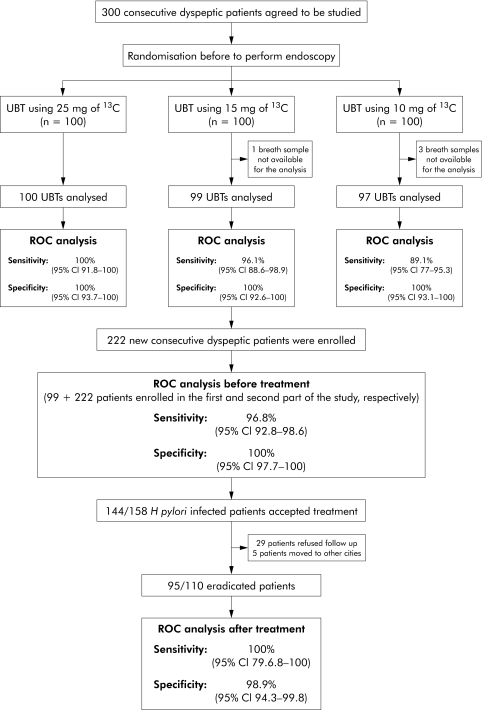
Methods: Three hundred consecutive patients were randomised to be tested with one of the three UBTs. All patients underwent upper endoscopy with biopsies. A total of 222 more patients were enrolled to evaluate the second aim. Infected patients were offered treatment and asked to return 4-6 weeks after the end of therapy to perform endoscopic follow up and to carry out 13C-UBT.
Results: In the pretreatment setting, 13C-UBT 25 mg had a sensitivity of 100% (95% confidence interval (CI) 91.8-100) and a specificity of 100% (95% CI 93.7-100); 13C-UBT 15 mg had a sensitivity of 96.1% (95% CI 86.8-98.9) and a specificity of 100% (95% CI 92.6-100); and 13C-UBT 10 mg had a sensitivity of 89.1% (95% CI 77-95.3) and a specificity of 100% (95% CI 93.3-100). As the test with the best performance and the lowest dose of 13C-urea was 13C-UBT 15 mg, it was evaluated after treatment, reporting a sensitivity of 100% (95% CI 79.6-100) and a specificity of 98.9% (95% CI 94.3-99.8).
Discussion: UBTs using 25 and 15 mg of 13C-urea were both accurate in the diagnosis of H pylori infection in untreated patients. 13C-UBT 15 mg was also accurate for follow up of patients after treatment.
Conflict of interest statement
Conflict of interest: None declared.
References
-
- Braden B, Caspary W F. Detection of Helicobacter pylori infection: when to perform which test? Ann Med 20013391–97. - PubMed
-
- Parente F, Bianchi Porro G. The 13C‐urea breath test for non‐invasive diagnosis of Helicobacter pylori infection: which procedure and which measuring equipment? Eur J Gastroenterol Hepatol 200113803–806. - PubMed
-
- Graham D Y, Klein P D, Evans D J., Jret al Campylobacter pylori detected non‐invasively by the 13C‐urea breath test. Lancet 1987I1174–1177. - PubMed
Publication types
MeSH terms
Substances
LinkOut - more resources
Full Text Sources
Medical