


Role of 20-HETE in the pial arteriolar constrictor response to decreased hematocrit after exchange transfusion of cell-free polymeric hemoglobin
- PMID: 16166237
- PMCID: PMC1826914
- DOI: 10.1152/japplphysiol.00890.2005
Role of 20-HETE in the pial arteriolar constrictor response to decreased hematocrit after exchange transfusion of cell-free polymeric hemoglobin
Abstract
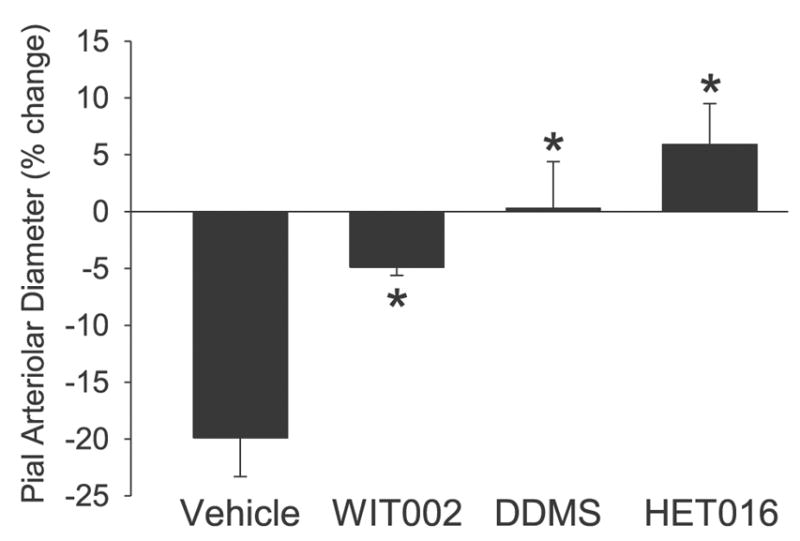
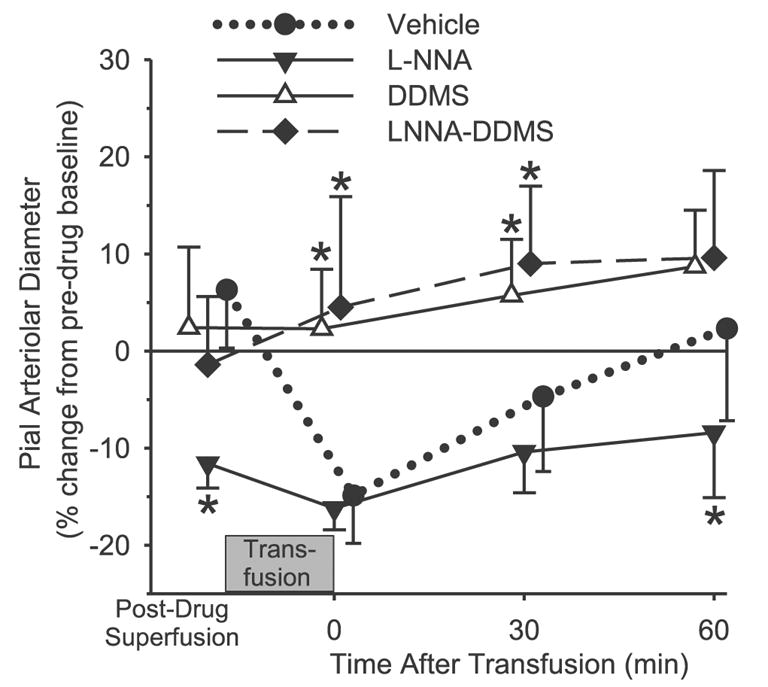
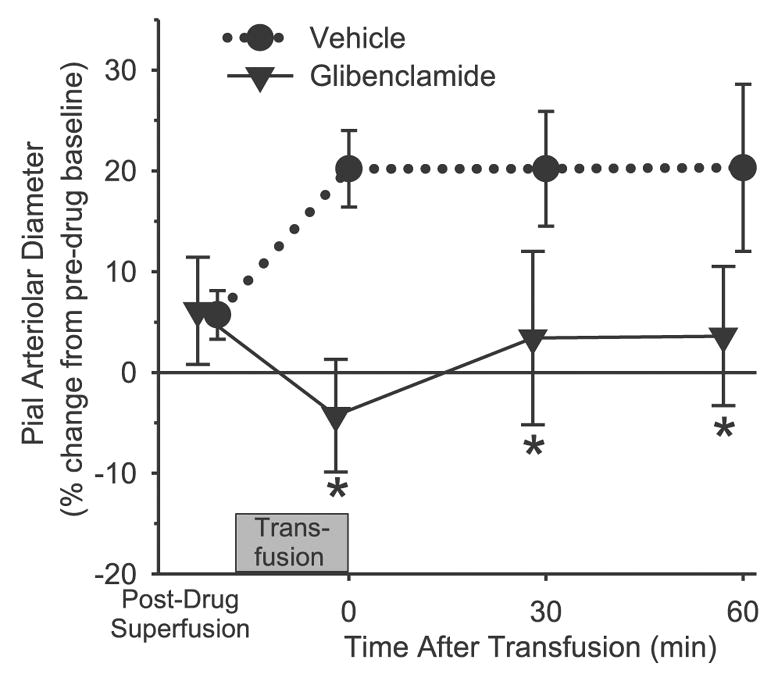
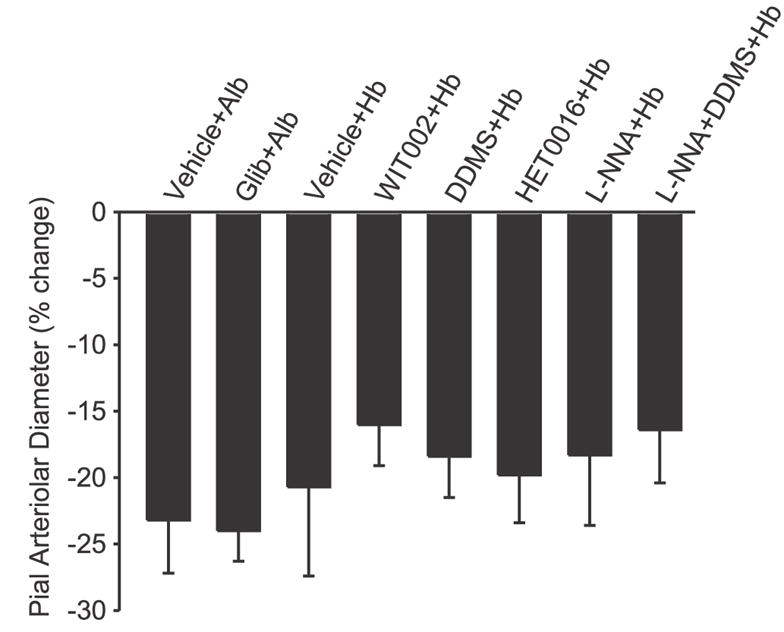
The cerebrovascular response to decreases in hematocrit and viscosity depends on accompanying changes in arterial O2 content. This study examines whether 1) the arteriolar dilation seen after exchange transfusion with a 5% albumin solution can be reduced by the K(ATP) channel antagonist glibenclamide (known to inhibit hypoxic dilation), and 2) the arteriolar constriction seen after exchange transfusion with a cell-free hemoglobin polymer to improve O2-carrying capacity can be blocked by inhibitors of the synthesis or vasoconstrictor actions of 20-HETE. In anesthetized rats, decreasing hematocrit by one-third with albumin exchange transfusion dilated pial arterioles (14 +/- 2%; SD), whereas superfusion of the surface of the brain with 10 muM glibenclamide blocked this response (-10 +/- 7%). Exchange transfusion with polymeric hemoglobin decreased the diameter of pial arterioles by 20 +/- 3% without altering arterial pressure. This constrictor response was attenuated by superfusing the surface of the brain with a 20-HETE antagonist, WIT-002 (10 microM; -5 +/- 1%), and was blocked by two chemically dissimilar selective inhibitors of the synthesis of 20-HETE, DDMS (50 microM; 0 +/- 4%) and HET-0016 (1 microM; +6 +/- 4%). The constrictor response to hemoglobin transfusion was not blocked by an inhibitor of nitric oxide (NO) synthase, and the inhibition of the constrictor response by DDMS was not altered by coadministration of the NO synthase inhibitor. We conclude 1) that activation of K(ATP) channels contributes to pial arteriolar dilation during anemia, whereas 2) constriction to polymeric hemoglobin transfusion at reduced hematocrit represents a regulatory response that limits increased O2 transport and that is mediated by increased formation of 20-HETE, rather than by NO scavenging.
Figures
References
-
- Alonso-Galicia M, Hudetz AG, Shen H, Harder DR, Roman RJ. Contribution of 20-HETE to vasodilator actions of nitric oxide in the cerebral microcirculation. Stroke. 1999;30:2727–2734. - PubMed
-
- Alonso-Galicia M, Maier KG, Greene AS, Cowley AW, Jr, Roman RJ. Role of 20-hydroxyeicosatetraenoic acid in the renal and vasoconstrictor actions of angiotensin II. Am J Physiol Regul Integr Comp Physiol. 2002;283:R60–R68. - PubMed
-
- Asano Y, Koehler RC, Kawaguchi T, McPherson RW. Pial arteriolar constriction to α2-adrenergic agonist dexmedetomidine in the rat. Am J Physiol Heart Circ Physiol. 1997;272:H2547–H2556. - PubMed
-
- Asano Y, Koehler RC, Ulatowski JA, Traystman RJ, Bucci E. Effect of cross-linked hemoglobin transfusion on endothelial-dependent dilation in feline pial arterioles. Am J Physiol Heart Circ Physiol. 1998;275:H1313–H1321. - PubMed
-
- Gebremedhin D, Lange AR, Lowry TF, Taheri MR, Birks EK, Hudetz AG, Narayanan J, Falck JR, Okamoto H, Roman RJ, Nithipatikom K, Campbell WB, Harder DR. Production of 20-HETE and its role in autoregulation of cerebral blood flow. Circ Res. 2000;87:60 – 65. - PubMed
Publication types
MeSH terms
Substances
Grants and funding
LinkOut - more resources
Full Text Sources
