. 2005 Oct;187(19):6701-7.
doi: 10.1128/JB.187.19.6701-6707.2005.

TolC is involved in enterobactin efflux across the outer membrane of Escherichia coli

Affiliations

TolC is involved in enterobactin efflux across the outer membrane of Escherichia coli

Corinna Bleuel et al. J Bacteriol. 2005 Oct.

Abstract

Escherichia coli excretes the catecholate siderophore enterobactin in response to iron deprivation. While the mechanisms underlying enterobactin biosynthesis and ferric enterobactin uptake and utilization are widely understood, nearly nothing is known about how enterobactin is exported from the cell. Mutant and high-performance liquid chromatography analyses demonstrated that the outer membrane channel tunnel protein TolC but none of the respective seven resistance nodulation cell division (RND) proteins CusA, AcrB, AcrD, AcrF, MdtF (YhiV), or the twin RND MdtBC (YegNO) was essential for enterobactin export across the outer membrane. Mutant E. coli strains with additional deletion of tolC or the major facilitator entS were growth deficient in iron-depleted medium. Strains with deletion of tolC or entS, but not with deletion of genes encoding RND transporters, excreted very little enterobactin into the growth medium. Enterobactin excretion in E. coli is thus probably a two-step process involving the major facilitator EntS and the outer membrane channel tunnel protein TolC. Quantitative reverse transcription-PCR analysis of gene-specific transcripts showed no significant changes in tolC expression upon iron depletion. However, iron starvation led to increased expression of the RND gene mdtF and a decrease in acrD.


Figures
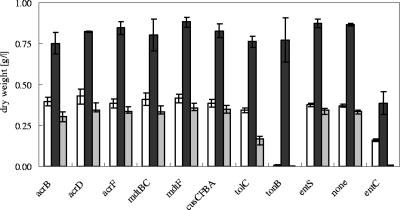
FIG. 1.
FIG. 1.
Growth of E. coli mutants in the presence or absence of iron. Cultures grown overnight in Tris minimal medium were diluted 1:400 into fresh medium for 2 h and diluted 1:400 into fresh iron-free minimal medium with 50 μM FeCl3 (black bars), 75 μM DIP (gray bars), or no additives (white bars). Cultures were cultivated for 16 h at 37°C with shaking, and the dry weight was calculated. The strains tested were derivatives of ECA263 (ΔfecABCDE ΔzupT ΔmntH ΔfeoABC; positive control), with additional deletion of the indicated genes: entC (negative control, no production of catecholate sideropohores); acrB, acrD, acrF, mdtB, mdtC, mdtF, and cusCFBA (encoding resistance nodulation cell division proteins); tolC (outer membrane channel tunnel protein); and entS (cytoplasmic membrane enterobactin transporter). Shown are the averages and standard deviations of three independent experiments.
FIG. 2.
FIG. 2.
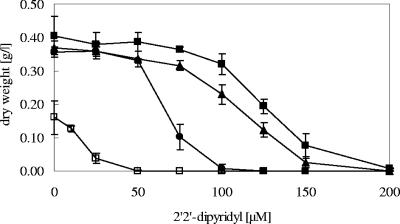
Dose-response curves of E. coli mutants under iron limitation. Cultures were grown as described for Fig. 1, except increasing concentrations of DIP were added to induce iron depletion. E. coli strains were derivatives of ECA263 (ΔfecABCDE ΔfeoABC ΔmntH ΔzupT) (▪) with additional deletion of tolC (•), entS (▴), or entC (□). Shown are the averages and standard deviations of three independent experiments.
FIG. 3.
FIG. 3.
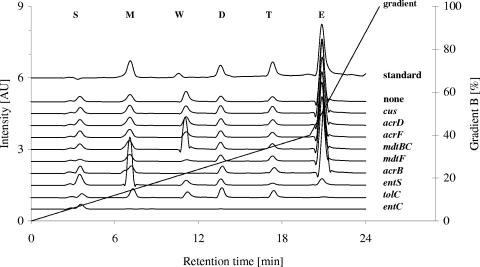
RP-HPLC analysis of enterobactin and its degradation products synthesized from several E. coli strains. Enterobactin and its degradation products were extracted from acidified supernatants from cultures of derivatives of E. coli strain GG199 (Δfur::cat), with additional deletion of the indicated genes, grown overnight in minimal medium at 37°C for 16 h, and subjected to HPLC analysis. Shown are panels of individual chromatograms. Peaks of enterobactin (E) and its degradation products DHBS triester (T), DHBS diester (D), and DHBS (M), tryptophan (W), and the injection peak (S) from the standard are indicated. Values of a medium control were subtracted from all chromatograms. The concentration profile of the gradient of acetonitrile is indicated.
FIG. 4.
FIG. 4.
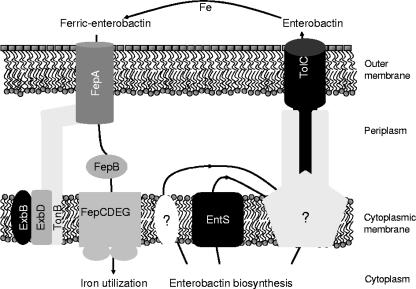
Proposed model of enterobactin transport in E. coli. After biosynthesis, enterobactin is translocated by the major facilitator EntS and to a lesser extent by other unknown mechanisms across the cytoplasmic membrane. There enterobactin is probably accepted by an efflux complex or complexes comprising the outer membrane factor TolC because for function TolC needs other transport proteins that are energized (e.g., by the proton motive force). After export by TolC, enterobactin scavenges ferric iron from the surrounding medium and is subsequently recognized and taken up as ferric enterobactin from the outer membrane receptor FepA, which is energized by the TonB/ExbB/ExbB machinery. FepB delivers ferric enterobactin from the periplasm to the ATP-driven membrane-bound ABC transporter FepCDEG. Within the cytoplasm, ferric enterobactin is degraded, aided by the Fes protein circumventing the high affinity of enterobactin toward iron, and the freed iron can be utilized.

References

    1. Albrecht-Gary, A. M., and A. L. Crumbliss. 1998. Coordination chemistry of siderophores: thermodynamics and kinetics of iron chelation and release. Met. Ions Biol. Syst. 35:239-327. - PubMed
    1. Aono, R. 1998. Improvement of organic solvent tolerance level of Escherichia coli by overexpression of stress-responsive genes. Extremophiles 2:239-248. - PubMed
    1. Aono, R., N. Tsukagoshi, and M. Yamamoto. 1998. Involvement of outer membrane protein TolC, a possible member of the mar-sox regulon, in maintenance and improvement of organic solvent tolerance of Escherichia coli K-12. J. Bacteriol. 180:938-944. - PMC - PubMed
    1. Bachmann, B. J. 1972. Pedigrees of some mutant strains of Escherichia coli K-12. Bacteriol. Rev. 36:525-557. - PMC - PubMed
    1. Chenault, S. S., and C. F. Earhart. 1991. Organization of genes encoding membrane proteins of the Escherichia coli ferrienterobactin permease. Mol. Microbiol. 5:1405-1413. - PubMed

Publication types

MeSH terms

LinkOut - more resources