Living with two extremes: conclusions from the genome sequence of Natronomonas pharaonis
- PMID: 16169924
- PMCID: PMC1240075
- DOI: 10.1101/gr.3952905
Living with two extremes: conclusions from the genome sequence of Natronomonas pharaonis
Abstract
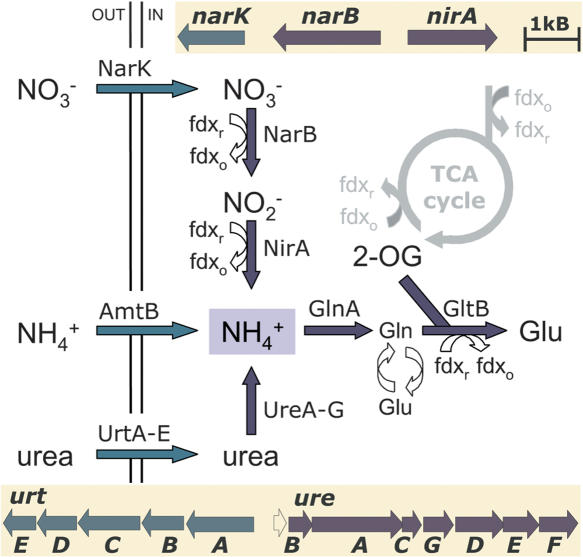
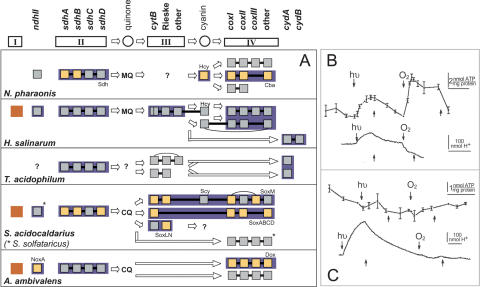
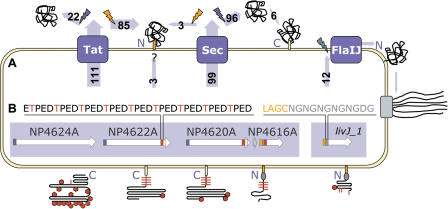
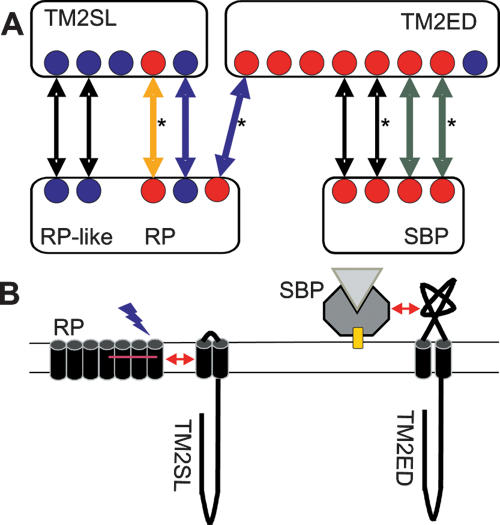
Natronomonas pharaonis is an extremely haloalkaliphilic archaeon that was isolated from salt-saturated lakes of pH 11. We sequenced its 2.6-Mb GC-rich chromosome and two plasmids (131 and 23 kb). Genome analysis suggests that it is adapted to cope with severe ammonia and heavy metal deficiencies that arise at high pH values. A high degree of nutritional self-sufficiency was predicted and confirmed by growth in a minimal medium containing leucine but no other amino acids or vitamins. Genes for a complex III analog of the respiratory chain could not be identified in the N. pharaonis genome, but respiration and oxidative phosphorylation were experimentally proven. These studies identified protons as coupling ion between respiratory chain and ATP synthase, in contrast to other alkaliphiles using sodium instead. Secretome analysis predicts many extracellular proteins with alkaline-resistant lipid anchors, which are predominantly exported through the twin-arginine pathway. In addition, a variety of glycosylated cell surface proteins probably form a protective complex cell envelope. N. pharaonis is fully equipped with archaeal signal transduction and motility genes. Several receptors/transducers signaling to the flagellar motor display novel domain architectures. Clusters of signal transduction genes are rearranged in haloarchaeal genomes, whereas those involved in information processing or energy metabolism show a highly conserved gene order.
Figures
References
-
- Avetisyan, A.V., Kaulen, A.D., Skulachev, V.P., and Feniouk, B.A. 1998. Photophosphorylation in alkalophilic halobacterial cells containing halorhodopsin: Chloride-ion cycle? Biochemistry (Mosc.) 63: 625-628. - PubMed
-
- Badger, J.H. and Olsen, G.J. 1999. CRITICA: Coding region identification tool invoking comparative analysis. Mol. Biol. Evol. 16: 512-524. - PubMed
WEB SITE REFERENCES
-
- http://www.cbs.dtu.dk/services; Center for Biological Sequence Analysis Prediction Server providing the NetNGlyc and NetOGlyc tools.
-
- http://www.halolex.mpg.de; Information System for Halophilic Archaea.
-
- http://www.migenas.mpg.de; Microbial Genome Analysis System of the Max-Planck Society.
MeSH terms
Associated data
- Actions
- Actions
- Actions
LinkOut - more resources
Full Text Sources
Molecular Biology Databases
Miscellaneous