


Identification of novel steroid-response elements
- PMID: 1617301
- PMCID: PMC6057364
Identification of novel steroid-response elements
Abstract
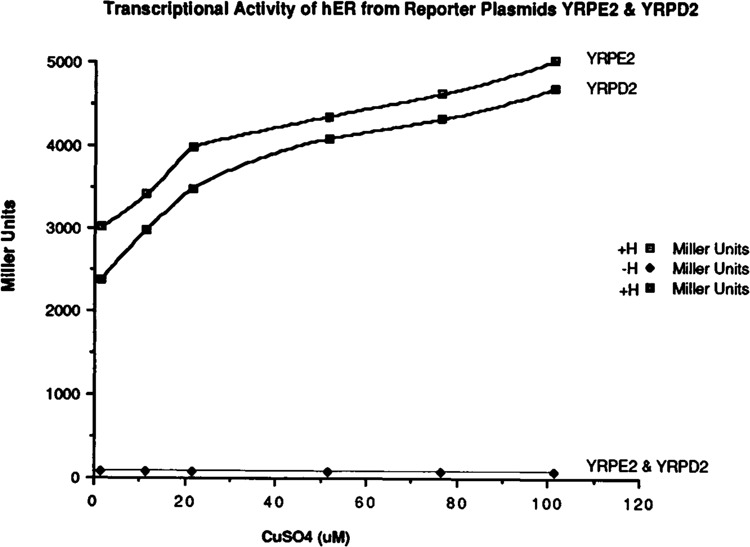
A rapid method for defining novel steroid-responsive elements has been developed. Large libraries of degenerate oligonucleotides were analyzed using a yeast-based screen to identify estrogen-responsive DNA sequences. From a library of 40,000 recombinants, seven estrogen-responsive clones were identified. When sequenced, these elements showed remarkable diversity and were different from the consensus vitellogenin A2 ERE. One surprising result was the presence of the two half sites as direct repeats in some of the clones. This implies that in vivo estrogen receptor can bind and transactivate yeast genes through response elements in which the two half sites align as direct repeats. This protocol requires no purified protein and specifically selects for functional response elements. It has a wide application in the study of any transcription factor/DNA interaction.
Figures


References
-
- Beato M. (1989), Cell 56, 335–344. - PubMed
-
- Blackwell T. K. and Weintraub H. (1990), Science 250, 1104–1110. - PubMed
-
- Bradford M. M. (1976), Anal Biochem 72, 248–254. - PubMed
-
- Carson M. A., Tsai M-J., Conneely O. M., Maxwell B. L., Clarck J. M., Dobson A. D. W., Elbrecht A., Toft D. O., Schrader W T., and O’Malley B. W. (1987), Mol Endocrinol 1, 791–801. - PubMed
Publication types
MeSH terms
Substances
LinkOut - more resources
Full Text Sources
Other Literature Sources