


Longitudinal relation between limited joint mobility, height, insulin-like growth factor 1 levels, and risk of developing microalbuminuria: the Oxford Regional Prospective Study
- PMID: 16177159
- PMCID: PMC1720121
- DOI: 10.1136/adc.2004.067272
Longitudinal relation between limited joint mobility, height, insulin-like growth factor 1 levels, and risk of developing microalbuminuria: the Oxford Regional Prospective Study
Abstract
Aims: To determine risk factors for development of microalbuminuria (MA) in relation to detection of limited joint mobility (LJM+) of the interphalangeal joints in a longitudinal cohort of type 1 diabetic (T1DM) subjects.
Methods: A total of 479 T1DM subjects diagnosed <16 years were followed from diagnosis of diabetes with annual assessments consisting of assessment of LJM, measurement of HbA1c and insulin-like growth factor 1 (IGF-1), and three urine samples for albumin:creatinine ratio (ACR).
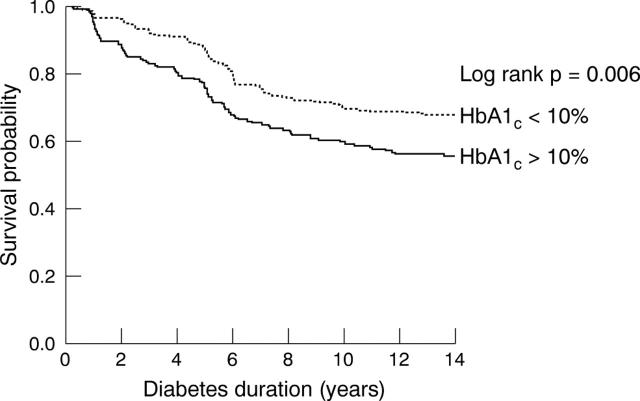
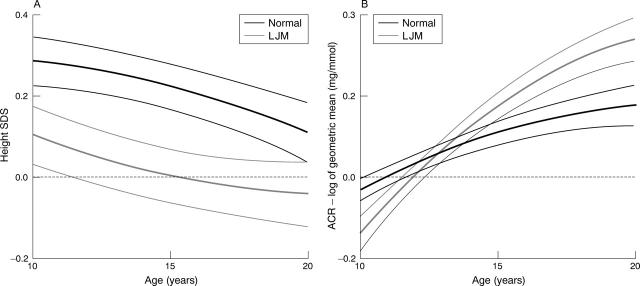
Results: After a median follow up of 10.9 years, 162 subjects (35.1%) developed LJM at median age 13.0 years and duration 5.2 years. More subjects developed LJM after compared to before puberty (67.6 v 32.4%). In LJM+ compared to LJM- subjects, HbA1c (mean 10.1 (SD 1.6) v 9.6 (1.4) %)) and ACR levels (median 1.1 (range 0.2-242.9) v 0.9 (0.4-70.7) mg/mmol) were higher, and in a Cox model probability of developing LJM was related to puberty and higher HbA1c levels. ACR levels were higher after detection of LJM compared to before (median 1.2 (range 0.4-102.6) v 0.8 (0.2-181.9) mg/mmol). Probability of developing MA was related to puberty, HbA1c, female sex, and presence of LJM (a 1.9-fold increased risk). Both LJM and MA were associated with lower height SDS (LJM: mean 0.0 (SD 1.0) v 0.2 (1.1); MA: 0.0 (1.0) v 0.2 (SD 1.0)) and lower IGF-1 levels.
Conclusion: The development of LJM was associated with an increased risk of microalbuminuria, independent of glycaemic control. Risk for both microalbuminuria and LJM was associated with puberty, reduced growth, and reduced IGF-1 levels, and may indicate underlying shared pathogenic mechanisms.
Figures

References
Publication types
MeSH terms
Substances
LinkOut - more resources
Full Text Sources
Medical
Miscellaneous
