


Understanding of placebo controls among older people with schizophrenia
- PMID: 16177271
- PMCID: PMC2632182
- DOI: 10.1093/schbul/sbi069
Understanding of placebo controls among older people with schizophrenia
Abstract
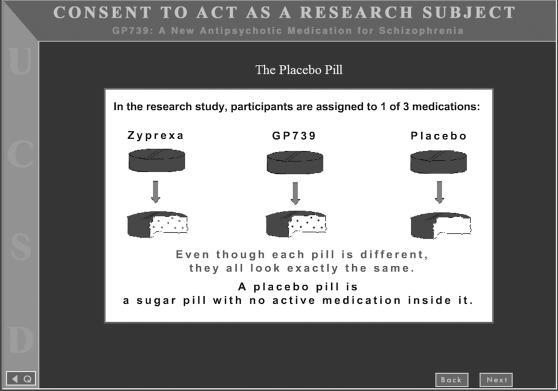
Research protocols frequently necessitate procedures or design elements that differ from those used in routine clinical care. An example is the inclusion of a placebo arm in many randomized clinical trials. Because there are risks to taking a placebo when one has a chronic disorder such as schizophrenia, ascertaining how well people with severe mental illness understand placebos is an important task for empirical research ethics. We investigated whether schizophrenia patients' understanding of placebo controls could be improved with a brief educational intervention. We randomized 49 middle-aged and older patients with schizophrenia or schizoaffective disorder to receive either (1) a routine explanation of placebos in the context of consent for a hypothetical double-blind placebo-controlled clinical trial, or (2) the consent for the hypothetical trial plus a brief educational module explaining placebos in more depth. Understanding of placebos was assessed with a 12-item questionnaire, and we examined demographic, clinical, neurocognitive, and decision-making correlates of understanding of placebos. Those participants who received the intervention obtained higher scores on the placebo post-test compared to those who received the standard information alone. Performance on the placebo post-test was positively correlated with measures of decisional capacity and neurocognitive abilities and negatively correlated with severity of negative symptoms, but it showed no relationship with positive or general symptoms. Some participants interpreted the common phrase "sugar pill" as relating somehow to diabetes. We conclude that the level of understanding of important research design-related information is not static but may be influenced by how investigators approach the consent process.
Figures
References
-
- US Department of Health and Human Services, Office of Inspector General. Recruiting Human Subjects: Pressures in Industry-Sponsored Clinical Research. June 2000. OEI-01-97-00195
-
- Simon C, Zyzanski SJ, Eder M, Raiz P, Kodish ED, Siminoff LA. Groups potentially at risk for making poorly informed decisions about entry into clinical trials for childhood cancer. J Clin Oncol. 2003;21:2173–2178. - PubMed
-
- Wendler D. Can we ensure that all research subjects give valid consent? Arch Intern Med. 2004;164:2201–2204. - PubMed
-
- Criscione LG, Sugarman J, Sanders L, Pisetsky DS, St Clair EW. Informed consent in a clinical trial of a novel treatment for rheumatoid arthritis. Arthritis Rheum. 2003;49:361–367. - PubMed
-
- Joffe S, Cook EF, Cleary PD, Clark JW, Weeks JC. Quality of informed consent in cancer clinical trials: a cross-sectional survey. Lancet. 2001;358:1772–1777. - PubMed
Publication types
MeSH terms
Substances
Grants and funding
LinkOut - more resources
Full Text Sources
Medical
