. 2005 Oct;73(10):6923-34.
doi: 10.1128/IAI.73.10.6923-6934.2005.

Role of HtrA in surface protein expression and biofilm formation by Streptococcus mutans

Affiliations

Role of HtrA in surface protein expression and biofilm formation by Streptococcus mutans

Saswati Biswas et al. Infect Immun. 2005 Oct.

Abstract

The HtrA surface protease in gram-positive bacteria is involved in the processing and maturation of extracellular proteins and degradation of abnormal or misfolded proteins. Inactivation of htrA has been shown to affect the tolerance to thermal and environmental stress and to reduce virulence. We found that inactivation of Streptococcus mutans htrA by gene-replacement also resulted in a reduced ability to withstand exposure to low and high temperatures, low pH, and oxidative and DNA damaging agents. The htrA mutation affected surface expression of several extracellular proteins including glucan-binding protein B (GbpB), glucosyltransferases, and fructosyltransferase. In addition, htrA mutation also altered the surface expression of enolase and glyceraldehyde-3-phosphate dehydrogenease, two glycolytic enzymes that are known to be present on the streptococcal cell surface. As expected, microscopic analysis of in vitro grown biofilm structure revealed that the htrA deficient biofilms adopted a much more granular patchy appearance, rather than the relatively smooth confluent layer normally seen in the wild type. These results suggest that HtrA plays an important role in the biogenesis of extracellular proteins including surface associated glycolytic enzymes and in biofilm formation of S. mutans.


Figures

FIG. 1.
FIG. 1.
Construction of S. mutans htrA-null strain. (A) Organization of open reading frames in the htrA region of various streptococci. The GenBank accession numbers of the sequences are as follows: S. mutans (Smu), NC004350; S. pyogenes (Spy), AE004092; S. pneumoniae (Spn), NC003098; and L. lactis (Lla), NC002662. Except for L. lactis, the region downstream of htrA is conserved and corresponds to chromosome replication origin/function, while the upstream region is not conserved. (B). Schematic diagram of the htrA inactivated S. mutans. The omega-Km cassette (thick black arrow) was used to inactivate the htrA gene by inserting it in the coding region. The chromosomal segments used as the homologous region for gene replacement are indicated by small arrowheads (1 and 2). The putative promoter of htrA gene is indicated by a bent arrow and the putative transcriptional terminator is shown by a lollipop. The region of htrA that was cloned in complementing plasmid pIB108 is indicated by a bar below. (C). PCR verification of htrA inactivation. The primer pairs used for this amplification (arrowheads 1 and 2) generate a diagnostic 1.9-kb fragment from the wild type and 3.9-kb fragment from the htrA mutant strains. The orientation of kamamycin-resistant cassette was verified by PCR using primers 1 and 4 and 3 and 2. The samples are as follows: M, 1-kb NEB ladder; 1, NG8; 2, isogenic htrA mutant (IBS101).
FIG. 2.
FIG. 2.
Phenotypic characterization of htrA mutant strain. (A) Overnight cultures of the wild type (NG-8) and its isogenic htrA mutant strain (IBS101) were grown in THY medium and the bacteria were visualized by scanning electron microscopy (magnification, ×1,600). (B) Effect of temperature on the growth of S. mutans strains. Different dilutions of fresh overnight cultures were spotted on MS-agar plates and incubated under microaerophilic conditions at the indicated temperature for 40 h before photographed. Samples are NG-8 (wild type), IBS101 (htrA), and IBS101/pIB108 (htrA/htrA+). Experiments were repeated no fewer than three times and relevant areas of representative plates are shown.
FIG. 3.
FIG. 3.
HtrA is essential for stress tolerance in S. mutans. (A) Freshly grown overnight cultures of NG-8 (wild type), IBS101 (htrA), and IBS101/pIB108 ((htrA/htrA+) were washed and 10-fold serially diluted in PBS. Ten-microliter samples were spotted on THY agar plates with nothing (37°C), puromycin (0.75 μM, PUR), or H2O2 (1.5 mM). (B) Cultures were spotted on THY agar plates that were buffered to generate pH 7.0, pH 6.0, or pH 5.5. (C) Cultures were spotted on THY agar containing nothing (control), NaCl (1 M), or mitomycin C (12.5 ng/ml, MC). Plates were incubated at 37°C in the presence of ambient air (A and C) or anaerobically (B). Experiments were repeated no fewer than three times and relevant areas of representative plates are shown.
FIG. 4.
FIG. 4.
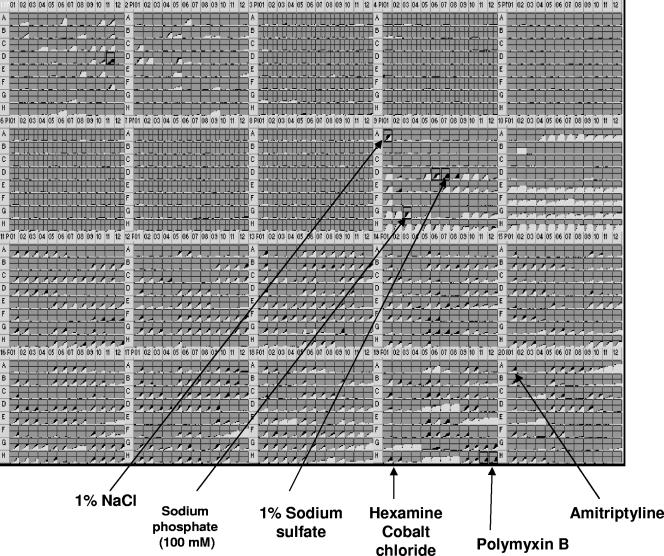
PM comparison of NG-8 and htrA mutant. Time course curve for respiration (tetrazolium color formation) was generated with OmniLog-PM software. Grey indicates that growth of the wild-type NG-8 and the mutant IBS101 were similar. Black indicates faster growth of either the NG-8 or the IBS101 strain.
FIG. 5.
FIG. 5.
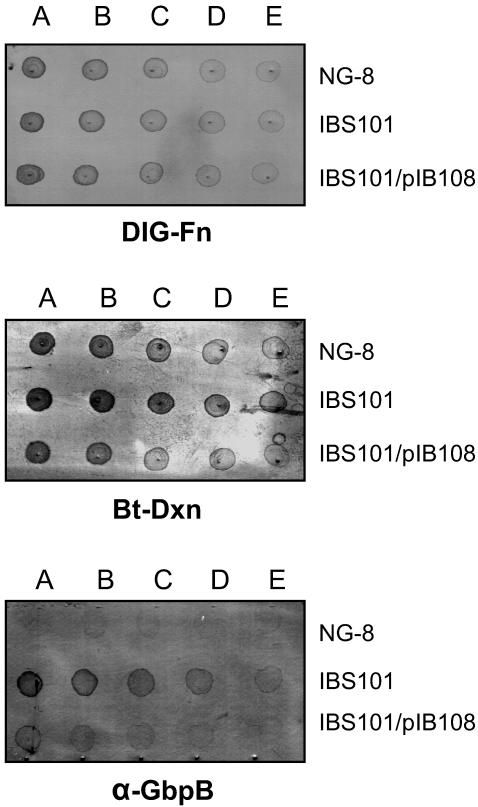
Expression of surface proteins in the htrA mutant. Twofold serial dilutions starting with 2 cell units/ml (A to E) from freshly prepared overnight cultures were spotted onto a nitrocellulose membrane and probed with DIG-labeled fibronectin (DIG-Fn), biotin-dextran (Bt-Dxn), and anti-GbpB. Samples are NG-8 (wild type), IBS101 (htrA), and IBS101/pIB108 (htrA/htrA+).
FIG. 6.
FIG. 6.
Analysis of extracellular proteins from the wild type and the htrA mutant. (A) Supernatant proteins from overnight cultures were precipitated by 20% TCA, washed with acetone and resuspended in PBS. Equal amounts of proteins were loaded in each lane and samples were run on SDS-4 to 20% PAGE gels and stained with Coomassie blue. Bands corresponding to arrowheads were excised from stained gel and identified by mass spectrometry. Lanes: M, NEB prestained marker; 1, NG-8; 2, IBS101. Proteins identified by mass spectrometry are indicated at the right. (B) Western blot analysis of supernatant proteins separated by SDS-4 to 20% PAGE. The antibodies used are indicated below the gels. Lanes contain sample from NG-8 (lanes 1), IBS101 (lanes 2), and IBS101/pIB108 (lanes 3). Open arrows indicate different species of the reacted proteins.
FIG. 7.
FIG. 7.
Western blot analysis of FTF (levansucrase) expression. NG-8 (wild type, lane 1), IBS101 (htrA, lane 2), and IBS101/pIB108 (htrA/htrA+, lane 3) were grown overnight in THY broth and whole-cell extracts were prepared. Equal amounts of cell extracts were separated on SDS-4 to 20% PAGE gels and reacted with anti-FTF antibody. M, prestained molecular mass marker (NEB).
FIG. 8.
FIG. 8.
Inactivation of htrA causes altered biofilm formation by S. mutans strains. (A) Crystal-violet-stained 24-h-old biofilm of NG-8 (wild type), IBS101 (htrA), and IBS101/pIB108 (htrA/htrA+). Biofilms were grown in BM media on glass slides (GS) or on polystyrene microtiter wells (PS). (B) Confocal laser scanning micrographs (top panel) and scanning electron micrographs (middle and lower panel) of biofilms accumulated on glass surface. Left panels, wild-type biofilms (NG-8); right panels, htrA mutant biofilms (IBS101). Magnifications, ×40 (top), ×600 (mid), and ×1,600 (bottom).

References

    1. Aduse-Opoku, J., M. L. Gilpin, and R. R. Russell. 1989. Genetic and antigenic comparison of Streptococcus mutans fructosyltransferase and glucan-binding protein. FEMS Microbiol. Lett. 50:279-282. - PubMed
    1. Ahn, S.-J., J. A. C. Lemos, and R. A. Burne. 2005. Role of HtrA in growth and competence of Streptococcus mutans UA159. J. Bacteriol. 187:3028-3038. - PMC - PubMed
    1. Antelmann, H., E. Darmon, D. Noone, J. W. Veening, H. Westers, S. Bron, O. P. Kuipers, K. M. Devine, M. Hecker, and J. M. van Dijl. 2003. The extracellular proteome of Bacillus subtilis under secretion stress conditions. Mol. Microbiol. 49:143-156. - PubMed
    1. Baddour, L. M. 1988. Twelve-year review of recurrent native-valve infective endocarditis: a disease of the modern antibiotic era. Rev. Infect. Dis. 10:1163-1170. - PubMed
    1. Banas, J. A., and M. M. Vickerman. 2003. Glucan-binding proteins of the oral streptococci. Crit. Rev. Oral Biol. Med. 14:89-99. - PubMed

Publication types

MeSH terms

LinkOut - more resources