


Measuring diagnoses: ICD code accuracy
- PMID: 16178999
- PMCID: PMC1361216
- DOI: 10.1111/j.1475-6773.2005.00444.x
Measuring diagnoses: ICD code accuracy
Abstract
Objective: To examine potential sources of errors at each step of the described inpatient International Classification of Diseases (ICD) coding process.
Data sources/study setting: The use of disease codes from the ICD has expanded from classifying morbidity and mortality information for statistical purposes to diverse sets of applications in research, health care policy, and health care finance. By describing a brief history of ICD coding, detailing the process for assigning codes, identifying where errors can be introduced into the process, and reviewing methods for examining code accuracy, we help code users more systematically evaluate code accuracy for their particular applications.
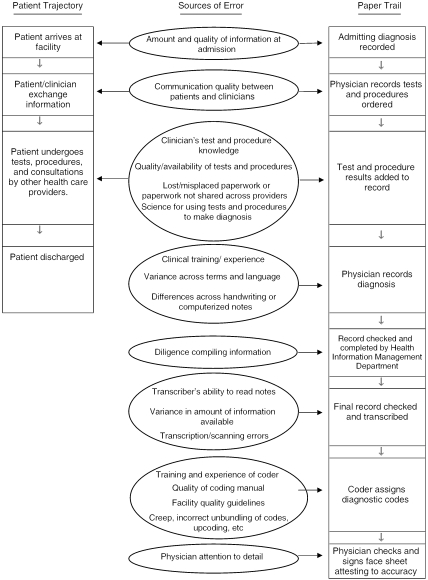
Study design/methods: We summarize the inpatient ICD diagnostic coding process from patient admission to diagnostic code assignment. We examine potential sources of errors at each step and offer code users a tool for systematically evaluating code accuracy.
Principle findings: Main error sources along the "patient trajectory" include amount and quality of information at admission, communication among patients and providers, the clinician's knowledge and experience with the illness, and the clinician's attention to detail. Main error sources along the "paper trail" include variance in the electronic and written records, coder training and experience, facility quality-control efforts, and unintentional and intentional coder errors, such as misspecification, unbundling, and upcoding.
Conclusions: By clearly specifying the code assignment process and heightening their awareness of potential error sources, code users can better evaluate the applicability and limitations of codes for their particular situations. ICD codes can then be used in the most appropriate ways.
Figures
References
-
- Albers GW, Caplan LR, Easton JD, Fayad PB, Mohr JP, Saver JL, Sherman DG. TIA Working Group “Transient Ischemic Attack—Proposal for a New Definition.”. New England Journal of Medicine. 2002;347(21):1713–6. - PubMed
-
- American Psychiatric Association . Diagnostic and Statistical Manual of Mental Disorders. 4th edition. Washington, DC: American Psychiatric Association; 1994.
-
- Benesch C, Witter DM, Jr., Wilder AL, Duncan PW, Samsa GP, Matchar DB. “Inaccuracy of the International Classification of Diseases (ICD-9-CM) in Identifying the Diagnosis of Ischemic Cerebrovascular Disease.”. Neurology. 1997;49:660–4. - PubMed
-
- Bossuyt PM, Reitsma JB, Bruns DE, Gatsonis CA, Glasziou PP, Irwig LM, Lijmer JG, Moher D, Rennie D, de Vet HC. STARD Group “Towards Complete and Accurate Reporting of Studies of Diagnostic Accuracy: The STARD Initiative.”. Family Practice. 2004;21:4–10. - PubMed
-
- Calle EE, Rodriguez C, Walker-Thurmond K, Thun MJ. “Overweight, Obesity, and Mortality from Cancer in a Prospectively Studied Cohort of U.S. Adults.”. New England Journal of Medicine. 2003;348(17):1625–38. - PubMed
Publication types
MeSH terms
LinkOut - more resources
Full Text Sources
