


doi: 10.1377/hlthaff.w5.r18.
The lifetime burden of chronic disease among the elderly
Affiliations
- PMID: 16186148
- PMCID: PMC6385883
- DOI: 10.1377/hlthaff.w5.r18
Item in Clipboard
The lifetime burden of chronic disease among the elderly
Health Aff (Millwood).
2005.
Abstract
The high costs of treating chronic diseases suggest that reducing their prevalence would improve Medicare's financial stability. In this paper we examine the impact of selected chronic diseases on the distribution of health spending and its variation over the course of disease. We also use a microsimulation model to estimate these conditions' impact on life expectancy and health spending from age sixty-five to death. A sixty-five-year-old with a serious chronic illness spends 1000-2000 dollars more per year on health care than a similar adult without the condition. However, cumulative Medicare payments are only modestly higher for the chronically ill because of their shorter life expectancy.
Figures

Annual Medical Expenditures by Chronic Condition and Stage of Disease

Total Annual Medical Expenditures Pre- and Post-Diagnosis
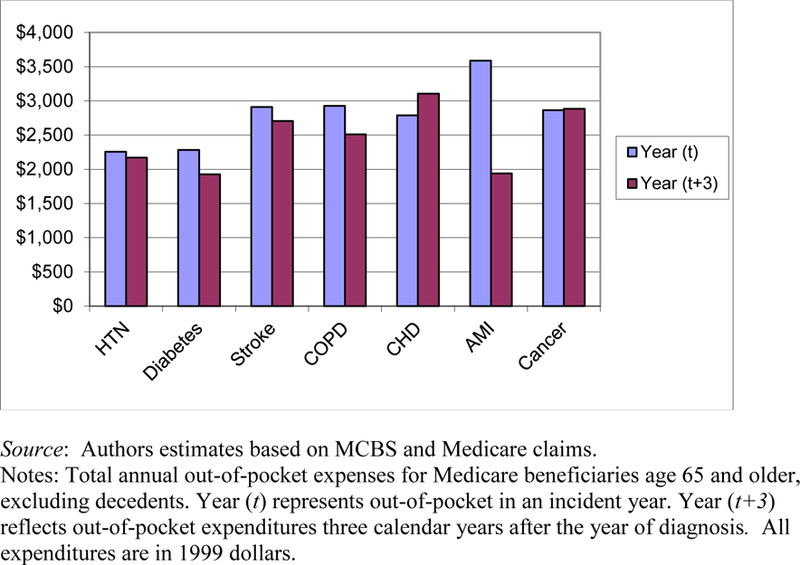
90th Percentile of Out-of-Pocket Expenses in Year of Diagnosis (t) and Three Years Later (t+3)
References
-
- Berk ML and Monheit AC, “The Concentration of Health Expenditures: An Update,” Health Affairs 11, no. 4 (1992): 145–149. - PubMed
-
- Fishman P et al., “Chronic Care Costs in Managed Care,” Health Affairs 16, no. 3 (1997): 239–247. - PubMed
-
- Garber AM, MaCurdy TE, and McClellan MB, “Persistence of Medicare Expenditures Among Elderly Beneficiaries,” NBER Working Paper #6249 October 1997.
-
- Lubitz J et al., “Health Life Expectancy, and Health Care Spending among Elderly,” New England Journal of Medicine 349, no. 11 (2003): 1048–1085. - PubMed
-
- Fireman B, Bartlett J, and Selby J, “Can Disease Management Reduce Health Care Costs By Improving Quality?,” Disease Management 23, no. 6 (2004): 63–75. - PubMed
Publication types
MeSH terms
Grants and funding
LinkOut - more resources
Full Text Sources
Medical
