


Patient reports of undesirable events during hospitalization
- PMID: 16191139
- PMCID: PMC1490233
- DOI: 10.1111/j.1525-1497.2005.0225.x
Patient reports of undesirable events during hospitalization
Abstract
Background: Thus far, incident reporting in health care has relied on health professionals. However, patients too may be able to signal the occurrence of undesirable events.
Objective: To estimate the frequency of undesirable events reported by recently discharged patients, and to identify correlates of undesirable events.
Design: Mailed patient survey.
Setting: Swiss public teaching hospital.
Participants: Adult patients (N=1,518) discharged from hospital.
Measurements: Self-reports of 27 undesirable events during hospitalization, including 9 medical complications, 9 interpersonal problems, and 9 incidents related to the health care process.
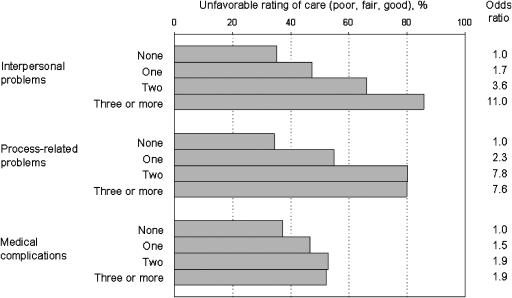
Results: Most survey respondents (1,433, 94.4%) completed the section about undesirable events, and 725 (50.6%) reported at least 1 event. The most frequent events were phlebitis (11.0%), unavailable medical record (9.5%), failure to respect confidentiality (8.4%), and hospital-acquired infection (8.2%). The odds of an unfavorable rating increased with each additional interpersonal problem (odds ratio [OR] 1.6, 95% confidence interval [CI] 1.3 to 1.8), each additional process-related problem (OR 1.5, 95% CI 1.3 to 1.9), but not with each additional medical complication (OR 1.0, 95% CI 0.9 to 1.2). Longer duration of stay, poor health, and depressed mood were all related to a greater reported frequency of undesirable events.
Conclusion: Patients are able to report undesirable events that occur during hospital care. Such events occur in about a half of the hospitalizations, and have a negative impact on satisfaction with care.
Figures
References
-
- Brennan TA, Leape LL, Laird NM, et al. Incidence of adverse events and negligence in hospitalized patients. Results of the Harvard Medical Practice Study I. N Engl J Med. 1991;324:370–6. - PubMed
-
- Leape LL, Brennan TA, Laird N, et al. The nature of adverse events in hospitalized patients. Results of the Harvard Medical Practice Study II. N Engl J Med. 1991;324:377–84. - PubMed
-
- Thomas EJ, Studdert DM, Burstin HR, et al. Incidence and types of adverse events and negligent care in Utah and Colorado. Med Care. 2000;38:261–71. - PubMed
-
- Leape LL, Berwick BM, Bates DW. What practices will most improve safety? Evidence-based medicine meets patient safety. JAMA. 2002;288:501–7. - PubMed
Publication types
MeSH terms
LinkOut - more resources
Full Text Sources