


Conversion of nicotine to nornicotine in Nicotiana tabacum is mediated by CYP82E4, a cytochrome P450 monooxygenase
- PMID: 16192354
- PMCID: PMC1253577
- DOI: 10.1073/pnas.0506581102
Conversion of nicotine to nornicotine in Nicotiana tabacum is mediated by CYP82E4, a cytochrome P450 monooxygenase
Abstract
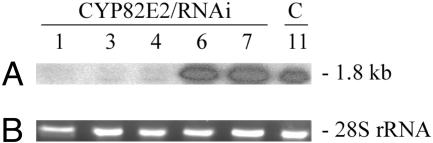
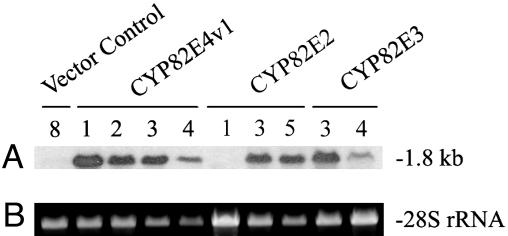
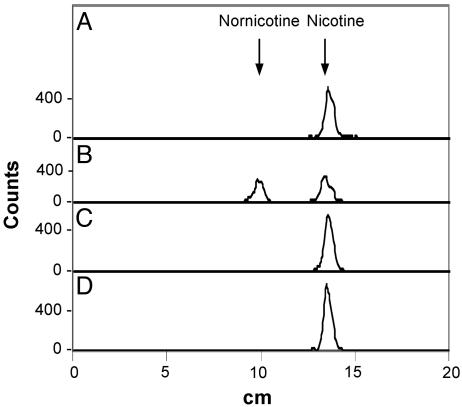
Nornicotine is a secondary tobacco alkaloid that is produced by the N-demethylation of nicotine. Nornicotine production and accumulation in tobacco are undesirable because nornicotine serves as the precursor in the synthesis of the well characterized carcinogen N'-nitrosonornicotine during the curing and processing of tobacco. Although nornicotine is typically a minor alkaloid in tobacco plants, in many tobacco populations a high percentage of individuals can be found that convert a substantial proportion of the nicotine to nornicotine during leaf senescence and curing. We used a microarray-based strategy to identify genes that are differentially regulated between closely related tobacco lines that accumulate either nicotine (nonconverters) or nornicotine (converters) as the predominant alkaloid in the cured leaf. These experiments led to the identification of a small number of closely related cytochrome P450 genes, designated the CYP82E2 family, whose collective transcript levels were consistently higher in converter versus nonconverter tobacco lines. RNA interference-induced silencing of the CYP82E2 gene family suppressed the synthesis of nornicotine in strong converter plants to levels similar to that observed in nonconverter individuals. Although each of the six identified members of the P450 family share >90% nucleotide sequence identity, sense expression of three selected isoforms revealed that only one (CYP82E4v1) was involved in the conversion of nicotine to nornicotine. Yeast expression analysis revealed that CYP82E4v1 functions as a nicotine demethylase. Identification of the gene(s) responsible for nicotine demethylation provides a potentially powerful tool toward efforts to minimize nornicotine levels, and thereby N'-nitrosonornicotine formation, in tobacco products.
Figures

References
-
- Hecht, S. S. (1998) Chem. Res. Toxicol. 11, 559-603. - PubMed
-
- Williams, D. L. H. (1999) Acc. Chem. Res. 32, 869-876.
-
- Hecht, S. S. & Hoffmann, D. (1989) Cancer Surv. 8, 273-294. - PubMed
-
- Hoffmann, D., Brunnemann, K. D., Prokopczyk, B. & Djordjevic, M. V. (1994) J. Toxicol. Environ. Health 41, 1-52. - PubMed
-
- Hecht, S. S. (2003) Nat. Rev. Cancer 3, 733-744. - PubMed
Publication types
MeSH terms
Substances
Associated data
- Actions
- Actions
- Actions
- Actions
- Actions
- Actions
LinkOut - more resources
Full Text Sources
Other Literature Sources
Molecular Biology Databases
