


The lrp gene and its role in type I fimbriation in Citrobacter rodentium
- PMID: 16199571
- PMCID: PMC1251604
- DOI: 10.1128/JB.187.20.7009-7017.2005
The lrp gene and its role in type I fimbriation in Citrobacter rodentium
Abstract
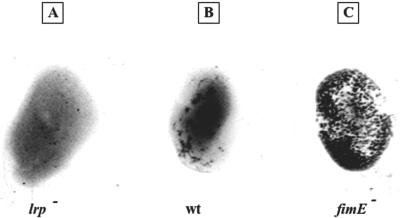
Citrobacter rodentium is a murine pathogen that is now widely used as an in vivo model for gastrointestinal infections due to its similarities with human enteropathogens, such as the possession of a locus for enterocyte effacement (the LEE island). We studied the lrp gene of C. rodentium and found that it encodes a product highly similar to members of the Lrp (leucine-responsive regulatory protein) family of transcriptional regulators, able to recognize leucine as an effector and to repress the expression of its own structural gene. In enterobacteria, Lrp is a global regulator of gene expression, as it controls a large variety of genes, including those coding for cell appendages and other potential virulence factors. Based on the well-established role of Lrp on the expression of pilus genes in Escherichia coli, we also studied the role of Lrp in controlling the formation of the type I pilus in C. rodentium. Type I pili, produced by the fim system, are virulence factors of uropathogens, involved in mediating bacterial adhesion to bladder epithelial cells. Yeast agglutination assays showed that Lrp is needed for type I pilus formation and real-time PCR experiments indicated that Lrp has a strong leucine-mediated effect on the expression of the fimAICDFGH operon. Mutant studies indicated that this positive action is exerted mainly through a positive control of Lrp on the phase variation mechanism that regulates fimAICDFGH expression. A quantitative analysis of its expression suggested that this operon may also be negatively regulated at the level of transcription.
Figures
References
-
- Brinkman, A. B., T. J. Ettema, W. M. de Vos, and J. van der Oost. 2003. The Lrp family of transcriptional regulators. Mol. Microbiol. 48:287-294. - PubMed
-
- Camacho, E. M., and J. Casadesus. 2002. Conjugal transfer of the virulence plasmid of Salmonella enterica is regulated by the leucine-responsive regulatory protein and DNA adenine methylation. Mol. Microbiol. 44:1589-1598. - PubMed
Publication types
MeSH terms
Substances
LinkOut - more resources
Full Text Sources
Miscellaneous
