


Hepatic expression of scavenger receptor class B type I (SR-BI) is a positive regulator of macrophage reverse cholesterol transport in vivo
- PMID: 16200214
- PMCID: PMC1236682
- DOI: 10.1172/JCI25327
Hepatic expression of scavenger receptor class B type I (SR-BI) is a positive regulator of macrophage reverse cholesterol transport in vivo
Abstract
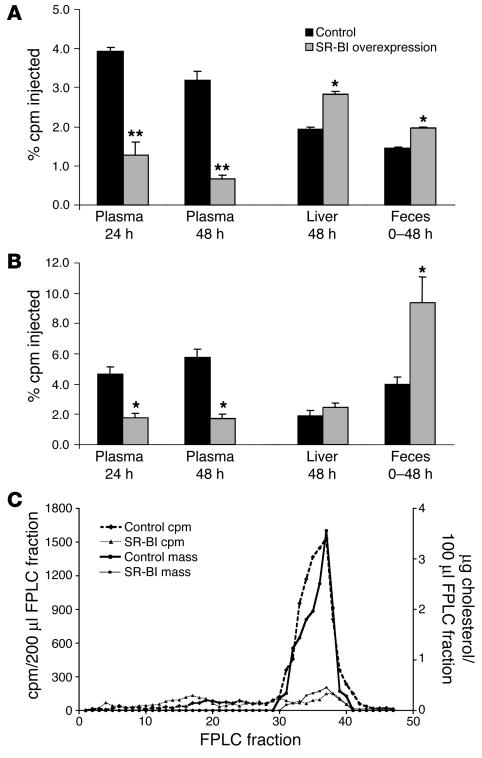
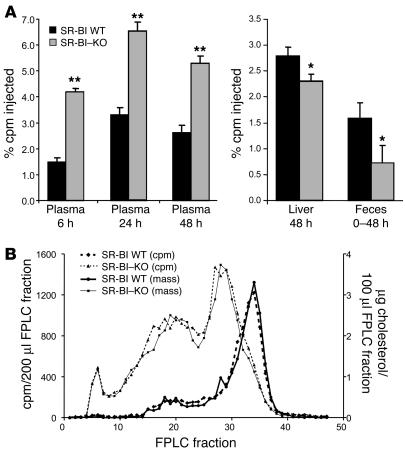
Hepatic expression of the scavenger receptor class B type I (SR-BI) promotes selective uptake of HDL cholesterol by the liver and is believed to play a role in the process of reverse cholesterol transport (RCT). We hypothesized that hepatic SR-BI expression is a regulator of the rate of integrated macrophage-to-feces RCT and used an in vivo model to test this hypothesis. Cholesterol-loaded and [3H]cholesterol-labeled J774 macrophages were injected intraperitoneally into mice, after which the appearance of the [3H]cholesterol in the plasma, liver, and feces over 48 hours was quantitated. Mice overexpressing SR-BI in the liver had significantly reduced [3H]cholesterol in the plasma but markedly increased [3H] tracer excretion in the feces over 48 hours. Conversely, mice deficient in SR-BI had significantly increased [3H]cholesterol in the plasma but markedly reduced [3H] tracer excretion in the feces over 48 hours. These studies demonstrate that hepatic SR-BI expression, despite its inverse effects on steady-state plasma HDL cholesterol concentrations, is an important positive regulator of the rate of macrophage RCT.
Figures
Comment in
-
Shifting gears: liver SR-BI drives reverse cholesterol transport in macrophages.J Clin Invest. 2005 Oct;115(10):2699-701. doi: 10.1172/JCI26241. J Clin Invest. 2005. PMID: 16200207 Free PMC article. Review.
References
-
- Rader DJ. Regulation of reverse cholesterol transport and clinical implications. Am. J. Cardiol. 2003;92:42J–49J. - PubMed
-
- Groen AK, Oude Elferink RP, Verkade HJ, Kuipers F. The ins and outs of reverse cholesterol transport. Ann. Med. 2004;36:135–145. - PubMed
-
- Tall AR. Role of ABCA1 in cellular cholesterol efflux and reverse cholesterol transport. Arterioscler. Thromb. Vasc. Biol. 2003;23:710–711. - PubMed
-
- Trigatti BL, Krieger M, Rigotti A. Influence of the HDL receptor SR-BI on lipoprotein metabolism and atherosclerosis. Arterioscler. Thromb. Vasc. Biol. 2003;23:1732–1738. - PubMed
-
- Zanlungo S, Rigotti A, Nervi F. Hepatic cholesterol transport from plasma into bile: implications for gallstone disease. Curr. Opin. Lipidol. 2004;15:279–286. - PubMed
Publication types
MeSH terms
Substances
Grants and funding
LinkOut - more resources
Full Text Sources
Other Literature Sources
Medical
Molecular Biology Databases
Research Materials
