


Integrin-linked kinase is responsible for Ca2+-independent myosin diphosphorylation and contraction of vascular smooth muscle
- PMID: 16201970
- PMCID: PMC1316305
- DOI: 10.1042/BJ20051173
Integrin-linked kinase is responsible for Ca2+-independent myosin diphosphorylation and contraction of vascular smooth muscle
Abstract
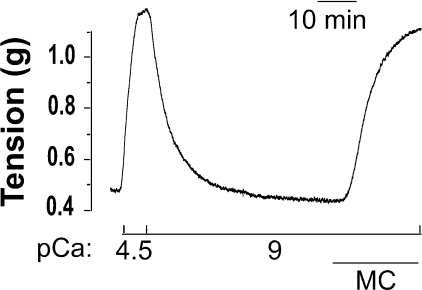
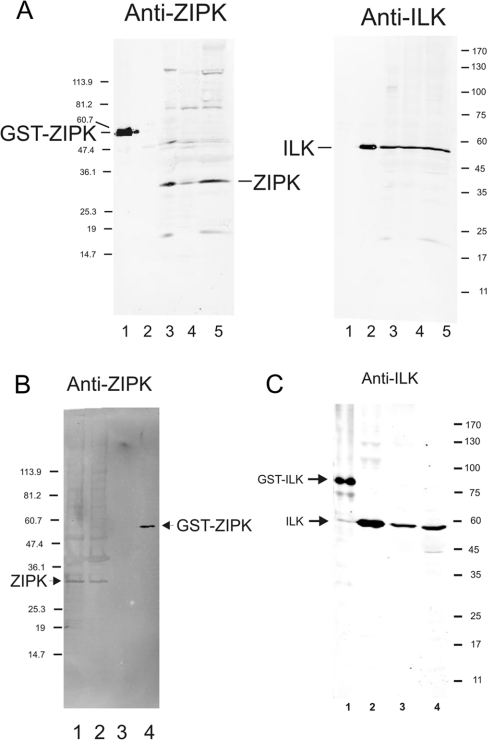
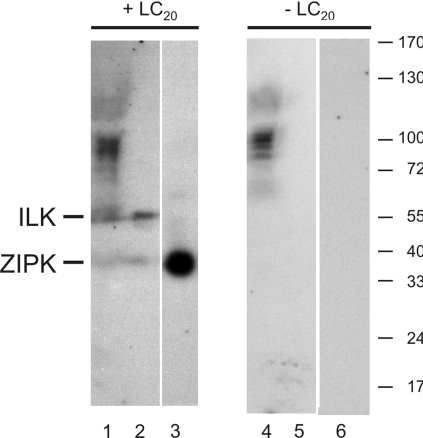
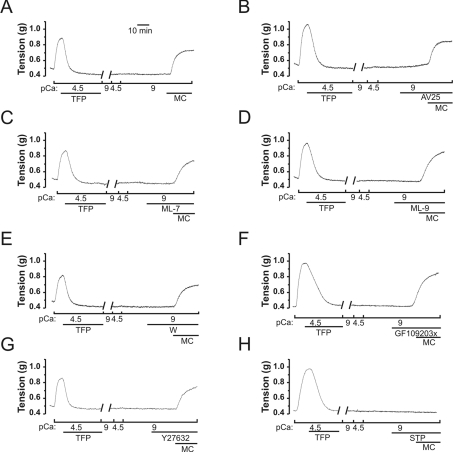
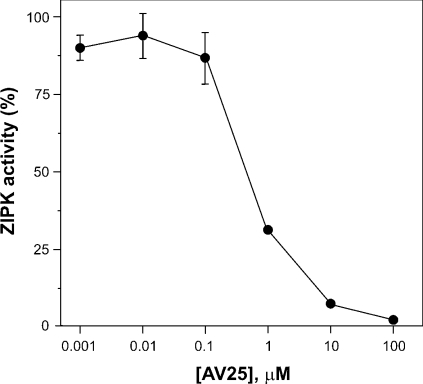
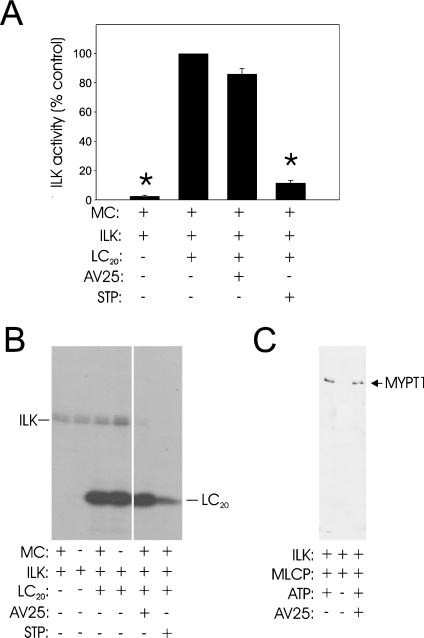
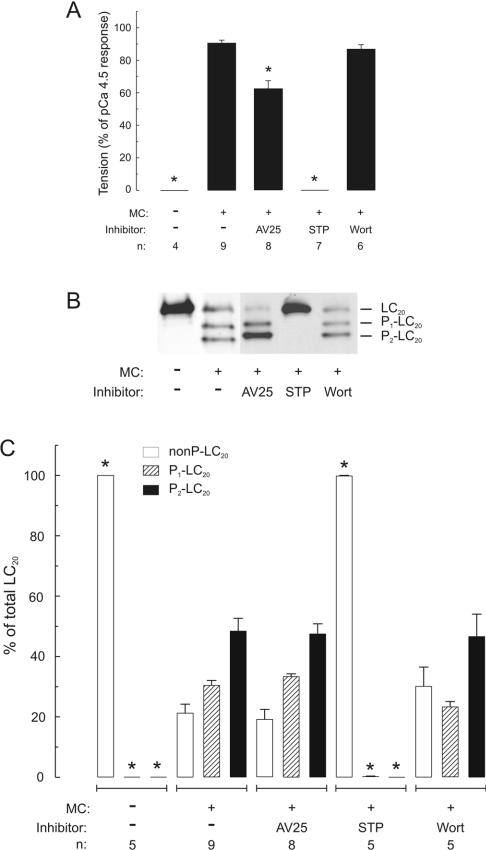
Smooth muscle contraction is activated by phosphorylation at Ser-19 of LC20 (the 20 kDa light chains of myosin II) by Ca2+/calmodulin-dependent MLCK (myosin light-chain kinase). Diphosphorylation of LC20 at Ser-19 and Thr-18 is observed in smooth muscle tissues and cultured cells in response to various contractile stimuli, and in pathological circumstances associated with hypercontractility. MLCP (myosin light-chain phosphatase) inhibition can lead to LC20 diphosphorylation and Ca2+-independent contraction, which is not attributable to MLCK. Two kinases have emerged as candidates for Ca2+-independent LC20 diphosphorylation: ILK (integrin-linked kinase) and ZIPK (zipper-interacting protein kinase). Triton X-100-skinned rat caudal arterial smooth muscle was used to investigate the relative importance of ILK and ZIPK in Ca2+-independent, microcystin (phosphatase inhibitor)-induced LC20 diphosphorylation and contraction. Western blotting and in-gel kinase assays revealed that both kinases were retained in this preparation. Ca2+-independent contraction of calmodulin-depleted tissue in response to microcystin was resistant to MLCK inhibitors [AV25 (a 25-amino-acid peptide derived from the autoinhibitory domain of MLCK), ML-7, ML-9 and wortmannin], protein kinase C inhibitor (GF109203X) and Rho-associated kinase inhibitors (Y-27632 and H-1152), but blocked by the non-selective kinase inhibitor staurosporine. ZIPK was inhibited by AV25 (IC50 0.63+/-0.05 microM), whereas ILK was insensitive to AV25 (at concentrations as high as 100 microM). AV25 had no effect on Ca2+-independent, microcystin-induced LC20 mono- or di-phosphorylation, with a modest effect on force. We conclude that direct inhibition of MLCP in the absence of Ca2+ unmasks ILK activity, which phosphorylates LC20 at Ser-19 and Thr-18 to induce contraction. ILK is probably the kinase responsible for myosin diphosphorylation in vascular smooth muscle cells and tissues.
Figures
References
-
- Kamm K. E., Stull J. T. Dedicated myosin light chain kinases with diverse cellular functions. J. Biol. Chem. 2001;276:4527–4530. - PubMed
-
- Somlyo A. P., Somlyo A. V. Ca2+ sensitivity of smooth muscle and non-muscle myosin II: modulated by G proteins, kinases, and myosin phosphatase. Physiol. Rev. 2003;83:1325–1358. - PubMed
-
- Hartshorne D. J., Ito M., Erdödi F. Role of protein phosphatase type 1 in contractile functions: myosin phosphatase. J. Biol. Chem. 2004;279:37211–37214. - PubMed
-
- Ito M., Nakano T., Erdödi F., Hartshorne D. J. Myosin phosphatase: structure, regulation and function. Mol. Cell. Biochem. 2004;259:197–209. - PubMed
Publication types
MeSH terms
Substances
LinkOut - more resources
Full Text Sources
Molecular Biology Databases
Miscellaneous
