Comparative Study
. 2005 Oct 11;102(41):14557-62.
doi: 10.1073/pnas.0507300102. Epub 2005 Oct 3.

Inhibition of hypothalamic fatty acid synthase triggers rapid activation of fatty acid oxidation in skeletal muscle

Affiliations
Comparative Study

Inhibition of hypothalamic fatty acid synthase triggers rapid activation of fatty acid oxidation in skeletal muscle

Seung Hun Cha et al. Proc Natl Acad Sci U S A. .

Abstract

Malonyl-CoA functions as a mediator in the hypothalamic sensing of energy balance and regulates the neural physiology that governs feeding behavior and energy expenditure. The central administration of C75, a potent inhibitor of the fatty acid synthase (FAS), increases malonyl-CoA concentration in the hypothalamus and suppresses food intake while activating fatty acid oxidation in skeletal muscle. Closely correlated with the increase in muscle fatty acid oxidation is the phosphorylation/inactivation of acetyl-CoA carboxylase, which leads to reduced malonyl-CoA concentration. Lowering muscle malonyl-CoA, a potent inhibitor of carnitine/palmitoyl-CoA transferase 1 (CPT1), releases CPT1 from inhibitory constraint, facilitating the entry of fatty acids into mitochondria for beta oxidation. Also correlated with these events are C75-induced increases in the expression of skeletal muscle peroxisome proliferator-activated receptor alpha (PPARalpha), a transcriptional activator of fatty acid oxidizing enzymes, and uncoupling protein 3 (UCP3), a thermogenic mitochondrial uncoupling protein. Phentolamine, an alpha-adrenergic blocking agent, prevents the C75-induced increases of skeletal muscle UCP3 and whole body fatty acid oxidation and C75-induced decrease of skeletal muscle malonyl-CoA. Thus, the sympathetic nervous system is implicated in the transmission of the "malonyl-CoA signal" from brain to skeletal muscle. Consistent with the up-regulation of UCP3 and PPARalpha is the concomitant increase in the expression of PGC1alpha, transcriptional coactivator of the UCP3 and PPARalpha-activated genes. These findings clarify the mechanism by which the hypothalamic malonyl-CoA signal is communicated to metabolic systems in skeletal muscle that regulate fatty acid oxidation and energy expenditure.


Figures
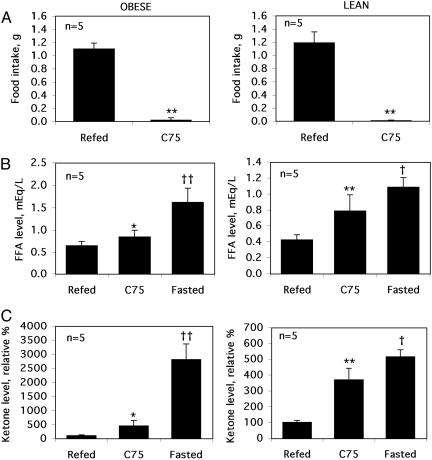
Fig. 1.
Fig. 1.
Central administration of C75 rapidly decreases food intake and blood fatty acid and ketone levels. Obese (Ob/Ob) or lean mice were fasted for 23 h and then given an i.c.v. injection of 10 μg of C75 (C75) or vehicle. Fasting was continued (Fasted), or mice were given access to food (Refed). Food intake (A), blood fatty acid (B), and ketone (C) levels were measured 2 h after i.c.v. injection. Each bar represents the mean ± SEM. Differences between treatment group were assessed by Student's t test. *, P < 0.01; **, P < 0.001 relative to refed mice or †, P < 0.01; ††, P < 0.001 relative to C75-treated mice.
Fig. 2.
Fig. 2.
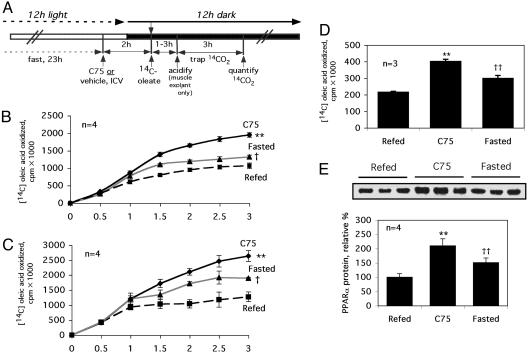
Central administration of C75 rapidly activates fatty acid oxidation measured in vivo and in muscle explants. (A) Treatment protocol. (B–E) Obese (Ob/Ob) (B) or lean (C) mice were fasted for 23 h and then given an i.c.v. injection of 10 μg of C75 (C75) or vehicle. Fasting was continued (Fasted), or mice were given access to food (Refed). Fatty acid oxidation ([1-14C] oleic acid) was measured in vivo (B and C) or with skeletal muscle explants from lean mice (D). Two hours after i.c.v. injection of lean mice with C75, skeletal (gastrocnemius) muscle tissue was subjected to immunoblotting with antibody directed against mouse PPARα (E). The results are expressed as the mean ± SEM. Differences between treatment groups were analyzed by Student's t test. *, P < 0.01; **, P < 0.001; †, P < 0.01 compared with refed mice; ††, P < 0.001 compared with C75-treated mice.
Fig. 3.
Fig. 3.
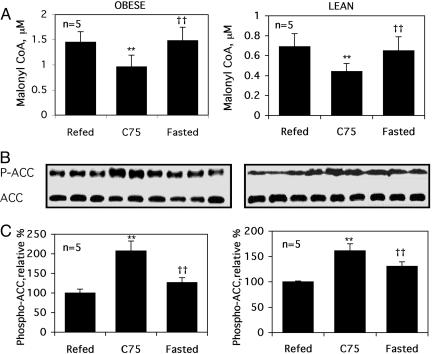
Effect of C75 on the malonyl-CoA concentration and phosphorylation state ACC in skeletal muscle. Effect of i.c.v. administration of C75 on malonyl-CoA (A) and the level (B) and phosphorylation state of ACC (at Ser-79) (C) in the gastrocnemius muscle of Ob/Ob and lean mice 2 h after i.c.v. injection of C75 (10 μg/mouse). The treatment protocols for Refed, C75, and Fasted were as described in the legend of Fig. 1. Protein and phosphoprotein levels were quantified from Western blots and are expressed as percent change relative to Refed controls. Each bar represents the mean ± SEM. Differences between the treatment groups were analyzed by Student's t test. **, P < 0.001 compared with refed mice; ††, P < 0.001 compared with C75-treated mice.
Fig. 4.
Fig. 4.
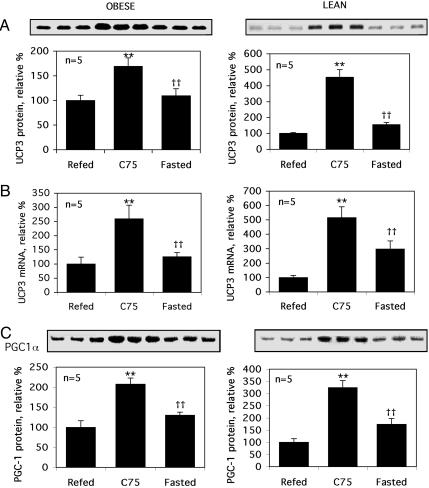
Effect of C75 on the expression of UCP3 and PGC1α in skeletal muscle. UCP3 protein and/or mRNA and PGC-1α protein levels were quantified by real-time PCR of RNA or by Western blotting of skeletal muscle extracts obtained 2 h after i.c.v. administration of C75 to lean and obese (Ob/Ob) mice. The protocols for Refed, C75, and Fasted treatments were as described in the legend of Fig. 1. Each bar represented the mean ± SEM. Differences between treatment groups were assessed by Student's t test. **, P < 0.001 compared with refed mice; ††, P < 0.001 compared with C75-treated mice.
Fig. 5.
Fig. 5.
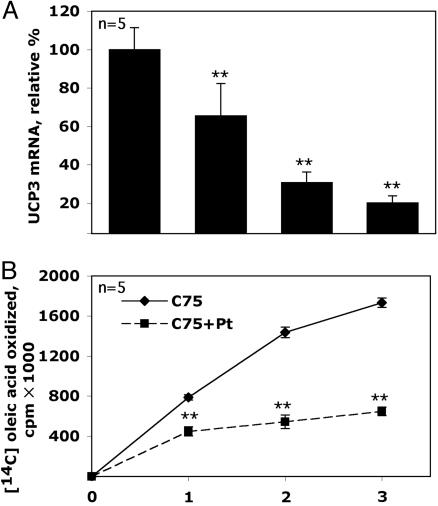
Role of the α adrenergic system in the response of skeletal muscle to centrally administered C75. The protocols for Refed, C75, and Fasted treatments were as described in the legend of Fig. 1. (A) UCP3 mRNA in skeletal muscle was analyzed by real-time PCR 2 h after i.c.v. injection of C75 (10 μg) in mice that had received an i.p. injection of the α blocker, Phentolamine (10 mg/kg body weight; C75 + Pt) 1 h before C75. (B) Lean mice were treated as described in A and then subjected to the fatty acid oxidation ([1-14C] oleic acid) protocol described in the legend to Fig. 2. Each bar represented the mean ± SEM. Statistical significance between treatment groups (Student's t test). **, P < 0.001 compared with C75-treated mice.

References

    1. Schwartz, M. W., Woods, S. C., Porte, D., Jr., Seeley, R. J. & Baskin, D. G. (2000) Nature 404, 661-671. - PubMed
    1. Minokoshi, Y. & Kahn, B. B. (2003) Biochem. Soc. Trans. 31, 196-201. - PubMed
    1. Dowell, P., Hu, Z. & Lane, M. D. (2005) Annu. Rev. Biochem. 74, 515-534. - PubMed
    1. Kuhajda, F. P., Pizer, E. S., Li, J. N., Mani, N. S., Frehywot, G. L. & Townsend, C. A. (2000) Proc. Natl. Acad. Sci. USA 97, 3450-3454. - PMC - PubMed
    1. Hu, Z., Cha, S. H., Chohnan, S. & Lane, M. D. (2003) Proc. Natl. Acad. Sci. USA 100, 12624-12629. - PMC - PubMed

Publication types

MeSH terms