


Endogenous BDNF is required for long-term memory formation in the rat parietal cortex
- PMID: 16204202
- PMCID: PMC1240062
- DOI: 10.1101/lm.27305
Endogenous BDNF is required for long-term memory formation in the rat parietal cortex
Abstract
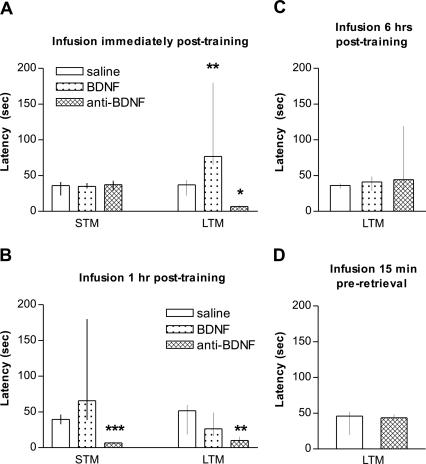
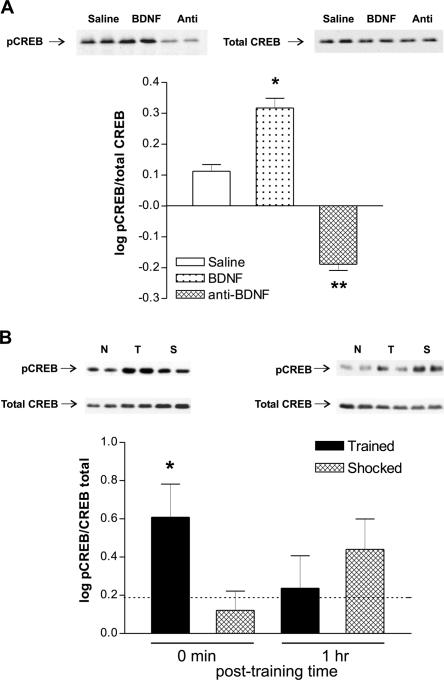
Information storage in the brain is a temporally graded process involving different memory phases as well as different structures in the mammalian brain. Cortical plasticity seems to be essential to store stable long-term memories, although little information is available at the moment regarding molecular and cellular events supporting memory consolidation in the neocortex. Brain-derived neurotrophic factor (BDNF) modulates both short-term synaptic function and activity-dependent synaptic plasticity in hippocampal and cortical neurons. We have recently demonstrated that endogenous BDNF in the hippocampus is involved in memory formation. Here we examined the role of BDNF in the parietal cortex (PCx) in short-term (STM) and long-term memory (LTM) formation of a one-trial fear-motivated learning task in rats. Bilateral infusions of function-blocking anti-BDNF antibody into the PCx impaired both STM and LTM retention scores and decreased the phosphorylation state of cAMP response element-binding protein (CREB). In contrast, intracortical administration of recombinant human BDNF facilitated LTM and increased CREB activation. Moreover, inhibitory avoidance training is associated with a rapid and transient increase in phospho-CREB/total CREB ratio in the PCx. Thus, our results indicate that endogenous BDNF is required for both STM and LTM formation of inhibitory avoidance learning, possibly involving CREB activation-dependent mechanisms. The present data support the idea that early sensory areas constitute important components of the networks subserving memory formation and that information processing in neocortex plays an important role in memory formation.
Figures
References
-
- Alonso, M., Vianna, M.R.M., Depino, A.M., Mello e Souza, T., Pereira, P., Szapiro, G., Viola, H., Pitossi, F., Izquierdo, I., and Medina, J.H. 2002a. BDNF-triggered events in the rat hippocampus are required for both short and long-term memory formation. Hippocampus 12: 551-560. - PubMed
-
- Ardenghi, P., Barros, D., Izquierdo, L.A., Bevilaqua, L., Schroder, N., Quevedo, J., Rodrigues, C., Madruga, M., Medina, J.H., and Izquierdo, I. 1997. Late and prolonged post-training memory modulation in entorhinal and parietal cortex by drugs acting on the cAMP/protein kinase A signalling pathway. Behav. Pharmacol. 8: 745-751. - PubMed
-
- Barros, D.M., Izquierdo, L.A., Mello e Souza, T., Ardenghi, P.G., Pereira, P., Medina, J.H., and Izquierdo, I. 2000. Molecular signalling pathways in the cerebral cortex are required for retrieval of one-trial avoidance learning in rats. Behav. Brain Res. 114: 183-192. - PubMed
Publication types
MeSH terms
Substances
LinkOut - more resources
Full Text Sources
Other Literature Sources
Medical