


Review
doi: 10.1128/AEM.71.10.5665-5677.2005.
Overview of the marine roseobacter lineage
Affiliations
- PMID: 16204474
- PMCID: PMC1265941
- DOI: 10.1128/AEM.71.10.5665-5677.2005
Item in Clipboard
Review
Overview of the marine roseobacter lineage
Appl Environ Microbiol.
2005 Oct.
No abstract available
Figures
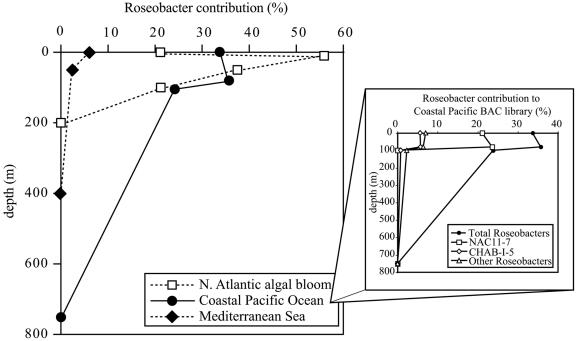
Contribution of roseobacters to the total bacterial community at different depths from three sites. Roseobacters associated with a North Atlantic algal bloom community were identified by group-specific 16S rRNA gene oligonucleotide probes (42). Roseobacters associated with western Mediterranean Sea waters were identified by PCR-generated 16S rRNA gene libraries (1). Roseobacters in coastal Pacific Ocean assemblages were identified by BAC libraries (107). The coastal Pacific BAC libraries revealed significant representation of two of the major sequence clusters described in the text (inset).
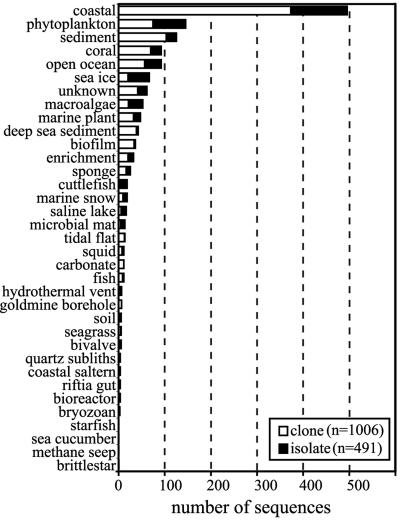
Type (clone or isolate) and origin (environment sampled) of 16S rRNA gene sequences in the Roseobacter data set. Definitions for environments are as follows: “coastal,” seawater samples collected from intertidal regions to edges of continental shelves; “open ocean,” seawater samples taken beyond continental shelves; “deep sea sediment,” samples collected from marine sediments at water depths of >1,000 m; “phytoplankton,” diatoms, dinoflagellates, and microalgae; “marine plant,” vascular coastal plant; “unknown,” insufficient information to determine source environment.
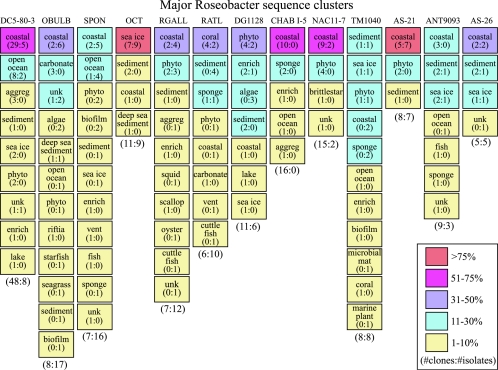
Type (clone or isolate) and origin (environment sampled) of 16S rRNA sequences in each of the major Roseobacter sequence clusters. The percentage of sequences from a given habitat for each sequence cluster is shown by color-coded boxes. The numbers of nonredundant clones and/or isolate sequences for a given habitat are shown in parenthesis (number of clones:number of isolates); at the bottom of each column are the total numbers of nonredundant sequences for each cluster. Abbreviations: aggreg, marine aggregates; phyto, phytoplankton; unk, unknown; enrich, seawater enrichments; vent, hydrothermal vents; and carbonate, deep-sea carbonate crusts. See the Fig. 2 legend for environment definitions.
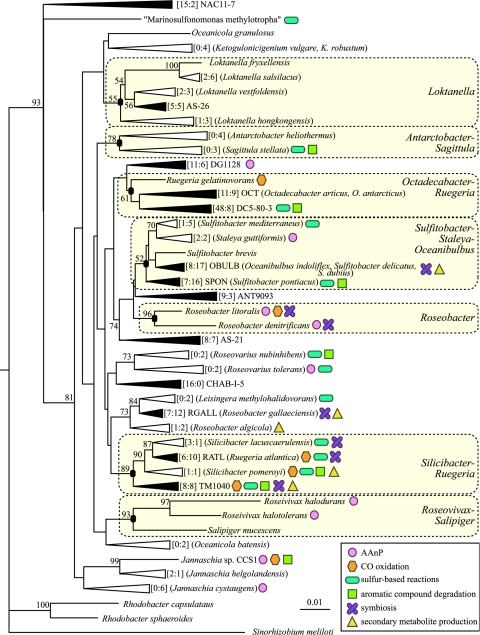
The 41 major lineages of the Roseobacter clade. The tree includes all currently described genera and the 13 major clusters defined in the text. Filled triangles represent clusters of ≥10 nonredundant members, and unfilled triangles represent clusters with <10 members. Described strains within each cluster are shown in parentheses. Robust phylogenetic lineages are indicated with filled ovals at branch nodes and vertical black lines. Numbers of clone and isolate sequences representing each cluster are provided in brackets ([number of clones:number of isolates]). Colored symbols represent evidence for the indicated physiologies. The tree is based on the following sequences: NAC11-7 (GenBank accession number AF245635), “M. methylotropha” (U62894), O. granulosus (AY424896), K. robustum (AF136850), L. fryxellensis (AJ582225), L. salsilacus (AJ582228), L. vestfoldensis (AJ582226), L. hongkongensis (AY600301), AS-26 (AJ391187), S. mediterraneus (Y17387), S. guttiformis (Y16427), S. pontiacus (Y13155), S. brevis (Y16425), O. indoliflex (AY550939), R. litoralis (X78312), R. denitrificans (M96746), ANT9093 (AY167254), AS-21 (AJ391182), O. batensis (AY424898), DG1128 (AY258100), R. gelatinovorans (D88523), O. antarcticus (U14583), DC5-80-3 (AY145589), R. nubinhibens (AF098495), R. tolerans (Y11551), CHAB-I-5 (AJ240910), S. lacuscaerulensis (U77644), R. atlantica (D88526), S. pomeroyi (AF098491), TM1040 (AY332662), L. methylohalidovorans (AY005463), R. gallaeciensis (Y13244), R. algicola (X78313), R. halodurans (D85829), R. halotolerans (D85831), S. mucescens (AY527274), “C. thiooxidans” (AY639887), A. heliothermus (Y11552), S. stellata (U58356), Jannaschia sp. strain CCS1 (www.jgi.doe.gov ), J. helgolandensis (AJ438157), J. cystaugens (AB121782), R. capsulatus (D16427), and R. sphaeroides (D16418). S. meliloti (D14509) served as the outgroup. The tree is based on positions 92 to 1443 of the 16S rRNA gene (E. coli numbering system). Prior to analysis, a filter was applied to the aligned sequences to exclude positions with <50% conservation. The tree was constructed using Phylip (29) and the neighbor-joining method. The bar represents Jukes-Cantor evolutionary distances. Bootstrap values of >50% are shown at branch nodes (100 iterations).
References
-
- Acinas, S. G., V. Klepac-Ceraj, D. E. Hunt, C. Pharino, I. Ceraj, D. L. Distel, and M. F. Polz. 2004. Fine-scale phylogenetic architecture of a complex bacterial community. Nature 430:551-554. - PubMed
-
- Alavi, M., T. Miller, K. Erlandson, R. Schneider, and R. Belas. 2001. Bacterial community associated with Pfiesteria-like dinoflagellate cultures. Environ. Microbiol. 3:380-396. - PubMed
-
- Alavi, M. R. 2004. Predator/prey interaction between Pfiesteria piscicida and Rhodomonas mediated by a marine alpha proteobacterium. Microb. Ecol. 47:48-58. - PubMed
Publication types
MeSH terms
Substances
LinkOut - more resources
Full Text Sources
