. 2005;6(10):R85.
doi: 10.1186/gb-2005-6-10-r85. Epub 2005 Sep 30.

The two tempos of nuclear pore complex evolution: highly adapting proteins in an ancient frozen structure

Affiliations

The two tempos of nuclear pore complex evolution: highly adapting proteins in an ancient frozen structure

Eric Bapteste et al. Genome Biol. 2005.

Abstract

Background: The origin of the nuclear compartment has been extensively debated, leading to several alternative views on the evolution of the eukaryotic nucleus. Until recently, too little phylogenetic information was available to address this issue by using multiple characters for many lineages.

Results: We analyzed 65 proteins integral to or associated with the nuclear pore complex (NPC), including all the identified nucleoporins, the components of their anchoring system and some of their main partners. We used reconstruction of ancestral sequences of these proteins to expand the detection of homologs, and showed that the majority of them, present all over the nuclear pore structure, share homologs in all extant eukaryotic lineages. The anchoring system, by contrast, is analogous between the different eukaryotic lineages and is thus a relatively recent innovation. We also showed the existence of high heterogeneity of evolutionary rates between these proteins, as well as between and within lineages. We show that the ubiquitous genes of the nuclear pore structure are not strongly conserved at the sequence level, and that only their domains are relatively well preserved.

Conclusion: We propose that an NPC very similar to the extant one was already present in at least the last common ancestor of all extant eukaryotes and it would not have undergone major changes since its early origin. Importantly, we observe that sequences and structures obey two very different tempos of evolution. We suggest that, despite strong constraints that froze the structural evolution of the nuclear pore, the NPC is still highly adaptive, modern, and flexible at the sequence level.


Figures
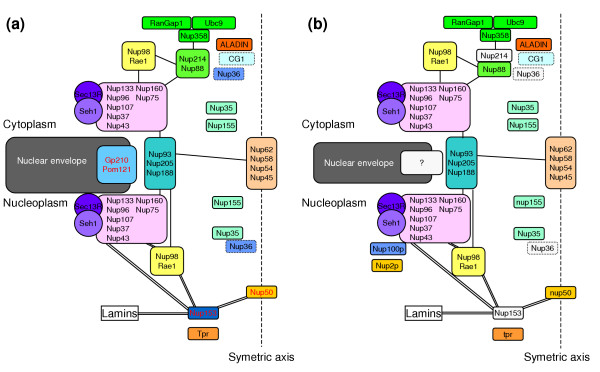
Figure 1
Figure 1
The structure of the nuclear pore complex. Schematic representation of the position of the major nucleoporin subcomplexes in (a) unikonts and (b) bikonts. The schematic organization of the NPC in unikonts is based on the schematic organizations of NPC in vertebrates published by Powers and Dasso [15], completed accordingly with recent works [5,19]. Boxes delimited by dashed lines indicate proteins having unkown or no precise localization within or around the NPC. Light gray boxes represent nucleoporins present in unikonts but having no homologs in bikonts. Protein names in black in (a) indicate proteins having homologs in fungi, whereas those in red indicate proteins having no homologs but structural analogues in fungi. Lines between subcomplexes indicate putative interactions whereas double lines indicate undisputable interactions.
Figure 2
Figure 2
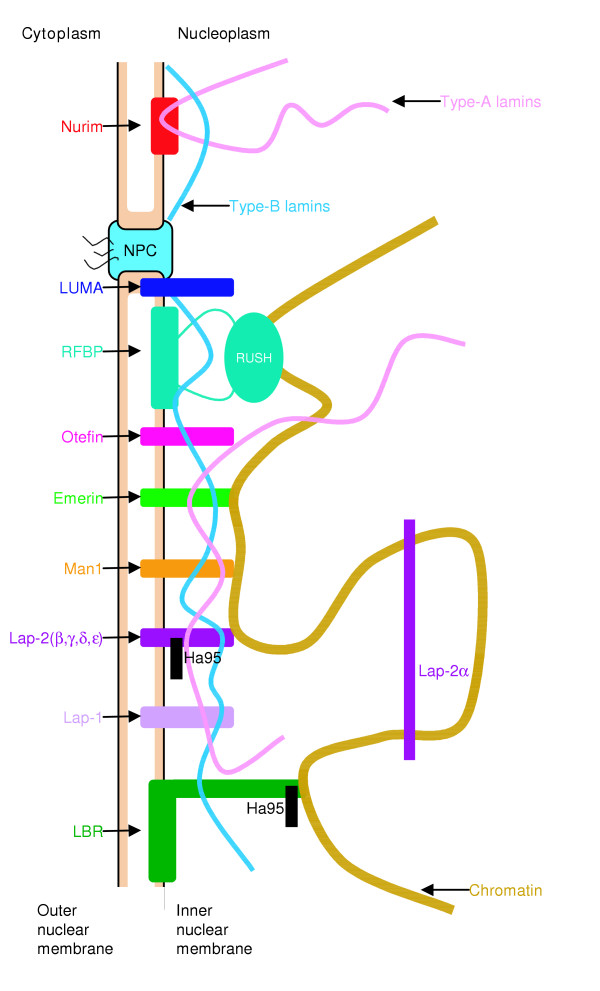
Schematic representation of the putative inner nucleus membrane organization. All the proteins (Nurim, Emerin, Lap-1, Lap-2, A-type lamins and B-type lamins) except Lbr are found only in metazoa (for more details, see [65]). Distant homologs of rfbp and Man1 have been found in some bikont protists (Table 1).
Figure 3
Figure 3
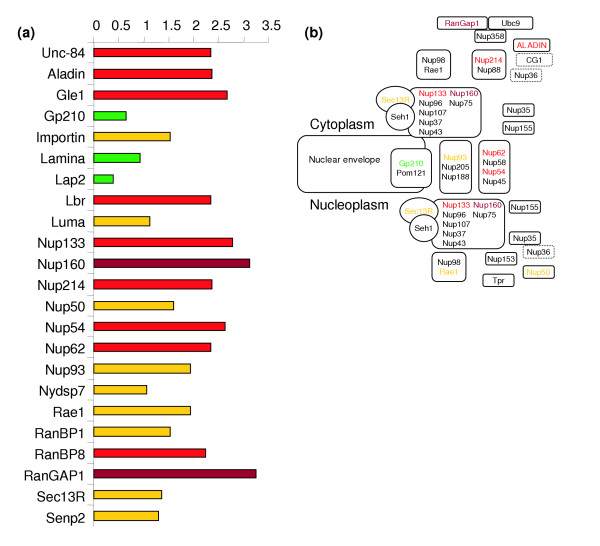
NPC and NPCa protein evloutionary rates. (a) Comparison of the evolutionary rates for several NPC and NPCa proteins. The evolutionary rate for a marker corresponds to the average distance estimated between species. (b) The evolutionary rates mapped onto the NPC structure with a color code: green, slowly evolving marker (average distance < 1); yellow, marker evolving at an average rate (1 < average distance < 2); red, rapidly evolving marker (2 < average distance < 3); dark red, very rapidly evolving marker (average distance > 3).
Figure 4
Figure 4
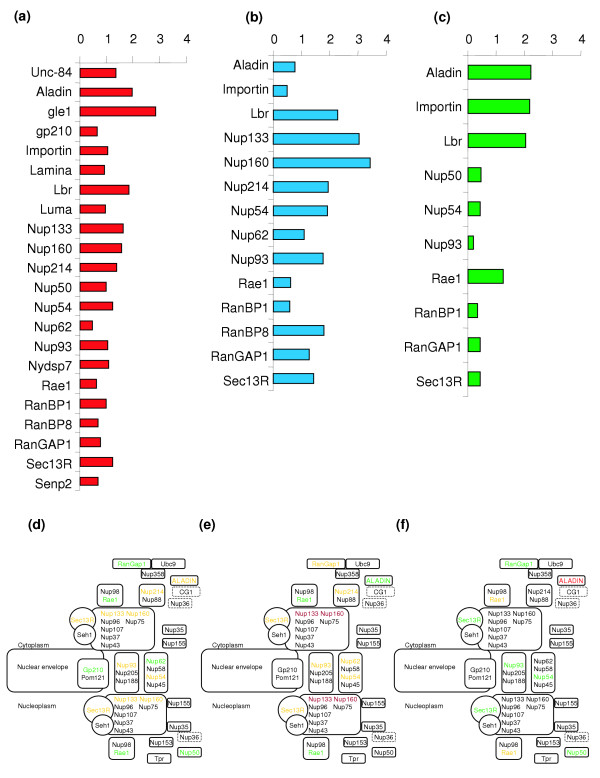
NPC and NPCa protein evloutionary rates within lineages. Comparison of the evolutionary rates of three lineages for several NPC and NPCa proteins, calculated for a marker as the average distance between species of a particular lineage: (a) metazoa in red; (b) fungi in blue; and (c) green plants in green. The evolutionary rate for a marker corresponds to the average distance estimated between species of a given lineage. The evolutionary rates were mapped onto the (d) metazoan, (e) fungi and (f) green plant NPC structures with a color code: green, slowly evolving marker (average distance < 1); yellow, marker evolving at an average rate (1 < average distance < 2); red, rapidly evolving marker (2 < average distance < 3); dark red, very rapidly evolving marker (average distance > 3).
Figure 5
Figure 5
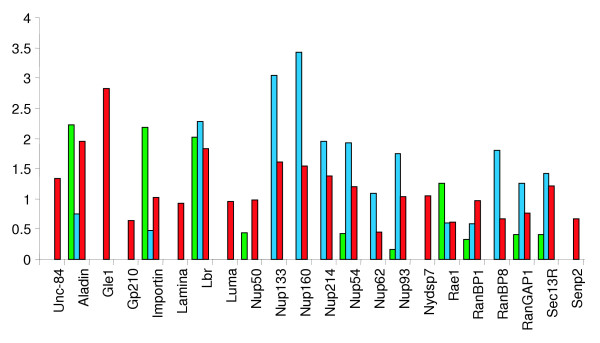
Alternative representation of the evolutionary rates presented in Figure 4a,b,c, allowing a better comparison of the evolutionary rates of several NPC and NPCa proteins between the three lineages (metazoa in red, fungi in blue and green plants in green).
Figure 6
Figure 6
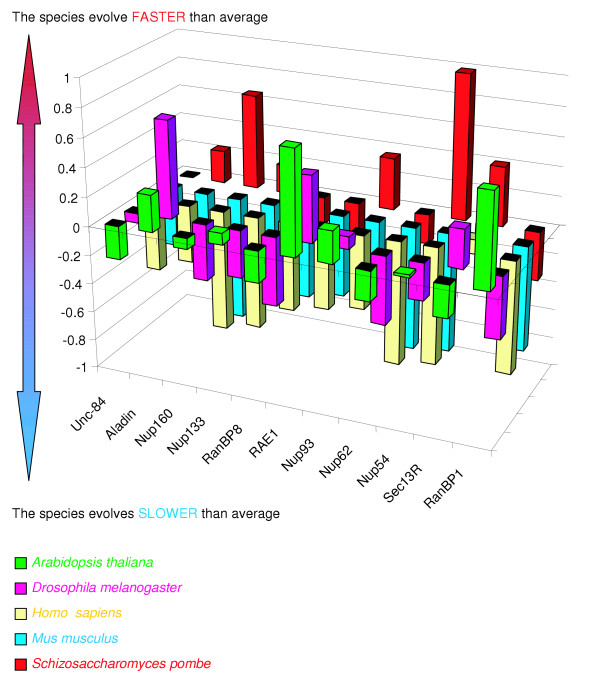
Relative evolutionary rates of several NPC and NPCa proteins for several species (H. sapiens, M. musculus, D. melanogaster, S. pombe and A. thaliana), corresponding to the average distance to a given species minus the average distance to any species.
Figure 7
Figure 7
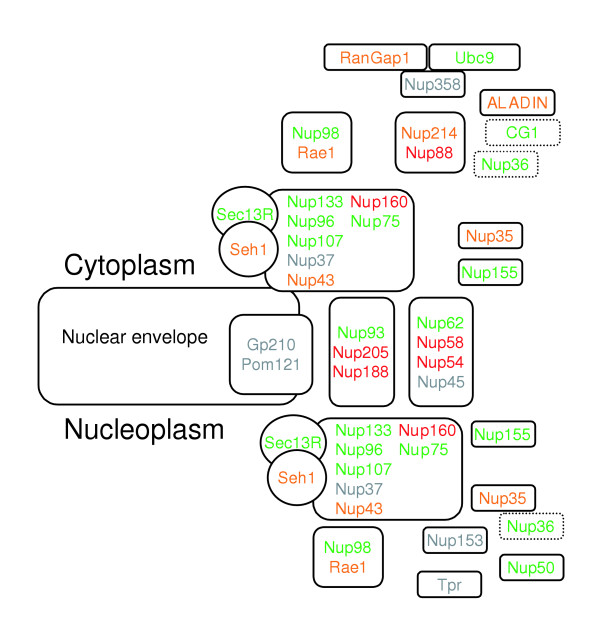
Domain conservation of the proteins constituting the NPC. The color code is: proteins exhibiting the same domain organization in the four species are in green; proteins presenting less than 90% similarity in their organization in domains are in orange; proteins presenting no PFAM domain are in red; proteins for which the structural organization was not studied are in gray.
Figure 8
Figure 8
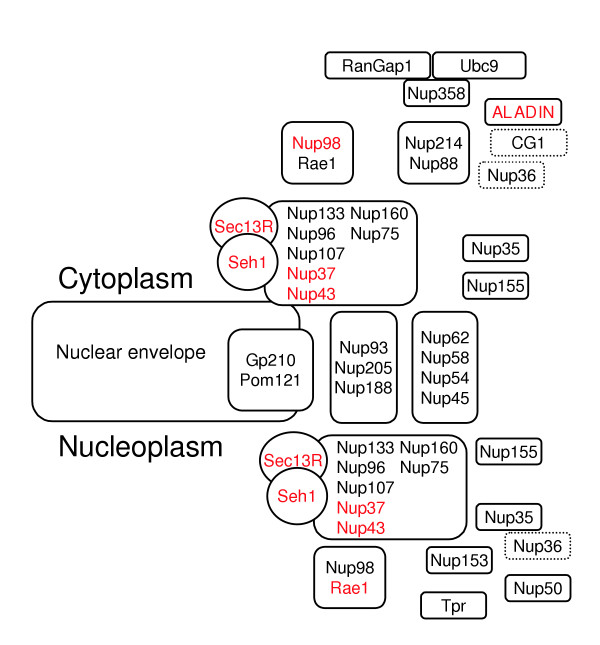
Localization of the six NPC proteins having prokaryotic homologs. The names of those six proteins are in red. All except Aladin are part or associated with the Nup160 subcomplex on the nuclear side.

References

    1. Copeland HF. The kingdoms of organisms. Quart Rev Biol. 1938;13:383–420. doi: 10.1086/394568. - DOI
    1. Copeland HF. Progress report on basic classification. Amer Nat. 1947;81:340–361. doi: 10.1086/281531. - DOI - PubMed
    1. Mans BJ, Anantharaman V, Aravind L, Koonin EV. Comparative genomics, evolution and origins of the nuclear envelope and nuclear pore complex. Cell Cycle. 2004;3:1612–1637. - PubMed
    1. Vasu SK, Forbes DJ. Nuclear pores and nuclear assembly. Curr Opin Cell Biol. 2001;13:363–375. doi: 10.1016/S0955-0674(00)00221-0. - DOI - PubMed
    1. Cronshaw JM, Krutchinsky AN, Zhang W, Chait BT, Matunis MJ. Proteomic analysis of the mammalian nuclear pore complex. J Cell Biol. 2002;158:915–927. doi: 10.1083/jcb.200206106. - DOI - PMC - PubMed

Publication types

Substances

LinkOut - more resources