


Case management for the treatment of patients with major depression in general practices--rationale, design and conduct of a cluster randomized controlled trial--PRoMPT (PRimary care Monitoring for depressive Patient's Trial) [ISRCTN66386086]--study protocol
- PMID: 16207375
- PMCID: PMC1262729
- DOI: 10.1186/1471-2458-5-101
Case management for the treatment of patients with major depression in general practices--rationale, design and conduct of a cluster randomized controlled trial--PRoMPT (PRimary care Monitoring for depressive Patient's Trial) [ISRCTN66386086]--study protocol
Abstract
Background: Depression is a disorder with high prevalence in primary health care and a significant burden of illness. The delivery of health care for depression, as well as other chronic illnesses, has been criticized for several reasons and new strategies to address the needs of these illnesses have been advocated. Case management is a patient-centered approach which has shown efficacy in the treatment of depression in highly organized Health Maintenance Organization (HMO) settings and which might also be effective in other, less structured settings.
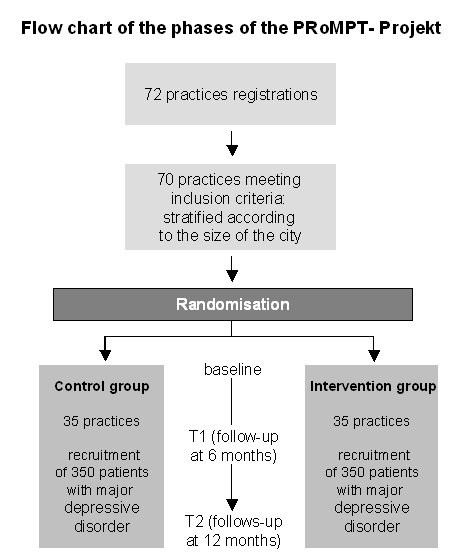
Methods/design: PRoMPT (PRimary care Monitoring for depressive Patients Trial) is a cluster randomised controlled trial with General Practice (GP) as the unit of randomisation. The aim of the study is to evaluate a GP applied case-management for patients with major depressive disorder. 70 GPs were randomised either to intervention group or to control group with the control group delivering usual care. Each GP will include 10 patients suffering from major depressive disorder according to the DSM-IV criteria. The intervention group will receive treatment based on standardized guidelines and monthly telephone monitoring from a trained practice nurse. The nurse investigates the patient's status concerning the MDD criteria, his adherence to GPs prescriptions, possible side effects of medication, and treatment goal attainment. The control group receives usual care--including recommended guidelines. Main outcome measure is the cumulative score of the section depressive disorders (PHQ-9) from the German version of the Prime MD Patient Health Questionnaire (PHQ-D). Secondary outcome measures are the Beck-Depression-Inventory, self-reported adherence (adapted from Moriskey) and the SF-36. In addition, data are collected about patients' satisfaction (EUROPEP-tool), medication, health care utilization, comorbidity, suicide attempts and days out of work. The study comprises three assessment times: baseline (T0) , follow-up after 6 months (T1) and follow-up after 12 months (T2).
Discussion: Depression is now recognized as a disorder with a high prevalence in primary care but with insufficient treatment response. Case management seems to be a promising intervention which has the potential to bridge the gap of the usually time-limited and fragmented provision of care. Case management has been proven to be effective in several studies but its application in the private general medical practice setting remains unclear.
References
-
- Kamerow D. Research on mental health in primary care settings. Rationale, topics and support. Family Practice Research Journal. 1986;6:5–11. - PubMed
-
- Ustun T, Sartorius N. Mental illness in general health care – an international Study. John Wiley & Sons: Chichester; 1995.
-
- Shah A. The burden of psychiatric disorder in primary care. International Review of Psychiatry. 1992;4:243–250.
Publication types
MeSH terms
Associated data
LinkOut - more resources
Full Text Sources
Miscellaneous
