Comparative Study
. 2005 Oct 5;25(40):9144-51.
doi: 10.1523/JNEUROSCI.2252-05.2005.

Behavioral sensitization to cocaine is associated with increased AMPA receptor surface expression in the nucleus accumbens

Affiliations
Comparative Study

Behavioral sensitization to cocaine is associated with increased AMPA receptor surface expression in the nucleus accumbens

Amy C Boudreau et al. J Neurosci. .

Abstract

Regulation of AMPA receptor trafficking is important for many forms of neuronal plasticity. In this study, a protein cross-linking assay was used to evaluate the contribution of AMPA receptor trafficking to plasticity associated with behavioral sensitization, an animal model of drug addiction. Cross-linking was used to distinguish between cell surface and intracellular AMPA receptors in nucleus accumbens (NAc) tissue obtained from rats treated repeatedly with saline or cocaine. Surface/intracellular (S/I) ratios for glutamate receptor 1 (GluR1) and GluR2/3 subunits were increased 21 d after the last injection in cocaine-sensitized rats but not rats that failed to sensitize, and the magnitude of the S/I ratio for cocaine-sensitized rats was positively correlated with the magnitude of behavioral sensitization. At the 1 d withdrawal time, cocaine did not alter S/I ratios, and there was no correlation between S/I ratios and behavioral sensitization. The majority of surface-expressed GluR1 detected with this assay was associated with synapses, based on coimmunoprecipitation with postsynaptic density protein of 95 kDa. These findings suggest that behavioral sensitization to cocaine is associated with a slowly developing redistribution of AMPA receptors to the surface of NAc neurons. Motor execution of drug-seeking responses depends on activation of AMPA receptors on NAc neurons by glutamate afferents originating in cortical and limbic regions. We propose that drug-seeking responses are more effectively triggered in cocaine-sensitized rats because of increased cell surface expression of AMPA receptors.


Figures
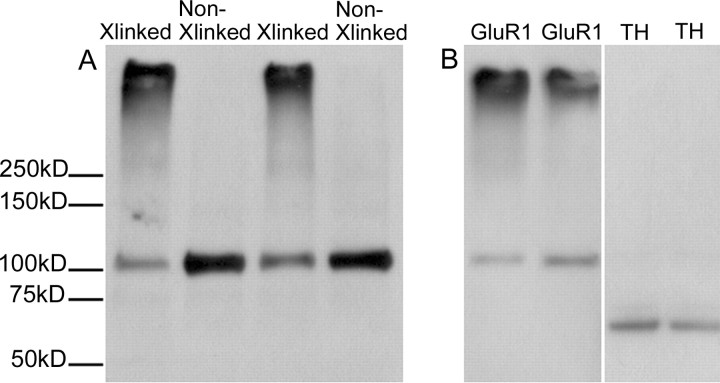
Figure 1.
Figure 1.
BS3 cross-linking measures surface and intracellular pools of GluR1. A, The NAc was dissected from a naive rat. One side was cross-linked, whereas the other was not, generating paired samples that were then immunoblotted for GluR1. Both high (surface-expressed) and monomeric (intracellular) molecular weight bands are detected in tissue from the cross-linked side (Xlinked), whereas noncross-linked (Non-Xlinked) tissue yields the monomeric molecular weight band only. B, In cross-linked NAc tissue, only proteins found both on the surface and inside the cell (GluR1, left) result in high and monomeric molecular weight bands. Proteins that are exclusively intracellular [tyrosine hydroxylase (TH); right] result in a monomeric molecular weight band only, confirming that the cross-linker does not cross cell membranes.
Figure 2.
Figure 2.
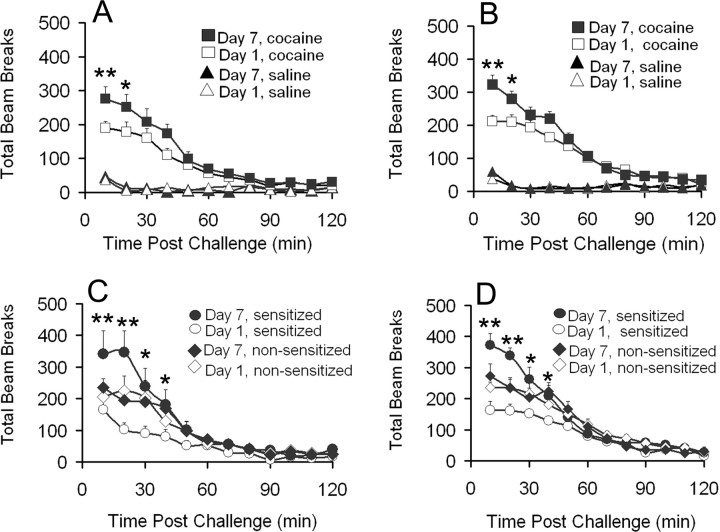
Repeated cocaine injections produce behavioral sensitization in a subset of rats. A, B, Locomotor activity data for all animals receiving repeated cocaine and saline injections; sum of two independent trials for both A and B (4 trials total). After behavioral testing was completed, rats from trials shown in A were killed for biochemical analysis 1 d after the last cocaine injection. Rats from trials shown in B were used for biochemical analysis 21 d after the last cocaine injection. C, Cocaine-treated rats from A were divided into sensitized and nonsensitized subgroups (see Materials and Methods for criteria), and locomotor activity data were reanalyzed. D, Cocaine-treated rats from B were divided into sensitized and nonsensitized subgroups, and locomotor activity data were reanalyzed. All data are expressed as mean ± SEM total beam breaks. **p < 0.01; *p < 0.05 for comparison between beam breaks on day 1 versus day 7.
Figure 3.
Figure 3.
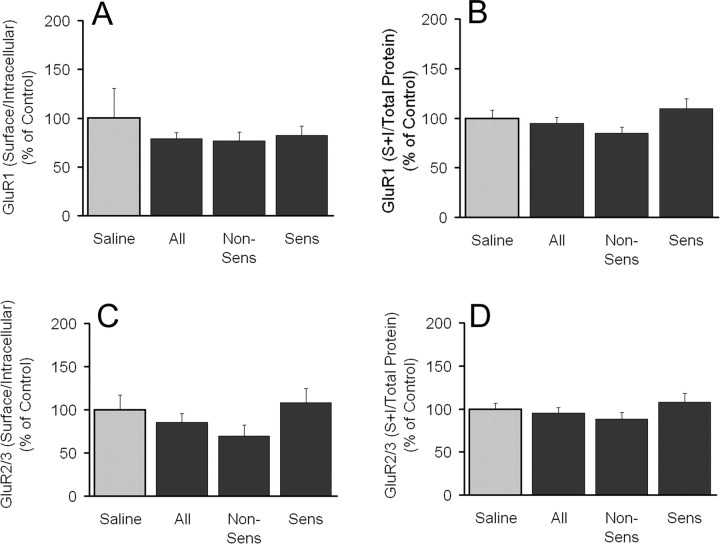
GluR1 and GluR2/3 surface to intracellular ratios and total protein levels are unchanged 1 d after the last cocaine injection. A, GluR1 S/I ratio. B, GluR1 total protein levels (S + I, normalized to total protein in the lane). C, GluR2/3 S/I ratio. D, GluR2/3 total protein levels (S + I normalized to total protein in the lane). Data (mean ± SEM) are normalized to saline controls and represent the sum of two independent experiments (see Fig. 2, A and C, for corresponding behavioral trial data). Saline, n = 12; all cocaine, n = 15; nonsensitized (Non-Sens), n = 9; sensitized (Sens), n = 6.
Figure 4.
Figure 4.
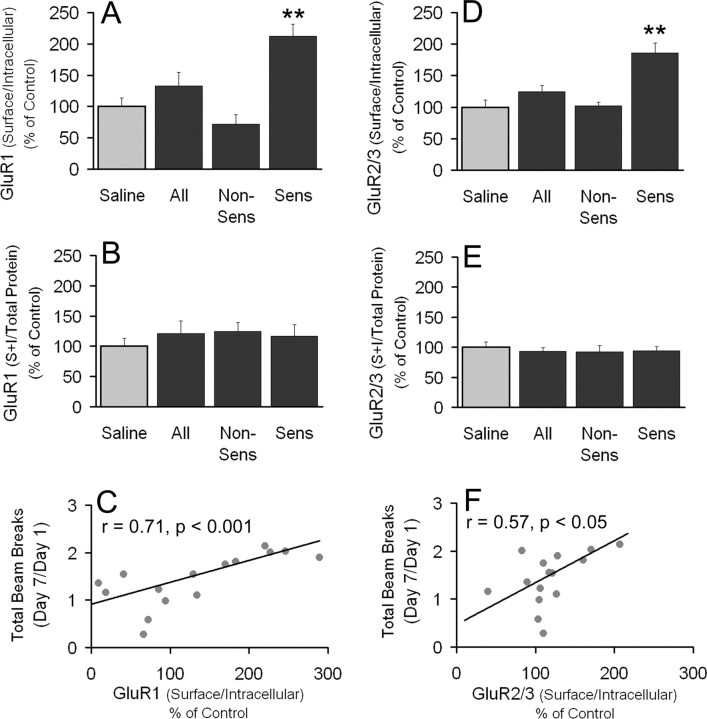
GluR1 and GluR2/3 surface to intracellular ratios (S/I) are increased in cocaine-sensitized rats 21 d after the last injection, and the magnitude of S/I is positively correlated with the magnitude of sensitization. Data (mean ± SEM) are normalized to saline controls and represent the sum of two independent trials (see Fig. 2, B and D, for corresponding behavioral trial data). A, GluR1 S/I ratio (**p < 0.01 relative to saline and nonsensitized groups). B, GluR1 total protein levels (S + I, normalized to total protein in the lane). Non-Sens, Nonsensitized; Sens, sensitized. C, Relationship between the magnitude of behavioral sensitization (day 7/day 1 beam breaks; first 30 min of activity after cocaine injection) and the GluR1 S/I ratio for all cocaine-treated rats. Data represent the sum of two independent trials; r = Spearman rank order. D, GluR2/3 S/I ratio (**p < 0.01 relative to saline and nonsensitized groups). E, GluR2/3 total protein levels (S + I, normalized to total protein in the lane). Non-Sens, Nonsensitized; Sens, sensitized. F, Relationship between the magnitude of behavioral sensitization (day 7/day 1 beam breaks; first 30 min of activity after cocaine injection) and the GluR2/3 S/I ratio for all cocaine-treated rats. Data represent the sum of two independent trials; r = Spearman rank order. Saline, n = 18; all cocaine, n = 16; nonsensitized, n = 9; sensitized, n = 7.
Figure 5.
Figure 5.
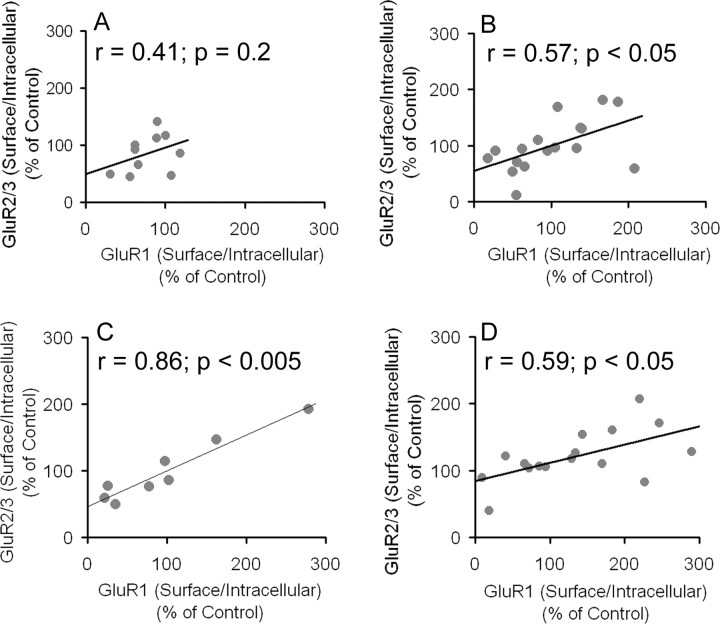
Relationship between GluR1 and GluR2/3 surface to intracellular ratios (S/I) for all cocaine- and saline-treated rats. A, GluR1 S/I ratio versus GluR2/3 S/I ratio 1 d after the last cocaine injection. B, GluR1 S/I ratio versus GluR2/3 S/I ratio 21 d after the last cocaine injection. C, GluR1 S/I ratio versus GluR2/3 S/I ratio 1 d after the last saline injection. D, GluR1 S/I ratio versus GluR2/3 S/I ratio 21 d after the last saline injection. r = Spearman rank order. For some rats, S/I ratio data were only obtained for one subunit (GluR1 or GluR2/3), accounting for a lower sample number in some of these analyses compared with the behavioral trials.
Figure 6.
Figure 6.
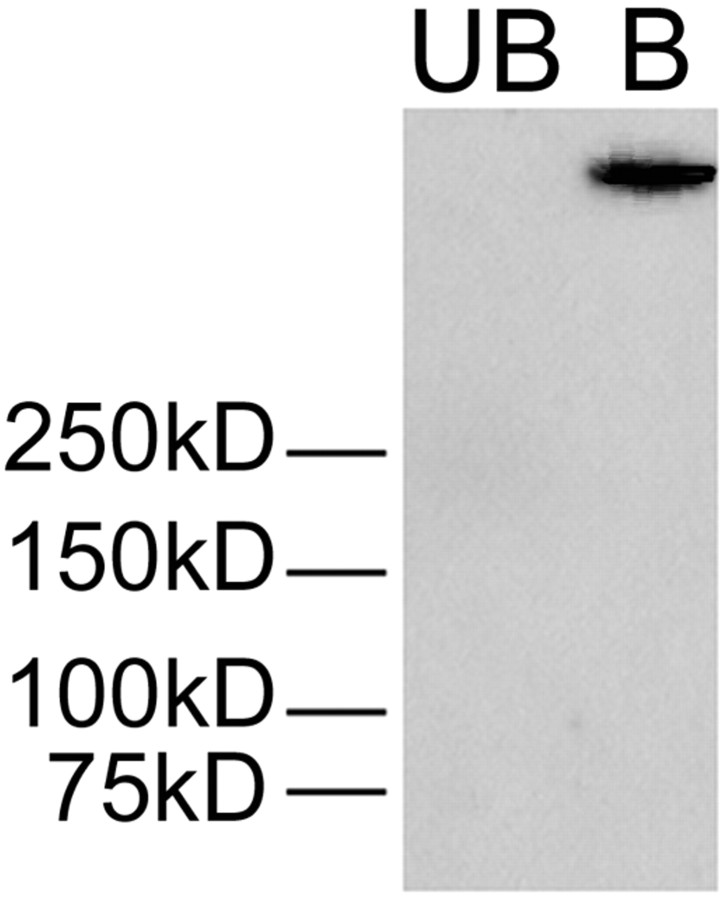
Immunodetection of GluR1 in NAc tissue obtained from a control rat after immunoprecipitation with an antibody to PSD-95. UB (Unbound), Portion of sample not associated with immunoprecipitating antibody; B (Bound), portion of sample associated with immunoprecipitating antibody.

References

    1. Archibald K, Perry MJ, Molnar E, Henley JM (1998) Surface expression and metabolic half-life of AMPA receptors in cultured rat cerebellar granule cells. Neuropharmacology 37: 1345-1353. - PubMed
    1. Baker DA, McFarland K, Lake RW, Shen H, Tang XC, Toda S, Kalivas PW (2003) Neuroadaptations in cystine-glutamate exchange underlie cocaine relapse. Nat Neurosci 6: 743-749. - PubMed
    1. Bernard V, Somogyi P, Bolam JP (1997) Cellular, subcellular, and subsynaptic distribution of AMPA-type glutamate receptor subunits in the neostriatum of the rat. J Neurosci 17: 819-833. - PMC - PubMed
    1. Bredt DS, Nicoll RA (2003) AMPA receptor trafficking at excitatory synapses. Neuron 40: 361-379. - PubMed
    1. Broutman G, Baudry M (2001) Involvement of the secretory pathway for AMPA receptors in NMDA-induced potentiation in hippocampus. J Neurosci 21: 27-34. - PMC - PubMed

Publication types

MeSH terms