


Outbreak of infection with a multiresistant Klebsiella pneumoniae strain associated with contaminated roll boards in operating rooms
- PMID: 16207948
- PMCID: PMC1248441
- DOI: 10.1128/JCM.43.10.4961-4967.2005
Outbreak of infection with a multiresistant Klebsiella pneumoniae strain associated with contaminated roll boards in operating rooms
Abstract
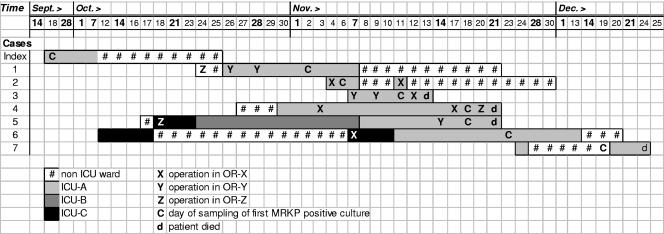
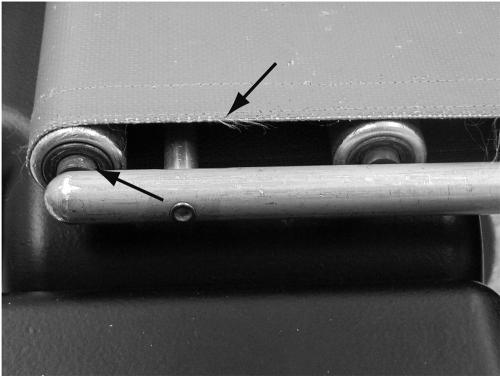
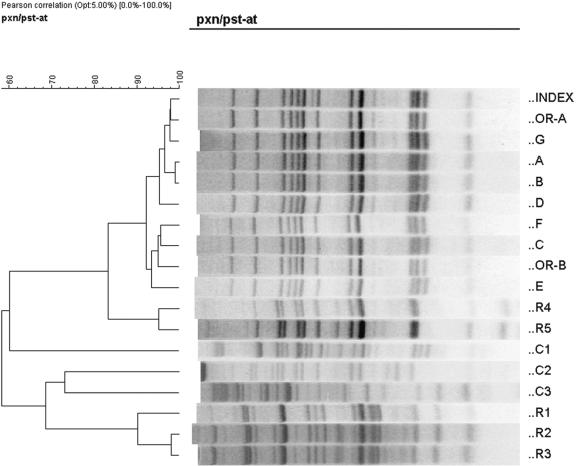
An outbreak with a multiresistant Klebsiella pneumoniae (MRKP) strain among seven patients admitted to the adult intensive care unit (ICU) of a regional teaching hospital in The Netherlands was investigated. Epidemiologic investigations revealed a short delay between an operation and the acquisition of the MRKP strain. A case-control study comprising 7 cases and 14 controls was conducted to identify the risk factors associated with the acquisition of the MRKP strain. An operation at each of two operation rooms was strongly associated with the acquisition of the MRKP strain: odds ratio of 36 (95% confidence interval, 2.7 to 481.2; P=0.003, Fisher exact two-tailed test). Cultures of environmental specimens of the operation rooms revealed contamination of the roll boards used to transport patients from the bed to the operation table with the MRKP strains. Molecular genotyping of the isolates revealed clonal similarity between the isolates of the seven cases, isolates from environmental specimen cultures, and in addition, an MRKP isolate from a re-patriated ICU patient from earlier that year. The outbreak ended after cleaning and replacement of the roll boards in the operation rooms and implementation of additional barrier precautions for colonized or infected patients. It was concluded that two operation rooms played a significant role in the transmission of an MRKP strain between ICU patients during the presented outbreak.
Figures
References
-
- Albesa, I., A. J. Eraso, C. I. Frigerio, and A. M. Lubetkin. 1980. Outbreak of hospital infection, due to members of the Klebsielleae tribe, in an intensive care unit for infants. Rev. Argent. Microbiol. 12:39-43. - PubMed
-
- Bisson, G., N. O. Fishman, J. Baldus Patel, P. H. Edelstein, and E. Lauterbach. 2002. Extended-spectrum β-lactamase-producing Escherichia coli and Klebsiella species: risk factors for colonization and impact of antimicrobial formulary interventions on colonization prevalence. Infect. Control Hosp. Epidemiol. 23:254-260. - PubMed
-
- Centers for Disease Control and Prevention. 2005. Guidelines for infection control in health care facilities. Centers for Disease Control and Prevention, Atlanta, Ga. [Online.] www.wip.nl, guideline 3b, www.cdc.gov.
-
- Cotton, M. F., E. Wasserman, C. H. Pieper, D. C. Theron, D. van Tubbergh, G. Campbell, F. C. Fang, and J. Barnes. 2000. Invasive disease due to extended spectrum beta-lactamase-producing Klebsiella pneumoniae in a neonatal unit: the possible role of cockroaches. J. Hosp. Infect. 44:13-17. - PubMed
-
- De Champs, C., M. P. Sauvant, C. Chanal, D. Sirot, N. Gazuy, R. Malhuret, J. C. Baquet, and J. Sirot. 1989. Prospective survey of colonization and infection caused by expanded-spectrum-beta-lactamase-producing members of the family Enterobacteriaceae in an intensive care unit. J. Clin. Microbiol. 27:2887-2890. - PMC - PubMed
MeSH terms
LinkOut - more resources
Full Text Sources
