


Characterization of Mycobacterium caprae isolates from Europe by mycobacterial interspersed repetitive unit genotyping
- PMID: 16207952
- PMCID: PMC1248478
- DOI: 10.1128/JCM.43.10.4984-4992.2005
Characterization of Mycobacterium caprae isolates from Europe by mycobacterial interspersed repetitive unit genotyping
Abstract
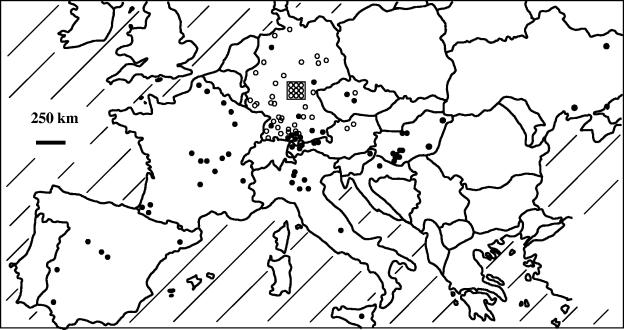
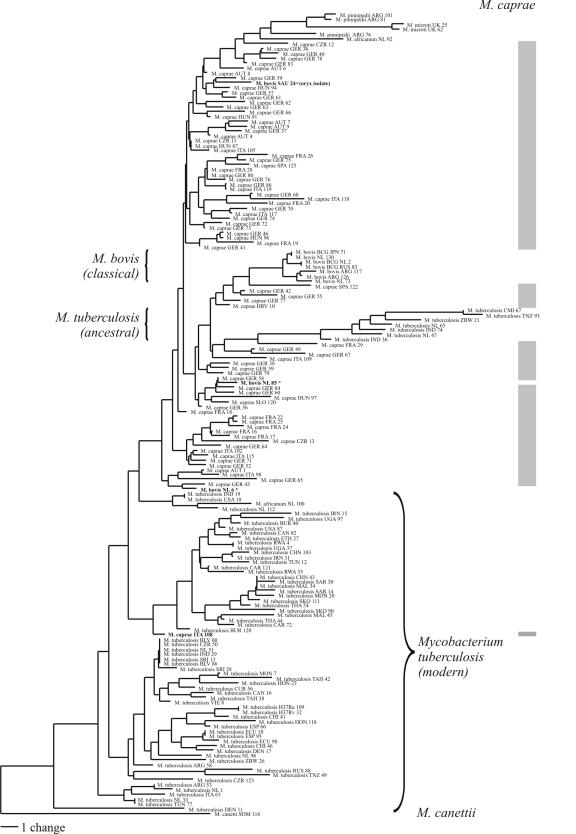
Mycobacterium caprae, a recently defined member of the Mycobacterium tuberculosis complex, causes tuberculosis among animals and, to a limited extent, in humans in several European countries. To characterize M. caprae in comparison with other Mycobacterium tuberculosis complex members and to evaluate genotyping methods for this species, we analyzed 232 M. caprae isolates by mycobacterial interspersed repetitive unit (MIRU) genotyping and by spoligotyping. The isolates originated from 128 distinct epidemiological settings in 10 countries, spanning a period of 25 years. We found 78 different MIRU patterns (53 unique types and 25 clusters with group sizes from 2 to 9) but only 17 spoligotypes, giving Hunter-Gaston discriminatory indices of 0.941 (MIRU typing) and 0.665 (spoligotyping). For a subset of 103 M. caprae isolates derived from outbreaks or endemic foci, MIRU genotyping and IS 6110 restriction fragment length polymorphism were compared and shown to provide similar results. MIRU loci 4, 26, and 31 were most discriminant in M. caprae, followed by loci 10 and 16, a combination which is different than those reported to discriminate M. bovis best. M. caprae MIRU patterns together with published data were used for phylogenetic inference analysis employing the neighbor-joining method. M. caprae isolates were grouped together, closely related to the branches of classical M. bovis, M. pinnipedii, M. microti, and ancestral M. tuberculosis, but apart from modern M. tuberculosis. The analysis did not reflect geographic patterns indicative of origin or spread of M. caprae. Altogether, our data confirm M. caprae as a distinct phylogenetic lineage within the Mycobacterium tuberculosis complex.
Figures
References
-
- Aranaz, A., D. Cousins, A. Mateos, and L. Dominguez. 2003. Elevation of Mycobacterium tuberculosis subsp. caprae Aranaz et al. 1999 to species rank as Mycobacterium caprae comb. nov., sp. nov. Int. J. Syst. Evol. Microbiol. 53:1785-1789. - PubMed
-
- Aranaz, A., E. Liebana, E. Gomez Mampaso, J. Galan, D. Cousins, A. Ortega, J. Blazquez, F. Baquero, A. Mateos, G. Suarez, and L. Dominguez. 1999. Mycobacterium tuberculosis subsp. caprae subsp. nov.: a taxonomic study of a new member of the Mycobacterium tuberculosis complex isolated from goats in Spain. Int. J. Syst. Bacteriol. 49:1263-1273. - PubMed
-
- Aranaz, A., E. Liebana, A. Mateos, L. Dominguez, and D. Cousins. 1998. Restriction fragment length polymorphism and spacer oligonucleotide typing: a comparative analysis of fingerprinting strategies for Mycobacterium bovis. Vet. Microbiol. 61:311-324. - PubMed
-
- Aranaz, A., E. Liebana, A. Mateos, L. Dominguez, D. Vidal, M. Domingo, O. Gonzalez, E. F. Rodriguez Ferri, A. E. Bunschoten, J. D. van Embden, and D. Cousins. 1996. Spacer oligonucleotide typing of Mycobacterium bovis strains from cattle and other animals: a tool for studying epidemiology of tuberculosis. J. Clin. Microbiol. 34:2734-2740. - PMC - PubMed
Publication types
MeSH terms
Substances
LinkOut - more resources
Full Text Sources
Medical
