


Delineation of Campylobacter concisus genomospecies by amplified fragment length polymorphism analysis and correlation of results with clinical data
- PMID: 16207968
- PMCID: PMC1248439
- DOI: 10.1128/JCM.43.10.5091-5096.2005
Delineation of Campylobacter concisus genomospecies by amplified fragment length polymorphism analysis and correlation of results with clinical data
Abstract
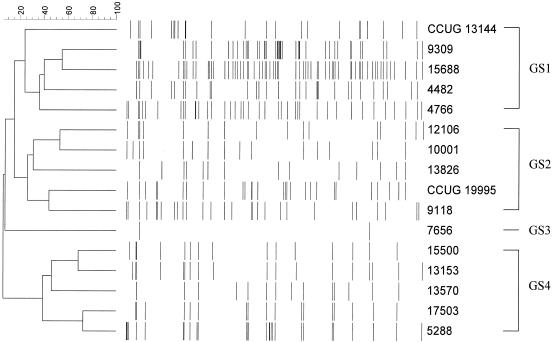
Campylobacter concisus has been as frequently isolated from human diarrhea as the important enteropathogen Campylobacter jejuni, but it also occurs in the feces of healthy individuals. The role of C. concisus in human disease has been difficult to determine, since the species comprises at least two phenotypically indistinguishable but genetically distinct taxa (i.e., genomospecies) that may vary in pathogenicity. We examined 62 C. concisus strains by amplified fragment length polymorphism (AFLP) profiling and correlated the results with clinical data. All C. concisus strains gave unique AFLP profiles, and numerical analysis of these data distributed the strains among four clusters. The clustering was of taxonomic significance: two clusters contained, respectively, the type strain (of oral origin) and a reference strain (from diarrhea) of each of the known genomospecies. Genomospecies 2 strains were more frequently isolated from immunocompetent patients and/or patients without concomitant infections that presented with fever, chronic diarrhea, and gut inflammation than was genomospecies 1, clustering with the type strain of oral origin. Bloody diarrhea was recorded only with C. concisus genomospecies 2 infections. We identified two additional C. concisus genomospecies: genomospecies 3 comprised a single strain from an immunocompetent patient, and genomospecies 4 contained five isolates from severely immunodeficient patients, i.e., organ transplantation recipients or those with hematological malignancies. All genomospecies 4 strains were of the same protein profile group and failed to react with a C. concisus species-specific PCR assay based on 23S rRNA gene sequences: the taxonomic position of this group requires closer investigation. Campylobacter concisus is genetically and taxonomically diverse and contains at least four distinct genomospecies that may exhibit differences in their spectra of virulence potential.
Figures
References
-
- Aabenhus, R., H. Permin, S. L. W. On, and L. P. Andersen. 2002. Prevalence of Campylobacter concisus in diarrhoea of immunocompromised patients. Scand. J. Infect. Dis. 34:248-252. - PubMed
-
- Barrow, G. I., and R. K. A. Feltham (ed.). 2004. Cowan and Steele's manual for the identification of medical bacteria, 3rd ed. Cambridge University Press, Cambridge, England.
-
- Bastyns, K., S. Chapelle, P. Vandamme, H. Goossens, and R. De Watcher. 1995. Specific detection of Campylobacter concisus by PCR amplification of 23S rDNA areas. Mol. Cell Probes 9:247-250. - PubMed
-
- Coenye, T., and P. Vandamme. 2003. Diversity and significance of Burkholderia species occupying diverse ecological niches. Environ. Microbiol. 5:719-729. - PubMed
Publication types
MeSH terms
LinkOut - more resources
Full Text Sources
Medical
Molecular Biology Databases
