


Effect of statins on the mortality of patients with ischaemic heart disease: population based cohort study with nested case-control analysis
- PMID: 16216864
- PMCID: PMC1860643
- DOI: 10.1136/hrt.2005.061523
Effect of statins on the mortality of patients with ischaemic heart disease: population based cohort study with nested case-control analysis
Abstract
Objective: To measure the effect of statins on mortality for community based patients with ischaemic heart disease and determine whether the likely benefits are similar for women, the elderly, and patients with diabetes.
Design: Open prospective cohort study with nested case-control analysis.
Setting: 1.18 million patients registered with 89 practices spread across 23 strategic health authority areas within the UK. All practices had a minimum of eight years of longitudinal data and were contributing to the UK QRESEARCH database.
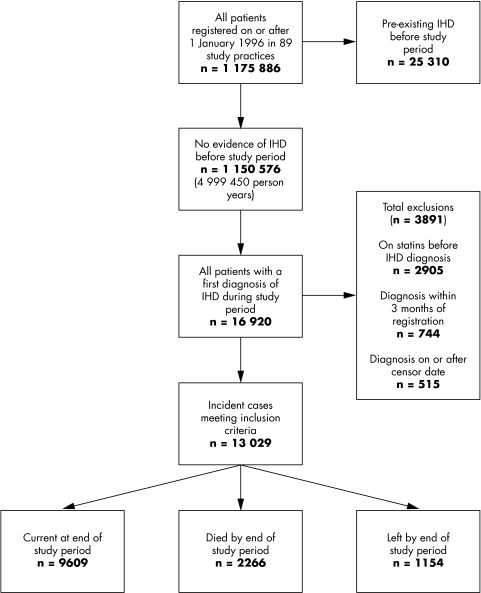
Subjects: All patients with a first diagnosis of ischaemic heart disease between January 1996 and December 2003.
Outcomes: Adjusted hazard ratio with 95% confidence intervals (CIs) for all cause mortality (cohort analysis) and odds ratio (OR) with 95% CI (case-control analysis) for current use of statins. Adjustments were made for current use of aspirin, beta blockers, and angiotensin converting enzyme inhibitors, co-morbidity (myocardial infarction, diabetes, hypertension, congestive cardiac failure), smoking, body mass index, and quintile of deprivation.
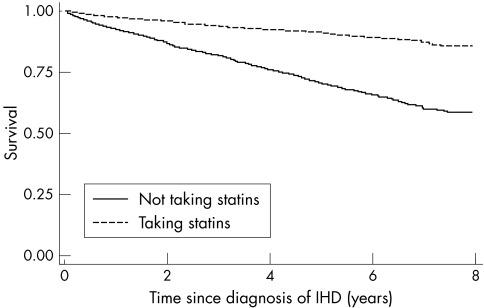
Results: 13,029 patients had a first diagnosis of ischaemic heart disease in the study period giving an incidence rate of 3.38/1000 person years. 2266 patients with ischaemic heart disease died during the 43,460 person years of observation giving an overall mortality rate of 52.1/1000 person years (95% CI 50.0 to 54.3). In the case-control analysis, patients taking statins had a 39% lower risk of death than did patients not taking statins (adjusted OR 0.61, 95% CI 0.52 to 0.72) after use of other medication, co-morbidity, smoking, body mass index, and deprivation were taken into account. The benefits found in this study compared favourably with those found in the randomised controlled trials, although the current study population is at higher overall risk. The benefits extend to women, patients with diabetes, and the elderly and can be seen within two years of treatment. Longer duration of usage was associated with lower OR for risk of death with a 19% reduction in risk of death with each additional year of treatment (adjusted OR 0.81, 95% CI 0.77 to 0.86 per year). Mortality was similarly reduced among patients prescribed atorvastatin (adjusted OR 0.62, 95% CI 0.48 to 0.79) and simvastatin (adjusted OR 0.62, 95% CI 0.50 to 0.76).
Conclusions: The benefits of statins found in randomised controlled trials extend to unselected community based patients. The benefits can be seen within the first two years of treatment and continue to accrue over time. Since patients in the community are likely to be at higher risk than those in trials, the potential benefits from statins are likely to be greater than expected.
Conflict of interest statement
Competing interests: None declared.
References
-
- Scandinavian Simvastatin Survival Group Randomised trial of cholesterol lowering in 4444 patients with coronary heart disease: the Scandinavian simvastatin survival study (4S). Lancet 19943441383–1389. - PubMed
-
- Long‐term Intervention with Pravastatin in Ischaemic Heart Disease (LIPID) Study Group Prevention of cardiovascular events and death with pravastatin in patients with coronary heart disease and a broad range of initial cholesterol levels. N Engl J Med 19983391349–1357. - PubMed
-
- Sacks F M, Pfeffer M A, Moye L A. The effects of pravastatin on coronary events after myocardial infarction in patients with average cholesterol levels. The CARE study. N Engl J Med 19963351001–1009. - PubMed
-
- Heart Protection Study Collaborative Group MRC/BHF heart protection study of cholesterol lowering with simvastatin in 20,536 high risk individuals: a randomised placebo‐controlled trial. Lancet 20023607–22. - PubMed
Publication types
MeSH terms
Substances
LinkOut - more resources
Full Text Sources
Medical
