


Human infection patterns and heterogeneous exposure in river blindness
- PMID: 16217028
- PMCID: PMC1257694
- DOI: 10.1073/pnas.0502659102
Human infection patterns and heterogeneous exposure in river blindness
Abstract
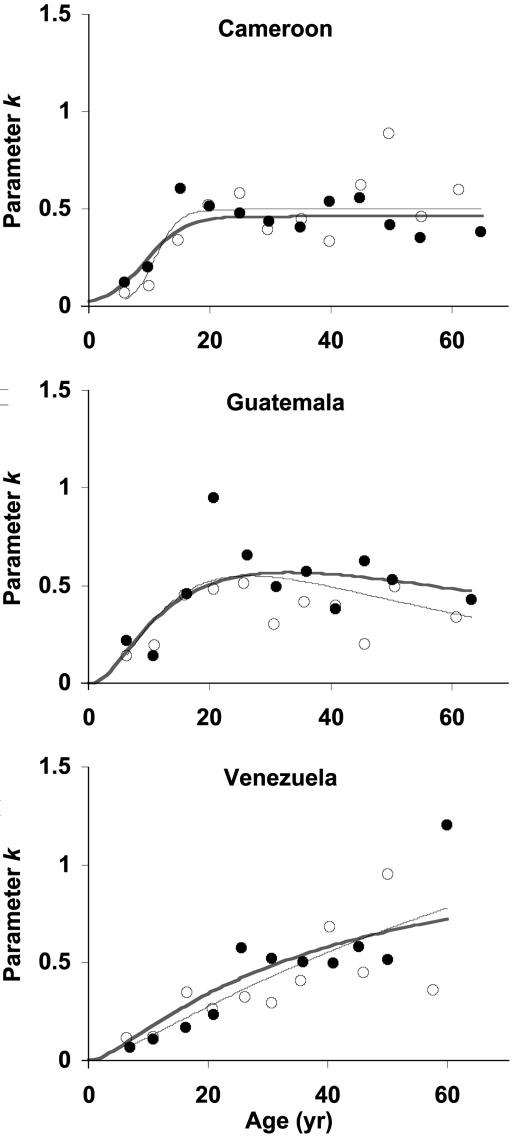
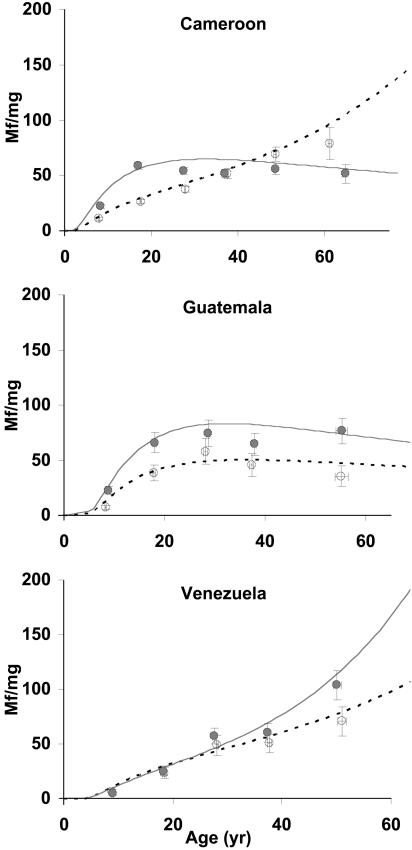
Here we analyze patterns of human infection with Onchocerca volvulus (the cause of river blindness) in different continents and ecologies. In contrast with some geohelminths and schistosome parasites whose worm burdens typically exhibit a humped pattern with host age, patterns of O. volvulus infection vary markedly with locality. To test the hypothesis that such differences are partly due to heterogeneity in exposure to vector bites, we develop an age- and sex-structured model for intensity of infection, with parasite regulation within humans and vectors. The model is fitted to microfilarial data from savannah villages of northern Cameroon, coffee fincas of central Guatemala, and forest-dwelling communities of southern Venezuela that were recorded before introducing ivermectin treatment. Estimates of transmission and infection loads are compared with entomological and epidemiological field data. Host age- and sex-heterogeneous exposure largely explains locale-specific infection patterns in onchocerciasis (whereas acquired protective immunity has been invoked for other helminth infections). The basic reproductive number, R0, ranges from 5 to 8, which is slightly above estimates for other helminth parasites but well below previously presented values.
Figures
References
-
- Anonymous (2004) Lancet 364, 1993-1994.
-
- Michael, E., Bundy, D. A. & Grenfell, B. T. (1996) Parasitology 112, 409-428. - PubMed
-
- Richards, F. O., Jr., Boatin, B., Sauerbrey, M. & Sékétéli, A. (2001) Trends Parasitol. 17, 558-563. - PubMed
-
- Molyneux, D. H. (2004) Lancet 364, 380-383. - PubMed
-
- Fenwick, A., Savioli, L., Engels, D., Bergquist, N. R. & Todd, M. H. (2003) Trends Parasitol. 19, 509-515. - PubMed
MeSH terms
LinkOut - more resources
Full Text Sources
