


Pattern-specific associative long-term potentiation induced by a sleep spindle-related spike train
- PMID: 16221848
- PMCID: PMC6725710
- DOI: 10.1523/JNEUROSCI.2149-05.2005
Pattern-specific associative long-term potentiation induced by a sleep spindle-related spike train
Abstract
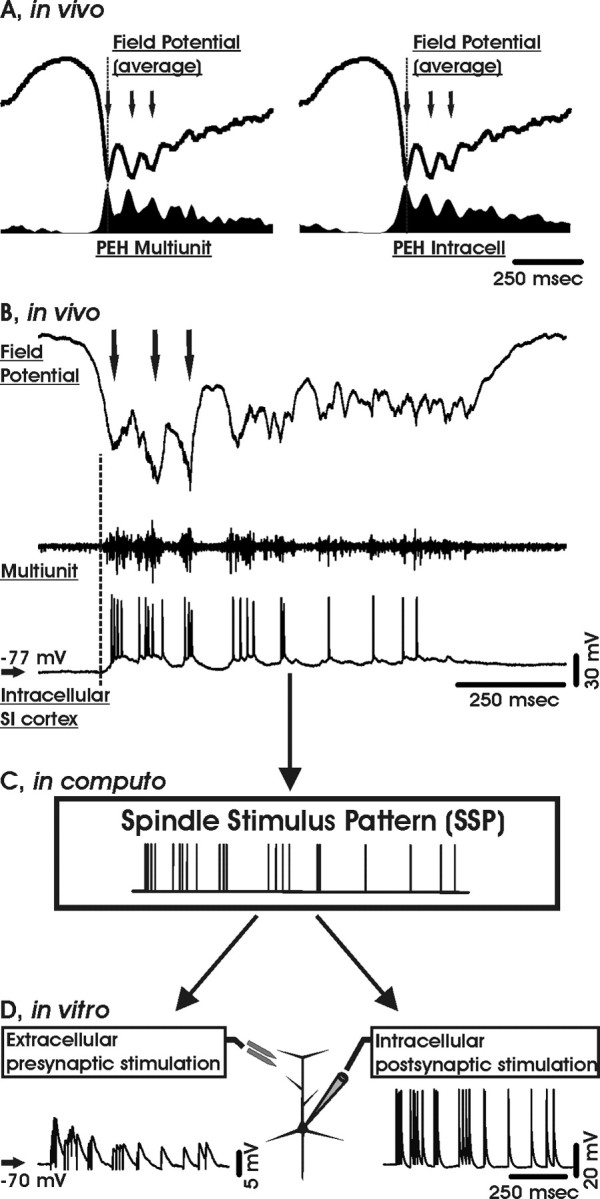
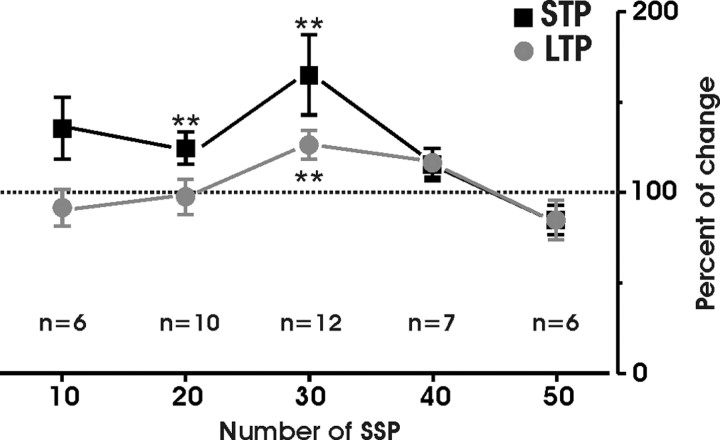
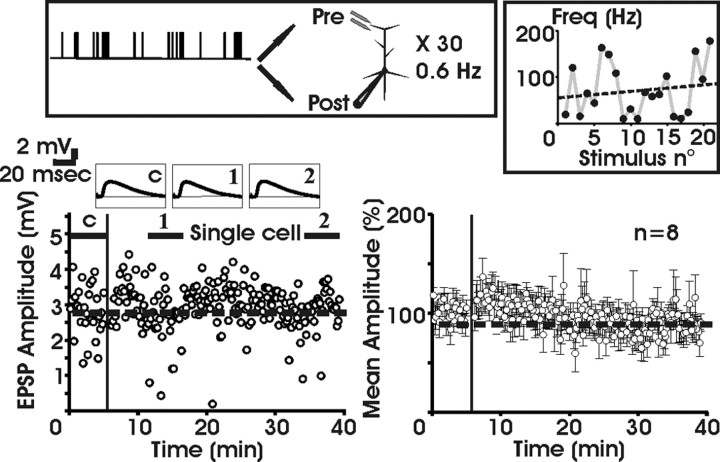
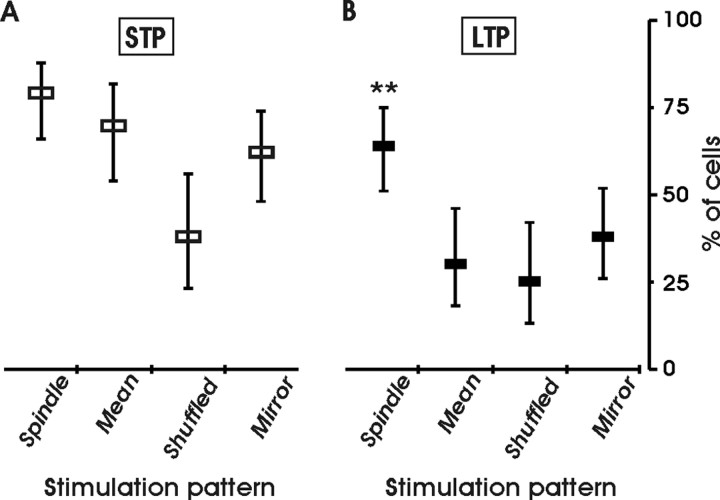
Spindles are non-rapid eye movement (non-REM) sleep EEG rhythms (7-14 Hz) that occur independently or in association with slow oscillations (0.6-0.8 Hz). Despite their proposed function in learning and memory, their role in synaptic plasticity is essentially unknown. We studied the ability of a neuronal firing pattern underlying spindles in vivo to induce synaptic plasticity in neocortical pyramidal cells in vitro. A spindle stimulation pattern (SSP) was extracted from a slow oscillation upstate that was recorded in a cat anesthetized with ketamine-xylazine, which is known to induce a sleep-like state. To mimic the recurrence of spindles grouped by the slow oscillation, the SSP was repeated every 1.5 s (0.6 Hz). Whole-cell patch-clamp recordings were obtained from layer V pyramidal cells of rat somatosensory cortex with infrared videomicroscopy, and composite EPSPs were evoked within layers II-III. Trains of EPSPs and action potentials simultaneously triggered by the SSP induced an NMDA receptor-dependent short-term potentiation (STP) and an L-type Ca2+ channel-dependent long-term potentiation (LTP). The number of spindle sequences affected the amount of STP-LTP. In contrast, spindle trains of EPSPs alone led to long-term depression. LTP was not consistently induced by a regular firing pattern, a mirrored SSP, or a randomized SSP; however, a synthetic spindle pattern consisting of repetitive spike bursts at 10 Hz reliably induced STP-LTP. Our results show that spindle-associated spike discharges are efficient in modifying excitatory neocortical synapses according to a Hebbian rule. This is in support of a role for sleep spindles in memory consolidation.
Figures




References
-
- Achermann P, Borbély AA (1997) Low-frequency (<1 Hz) oscillations in the human sleep electroencephalogram. Neuroscience 81: 213-222. - PubMed
-
- Akaike N, Hattori K, Oomura Y, Carpenter DO (1985) Bicuculline and picrotoxin block gamma-aminobutyric acid-gated Cl- conductance by different mechanisms. Experientia 41: 70-71. - PubMed
-
- Allen CB, Celikel T, Feldman DE (2003) Long-term depression induced by sensory deprivation during cortical map plasticity in vivo. Nat Neurosci 6: 291-299. - PubMed
-
- Amzica F, Steriade M (1997) The K-complex: its slow (<1-Hz) rhythmicity and relation to delta waves. Neurology 49: 952-959. - PubMed
Publication types
MeSH terms
LinkOut - more resources
Full Text Sources
Miscellaneous
