Review
. 2005 Oct;18(4):687-702.
doi: 10.1128/CMR.18.4.687-702.2005.

Vaccines for tuberculosis: novel concepts and recent progress

Affiliations
Review

Vaccines for tuberculosis: novel concepts and recent progress

T Mark Doherty et al. Clin Microbiol Rev. 2005 Oct.

Abstract

Three-quarters of a century after the introduction of Mycobacterium bovis BCG, the first tuberculosis vaccine, new vaccines for tuberculosis are finally entering clinical trials. This breakthrough is based not only on advances in proteomics and genomics which have made the construction of new vaccines possible, but also on a greatly expanded knowledge of the immunology of tuberculosis. Here we review our current understanding of how Mycobacterium tuberculosis subverts or survives the host's immune response to cause disease and why the current vaccination strategy, which relies on BCG, is only partially successful in countering the pathogen. This provides a background for describing the new generation of vaccines designed to supplement or replace the current vaccine and the different approaches they take to stimulate immunity against M. tuberculosis.


Figures
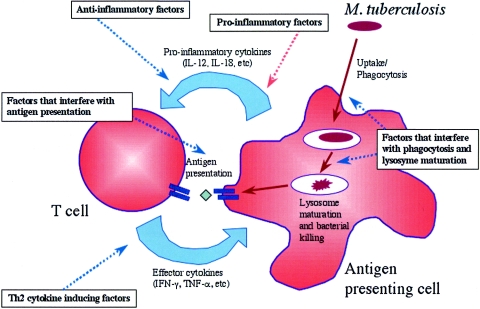
FIG. 1.
FIG. 1.
Schematic representation of the normal immune response and the different steps where M. tuberculosis intervenes. The Th1 immune response to M. tuberculosis is central to immunity to the pathogen, and the IFN-γ and IL-12 pathway stimulated by proinflammatory factors induced by mycobacterial cell wall lipids is essential for macrophage activation, resulting in lysosome maturation and bacterial killing. M. tuberculosis counteracts this by manipulating the cytokine response through induction of inhibitory Th2 cytokines (IL-4 and IL-10), affecting production of IL-12 themselves, and by modulating the activity of receptor-associated transcription factors such as Stat1. The immune response is also modulated by factors that interfere with antigen-specific responses (by either blocking presentation of antigen or, conversely, promoting immune responses to nonprotective antigens). At the same time, M. tuberculosis deploys an impressive armory of genes to interfere with phagocytosis and lysozyme maturation and function of antigen-presenting cells.
FIG. 2.
FIG. 2.
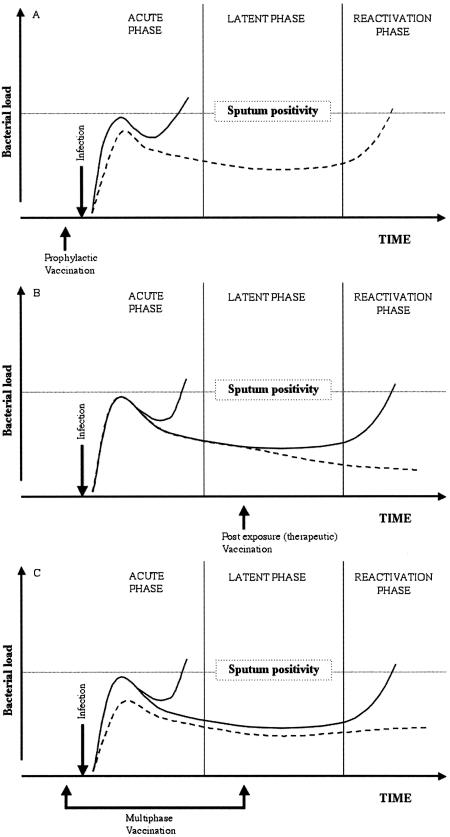
Schematic model of the effect of preexposure, postexposure, and multiphase vaccination. The course of infection with M. tuberculosis (black line) is characterized by an increase in bacterial load until the cognate immune response develops, at which point bacterial growth is reversed. In a minority of individuals (3 to 5%), the bacteria escape control and begin to expand again, resulting in clinical TB and sputum positivity. Preexposure vaccination hastens the development of this initial immune response, leading to earlier arrest of bacterial growth and preventing the infection from becoming symptomatic (A). However, in the majority of infected individuals, the initial infection may be controlled but sterile immunity is not achieved. Instead, M. tuberculosis establishes a latent infection which can later reactivate, causing clinical TB. Postexposure vaccination aims to strengthen immune surveillance to prevent this reactivation (B), but it cannot prevent those cases that arise during acute infection. A hypothetical multiphase vaccine will not only inhibit the infection from becoming symptomatic but will also prevent later reactivation (C). An important consequence of preventing reactivation is that if bacterial load is reduced, not only is disease prevented in the recipient, but the cycle of transmission is broken.

References

    1. Aaron, L., D. Saadoun, I. Calatroni, O. Launay, N. Memain, V. Vincent, G. Marchal, B. Dupont, O. Bouchaud, D. Valeyre, and O. Lortholary. 2004. Tuberculosis in HIV-infected patients: a comprehensive review. Clin. Microbiol. Infect. 10:388-398. - PubMed
    1. Agger, E. M., and P. Andersen. 2001. Tuberculosis subunit vaccine development: on the role of interferon-gamma. Vaccine 19:2298-2302. - PubMed
    1. Anonymous 1999. Fifteen year follow up of trial of BCG vaccines in south India for tuberculosis prevention. Indian J. Med. Res. 110:56-69. - PubMed
    1. Anonymous 2005. Global tuberculosis control - surveillance, planning, financing W.H.O./HTM/TB/2005. World Health Organization, Geneva, Switzerland.
    1. Arias, M., M. Rojas, J. Zabaleta, J. I. Rodriguez, S. C. Paris, L. F. Barrera, and L. F. Garcia. 1997. Inhibition of virulent Mycobacterium tuberculosis by Bcg(r) and Bcg(s) macrophages correlates with nitric oxide production. J Infect. Dis. 176:1552-1558. - PubMed

MeSH terms