


Distinct chemokine triggers and in vivo migratory paths of fluorescein dye-labeled T Lymphocytes in acutely simian immunodeficiency virus SIVmac251-infected and uninfected macaques
- PMID: 16227295
- PMCID: PMC1262620
- DOI: 10.1128/JVI.79.21.13759-13768.2005
Distinct chemokine triggers and in vivo migratory paths of fluorescein dye-labeled T Lymphocytes in acutely simian immunodeficiency virus SIVmac251-infected and uninfected macaques
Abstract
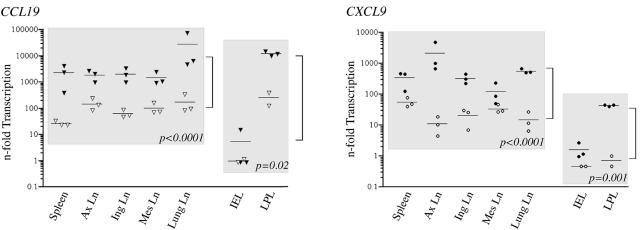
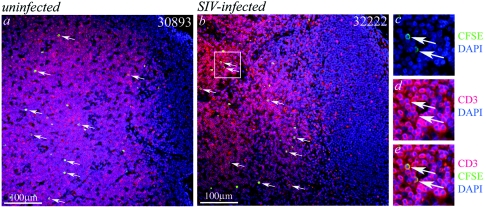
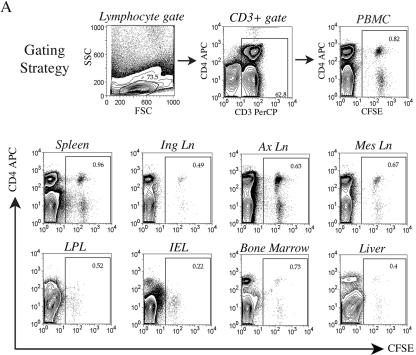
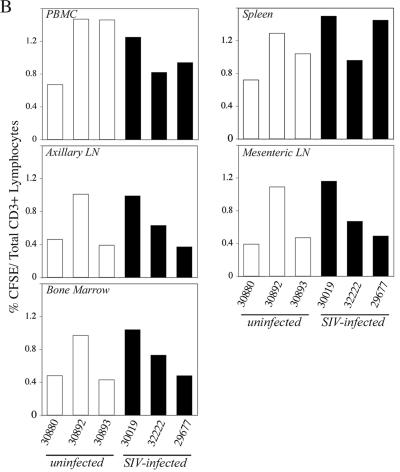
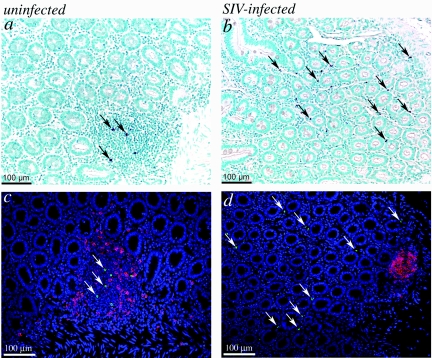
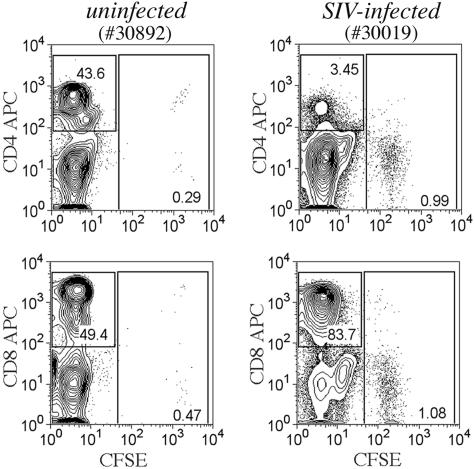
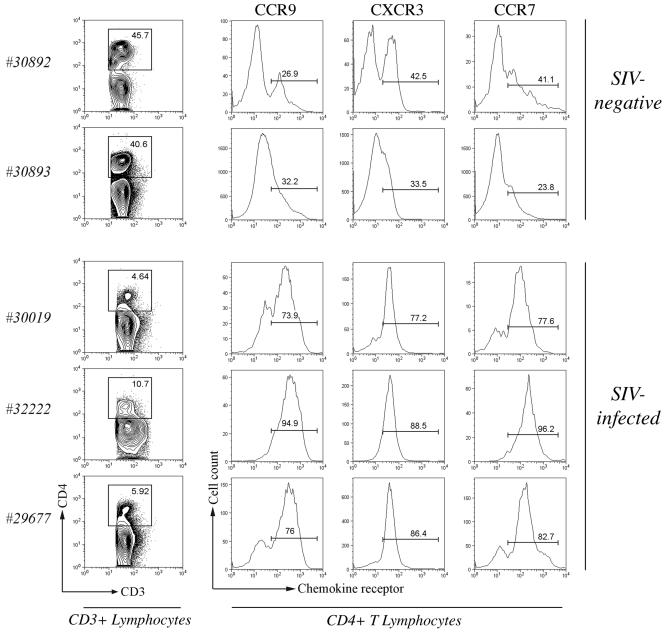
To define the possible impact of T-lymphocyte trafficking parameters on simian immunodeficiency virus (SIV) pathogenesis, we examined migratory profiles of carboxyfluorescein diacetate succinimidyl ester (CFSE)-labeled T lymphocytes in acutely SIVmac251-infected and uninfected macaques within 48 h after autologous transfer. Despite significant upregulation of homeostatic chemokine CCL19/macrophage inflammatory protein 3beta and proinflammatory chemokine CXCL9/monokine induced by gamma interferon in secondary lymphoid tissue in SIV infection, no differences in CFSE+ T-lymphocyte frequencies or cell compartmentalization in lymph nodes were identified between animal groups. By contrast, a higher frequency of CFSE+ T lymphocytes in the small intestine was detected in acute SIV infection. This result correlated with increased numbers of gut CD4 T lymphocytes expressing chemokine receptors CCR9, CCR7, and CXCR3 and high levels of their respective chemokine ligands in the small intestine. The changes in trafficking parameters in SIV-infected macaques occurred concomitantly with acute gut CD4 T-lymphocyte depletion. Here, we present the first in vivo T-lymphocyte trafficking study in SIV infection and a novel approach to delineate T-lymphocyte recruitment into tissues in the nonhuman primate animal model for AIDS. Such studies are likely to provide unique insights into T-lymphocyte sequestration in distinct tissue compartments and possible mechanisms of CD4 T-lymphocyte depletion and immune dysfunction in simian AIDS.
Figures
References
-
- Alimonti, J. B., T. B. Ball, and K. R. Fowke. 2003. Mechanisms of CD4+ T lymphocyte cell death in human immunodeficiency virus infection and AIDS. J. Gen. Virol. 84:1649-1661. - PubMed
-
- Appay, V., D. F. Nixon, S. M. Donahoe, G. M. Gillespie, T. Dong, A. King, G. S. Ogg, H. M. Spiegel, C. Conlon, C. A. Spina, D. V. Havlir, D. D. Richman, A. Waters, P. Easterbrook, A. J. McMichael, and S. L. Rowland-Jones. 2000. HIV-specific CD8(+) T cells produce antiviral cytokines but are impaired in cytolytic function. J. Exp. Med. 192:63-75. - PMC - PubMed
-
- Brenchley, J. M., N. J. Karandikar, M. R. Betts, D. R. Ambrozak, B. J. Hill, L. E. Crotty, J. P. Casazza, J. Kuruppu, S. A. Migueles, M. Connors, M. Roederer, D. C. Douek, and R. A. Koup. 2003. Expression of CD57 defines replicative senescence and antigen-induced apoptotic death of CD8+ T cells. Blood 101:2711-2720. - PubMed
-
- Brenchley, J. M., T. W. Schacker, L. E. Ruff, D. A. Price, J. H. Taylor, G. J. Beilman, P. L. Nguyen, A. Khoruts, M. Larson, A. T. Haase, and D. C. Douek. 2004. CD4+ T cell depletion during all stages of HIV disease occurs predominantly in the gastrointestinal tract. J. Exp. Med. 200:749-759. - PMC - PubMed
Publication types
MeSH terms
Substances
Grants and funding
LinkOut - more resources
Full Text Sources
Research Materials
