. 2005 Nov;25(21):9269-82.
doi: 10.1128/MCB.25.21.9269-9282.2005.

The splicing ATPase prp43p is a component of multiple preribosomal particles

Affiliations

The splicing ATPase prp43p is a component of multiple preribosomal particles

Simon Lebaron et al. Mol Cell Biol. 2005 Nov.

Abstract

Prp43p is a putative helicase of the DEAH family which is required for the release of the lariat intron from the spliceosome. Prp43p could also play a role in ribosome synthesis, since it accumulates in the nucleolus. Consistent with this hypothesis, we find that depletion of Prp43p leads to accumulation of 35S pre-rRNA and strongly reduces levels of all downstream pre-rRNA processing intermediates. As a result, the steady-state levels of mature rRNAs are greatly diminished following Prp43p depletion. We present data arguing that such effects are unlikely to be solely due to splicing defects. Moreover, we demonstrate by a combination of a comprehensive two-hybrid screen, tandem-affinity purification followed by mass spectrometry, and Northern analyses that Prp43p is associated with 90S, pre-60S, and pre-40S ribosomal particles. Prp43p seems preferentially associated with Pfa1p, a novel specific component of pre-40S ribosomal particles. In addition, Prp43p interacts with components of the RNA polymerase I (Pol I) transcription machinery and with mature 18S and 25S rRNAs. Hence, Prp43p might be delivered to nascent 90S ribosomal particles during pre-rRNA transcription and remain associated with preribosomal particles until their final maturation steps in the cytoplasm. Our data also suggest that the ATPase activity of Prp43p is required for early steps of pre-rRNA processing and normal accumulation of mature rRNAs.


Figures
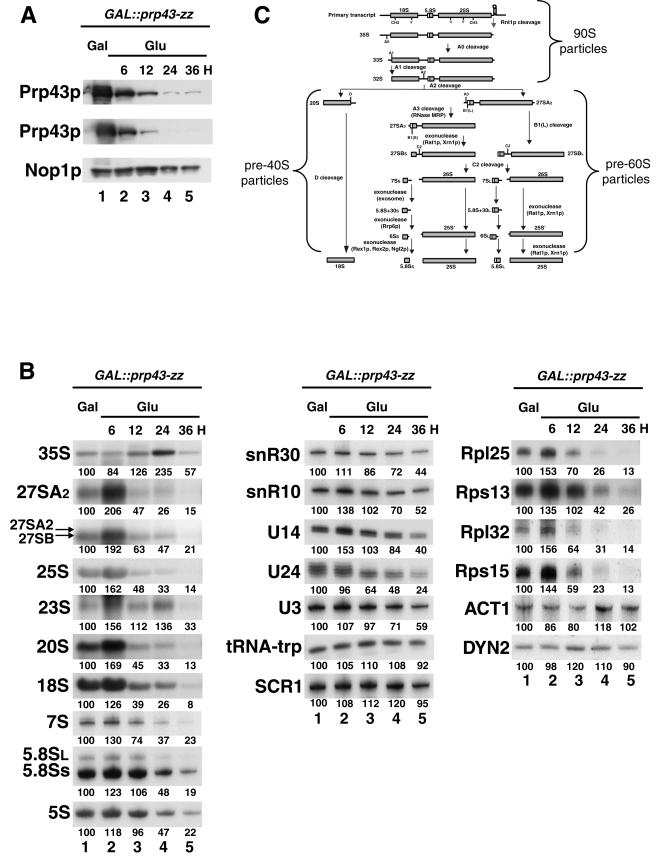
FIG.1.
FIG.1.
Prp43p depletion inhibits accumulation of mature rRNAs. A GAL::prp43-zz strain was grown in galactose-containing medium (GAL; lanes 1) and then shifted to a glucose-containing medium (Glu; lanes 2 to 5). Culture samples corresponding to the same number of cells were collected before the transfer (lanes 1) and at 6 (lanes 2), 12 (lanes 3), 24 (lanes 4), or 36 (lanes 5) h after transfer to glucose-containing medium. From these samples, total proteins (A) or RNAs (B) were extracted and subjected to Western blot (A) or Northern blot (B) analysis. In panel A, total proteins were subjected to SDS-polyacrylamide gel electrophoresis (PAGE), transferred to a cellulose membrane, and detected by enhanced chemiluminescence using either Dakko rabbit PAP or a polyclonal anti-Nop1p serum. Two different exposures of the film are shown for better appreciation of both the sharp decrease in Prp43p levels and the remaining quantities of that protein after 36 h of growth in glucose-containing medium. In panel B, total RNAs were separated by denaturing agarose or acrylamide gel electrophoresis and transferred to nylon membranes. Specific RNAs were detected by hybridization with antisense oligonucleotide probes. Signal intensities were measured by phosphorimager scanning. Values (indicated below each lane) are expressed as percentages of the intensities obtained in the case of galactose-grown samples. (C) Pre-rRNA processing scheme in S. cerevisiae. The primary pre-rRNA transcript is first cleaved, maybe cotranscriptionally, by the Rnt1p endonuclease in the 3′ external transcribed spacer at site B0, producing the 35S pre-rRNA. 35S is cleaved at site A0, producing 33S, which is then cleaved at site A1 corresponding to the 5′ end of mature 18S rRNA, producing 32S. Cleavage of 32S at site A2 in internal transcribed spacer 1 generates 20S, precursor to 18S rRNA, and 27SA2, precursor to 25S and 5.8S rRNAs. 20S is exported to the cytoplasm, where it undergoes endonucleolytic cleavage at site D, generating mature 18S rRNA. 27SA2 can be processed by one of two parallel pathways. A total of 90% of 27SA2 molecules are cut at site A3 by the mitochondrial RNA processing endonuclease, producing 27SA3, the 5′ end of which is digested by the Rat1p and Xrn1p exonucleases up to B1S, producing 27SBS. A total of 10% of 27SA2 molecules are processed by an as-yet-unknown mechanism at site B1L, releasing 27SBL. 27SBS and 27SBL are then processed identically. C2 cleavage releases the 26S and 7SS or 7SL molecules. The 5′ end of 26S is digested by the Rat1p and Xrn1p exonucleases up to the 5′ end of mature 25S rRNA. The ITS2 fragment remaining on 7SS or 7SL molecules is removed in successive steps by several exonucleases. The core exosome intervenes first to produce 5.8S plus 30S or 5.8S plus 30L, followed by the Rrp6p exosome component generating 6SS or 6SL molecules. The remaining ITS2 nucleotides are removed by the Rex1p, Rex2p, and Ngl2p exonucleases. The endonucleases acting at sites A0, A1, A2, and C2 are unknown. Also indicated are the names of the preribosomal particles in which these pre-rRNA intermediates are embedded.
FIG. 2.
FIG. 2.
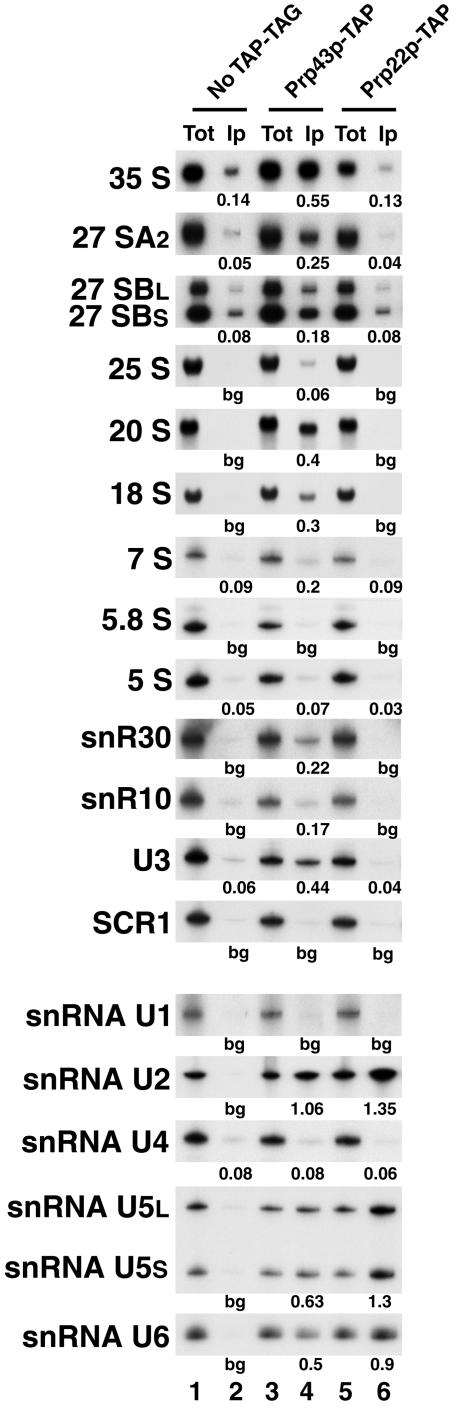
Prp43p is associated with several spliceosomal snRNAs and pre-rRNAs and with mature 18S and 25S rRNAs. Immunoprecipitation experiments were carried out using IgG-Sepharose and total cellular extracts from the parental strain lacking a tagged protein (No TAP-TAG; lanes 1 and 2), or from strains expressing Prp43p-TAP (lanes 3 and 4) or Prp22p-TAP (lanes 5 and 6). RNAs were extracted from the pellets obtained following precipitation (Ip) or from an amount of input extract corresponding to 1/150 of that used for the precipitation (Tot) and analyzed by the Northern blot technique or the primer-extension procedure (to detect 35S, 27SA2, and 27SB pre-rRNAs). cDNA products obtained by primer extensions were separated on a 6% sequencing gel, and RNAs were separated and detected as described in the legend of Fig. 1B. Signal intensities were measured by phosphorimager scanning to derive the percentage of input RNAs precipitated (indicated below each Ip lane). bg, background value.
FIG. 3.
FIG. 3.
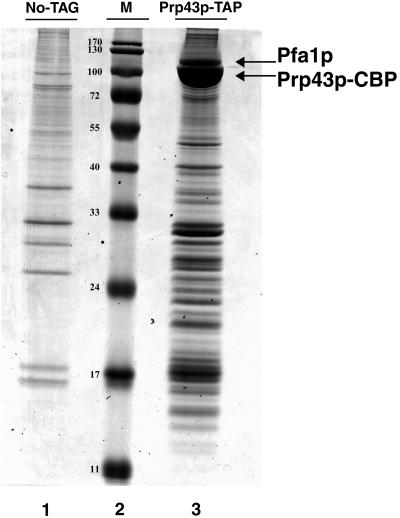
Tandem affinity purification of Prp43p-TAP. Total extracts from strains expressing Prp43p-TAP (lane 3) or devoid of tagged protein (lane 1) were subjected to the tandem affinity purification procedure. Polypeptides eluted from the calmodulin columns following EGTA addition were resolved by SDS-PAGE and stained with Coomassie blue. Stained proteins were excised, digested by trypsin, and identified by coupling liquid chromatography and mass spectrometry. Lane 2: molecular mass markers (in kilodaltons).
FIG. 4.
FIG. 4.
Prp43p is associated with Pfa1p and with the RNA polymerase I machinery. Total extracts from cells expressing Pfa1p-TAP (lanes 1 and 2), Net1p-TAP (lanes 3 and 4), or Rpa190p-TAP (lanes 5 and 6) or devoid of tagged protein (lanes 7 and 8) were subjected to the tandem affinity purification procedure. In the case of the Pfa1p-TAP purification, 1/40th of the second fraction eluted from the calmodulin column was loaded in the immunoprecipitation (Ip) lane while in the case of the Net1p-TAP, Rpa190p-TAP, and control (No TAP-TAG) purifications, fractions eluted from the calmodulin column were pooled and all proteins present were precipitated using trichloroacetic acid and loaded in the Ip lanes. Tot: aliquot of the input extract. Proteins were subjected to SDS-PAGE, transferred to a cellulose membrane, and detected by enhanced chemiluminescence using affinity-purified anti-Prp43p polyclonal antibodies.
FIG. 5.
FIG. 5.
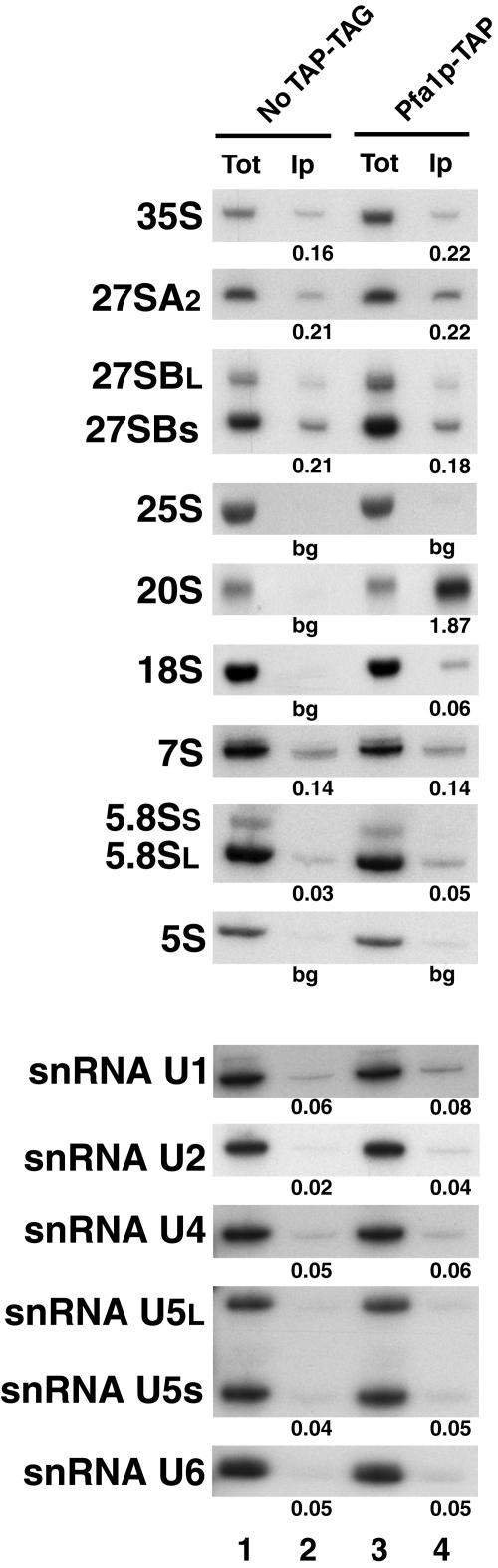
Pfa1p is associated with 20S pre-rRNA and 18S rRNA. Immunoprecipitations (Ip) were carried out from total extracts of cells expressing Pfa1p-TAP (lanes 3 and 4) or devoid of tagged protein (lanes 1 and 2). Immunoprecipitations and analysis of precipitated RNAs were performed as described in the legend of Fig. 2.
FIG. 6.
FIG. 6.
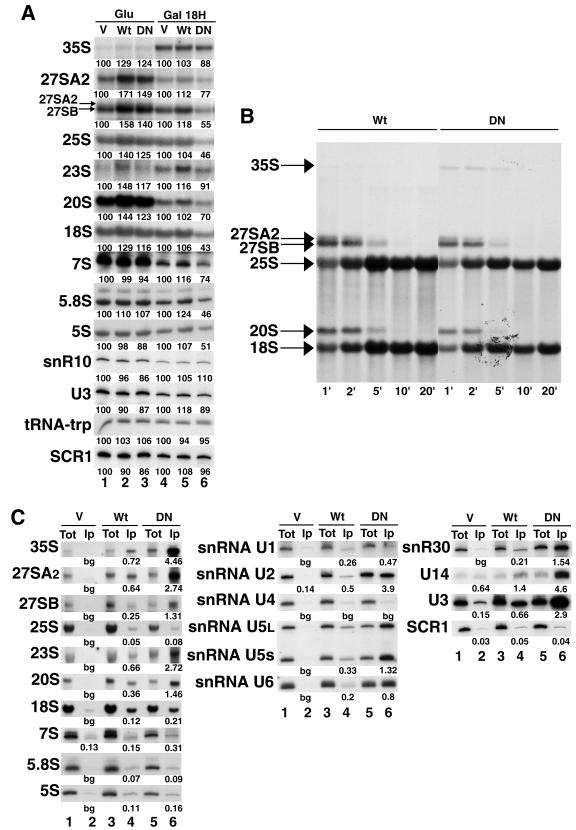
Phenotype induced by overexpression of Prp43pR430A. (A) Northern analysis. A wild-type yeast strain was transformed with a centromeric vector lacking an insert (V) or containing either the wild-type PRP43 gene (Wt) or a mutated prp43 allele encoding Prp43pR430A (DN) positioned downstream of the GAL1-10-CYC1 promoter and upstream of the ZZ gene cassette encoding two IgG-binding domains derived from S. aureus protein A. The transformed strains were grown in glucose-containing medium, washed, and incubated for 18 h in galactose-containing medium. Samples from cultures growing in glucose (lanes 1 to 3) or in galactose (lanes 4 to 6) corresponding to the same number of cells were collected. Total RNAs were extracted from these samples and analyzed by the Northern blot technique as described in the legend of Fig. 1. Signal intensities were measured by phosphorimager scanning. Values (indicated below each lane) are expressed as percentages of the intensities obtained in the case of V strains grown in glucose- or galactose-containing media. (B) Pulse-chase analysis. Strains transformed with the plasmid containing the wild-type PRP43 gene (Wt) or the mutated prp43 allele encoding Prp43pR430A (DN) were grown in glucose-containing medium and transferred for 24 h to a galactose-containing medium. Cells were pulse labeled with 540 μCi [3H]methylmethionine for 3 min. An excess of cold methionine was then added, and cell samples were collected at the indicated times after cold methionine addition. Total RNAs extracted from these samples were separated on a 1% agarose denaturing gel. Separated RNAs were transferred to a nylon membrane and labeled RNAs were detected by fluorography. (C) Immunoprecipitations. The V strains (lanes 1 and 2), Wt strains (lanes 3 and 4), or DN strains (lanes 5 and 6) (see above) were grown in glucose-containing medium, washed, and incubated for 24 h in galactose-containing medium. Immunoprecipitations were performed with extracts from the cultures grown in galactose as described in the legend of Fig. 2.

References

    1. Arenas, J. E., and J. N. Abelson. 1997. Prp43: An RNA helicase-like factor involved in spliceosome disassembly. Proc. Natl. Acad. Sci. USA 94:11798-11802. - PMC - PubMed
    1. Bassler, J., P. Grandi, O. Gadal, T. Lessmann, E. Petfalski, D. Tollervey, J. Lechner, and E. Hurt. 2001. Identification of a 60S preribosomal particle that is closely linked to nuclear export. Mol. Cell 8:517-529. - PubMed
    1. Becam, A. M., F. Nasr, W. J. Racki, M. Zagulski, and C. J. Herbert. 2001. Ria1p (Ynl163c), a protein similar to elongation factors 2, is involved in the biogenesis of the 60S subunit of the ribosome in Saccharomyces cerevisiae. Mol. Genet. Genom. 266:454-462. - PubMed
    1. Bond, A. T., D. A. Mangus, F. He, and A. Jacobson. 2001. Absence of Dbp2p alters both nonsense-mediated mRNA decay and rRNA processing. Mol. Cell. Biol. 21:7366-7379. - PMC - PubMed
    1. Bonneaud, N., O. Ozier-Kalogeropoulos, G. Y. Li, M. Labouesse, L. Minvielle-Sebastia, and F. Lacroute. 1991. A family of low and high copy replicative, integrative and single-stranded S. cerevisiae/E. coli shuttle vectors. Yeast 7:609-615. - PubMed

Publication types

MeSH terms