


Review
doi: 10.1165/rcmb.F307.
One hundred years of research in the pathogenesis of pulmonary hypertension
Affiliations
- PMID: 16234331
- PMCID: PMC2715349
- DOI: 10.1165/rcmb.F307
Item in Clipboard
Review
One hundred years of research in the pathogenesis of pulmonary hypertension
Am J Respir Cell Mol Biol.
2005 Nov.
No abstract available
Figures
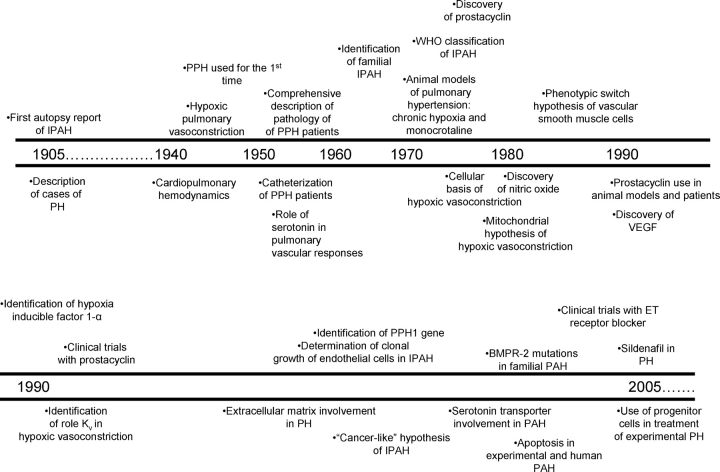
Timeline of significant achievements in the last 100 years of pulmonary hypertension research.
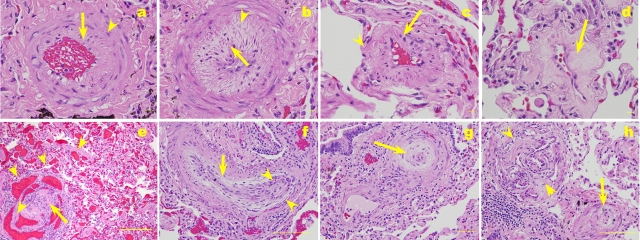
Pulmonary vascular remodeling in a lung of a patient with IPAH. (a) Pulmonary artery with medial hypertrophy (arrowhead), with intima thickening by longitudinally oriented smooth muscle cells (arrow). (b) Pulmonary artery with marked medial and intima thickening, with crenated internal elastic layer (dark arrow), suggestive of vasoconstriction. (c) Peripheral muscularization of a small precapillary pulmonary artery (arrowhead), also showing intima thickening. (d) Peripheral pulmonary artery with collagenous intima thickening (arrow). (e) Plexiform lesion (arrow) surrounded by markedly vascular dilation compromising both vessels draining the lesion and in alveolar capillaries (arrowheads). (f) Longitudinal section of a pulmonary artery with a concentric arrangement of elongated smooth muscle cell–like cells (arrow) and a plexiform lesion (flanked by arrowheads). (g) Concentric lesion cross-sectioned (arrow). (h) Plexiform lesion (arrowheads) and an adjoining pulmonary artery with marked intima thickening leading to reduction of vascular lumen (bar = 20 μm in a–d and g; 200 μm in e, f, and h).
References
-
- Simonneau G, Galie N, Rubin LJ, Langleben D, Seeger W, Domenighetti G, Gibbs S, Lebrec D, Speich R, Beghetti M. Clinical classification of pulmonary hypertension. J Am Coll Cardiol 2004;43:S5–S12. - PubMed
-
- Fishman AP. A century of primary pulmonary hypertension. In: Rubin LJ, Rich S, editors. Primary pulmonary hypertension, 1st ed. New York: Marcel Decker; 1997. pp. 1–17.
-
- Arrilaga FC. Sclerose de l'artere pulmonaire a certains etats pulmonaries chroniques. Archives Maladie Coeur 1913;6:518–529.
-
- Gilmour JR, Evans W. Primary pulmonary hypertension. J Pathol Bacteriol 1946;58:687–697. - PubMed
-
- Zhu L, Wigle D, Hinek A, Kobayashi J, Ye C, Zuker M, Dodo H, Keeley FW, Rabinovitch M. The endogenous vascular elastase that governs development and progression of monocrotaline-induced pulmonary hypertension in rats is a novel enzyme related to the serine proteinase adipsin. J Clin Invest 1994;94:1163–1171. - PMC - PubMed
Publication types
MeSH terms
Grants and funding
LinkOut - more resources
Full Text Sources
Other Literature Sources
Medical
