Advantage of three dimensional animated teaching over traditional surgical videos for teaching ophthalmic surgery: a randomised study
- PMID: 16234460
- PMCID: PMC1772942
- DOI: 10.1136/bjo.2005.075077
Advantage of three dimensional animated teaching over traditional surgical videos for teaching ophthalmic surgery: a randomised study
Abstract
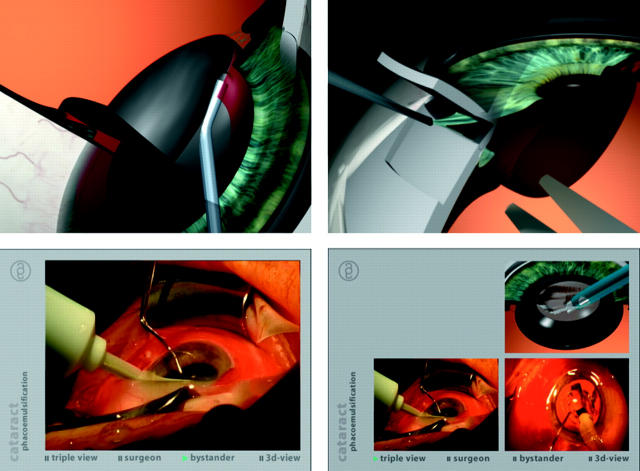
Background/aim: Owing to the complex topographical aspects of ophthalmic surgery, teaching with conventional surgical videos has led to a poor understanding among medical students. A novel multimedia three dimensional (3D) computer animated program, called "Ophthalmic Operation Vienna" has been developed, where surgical videos are accompanied by 3D animated sequences of all surgical steps for five operations. The aim of the study was to assess the effect of 3D animations on the understanding of cataract and glaucoma surgery among medical students.
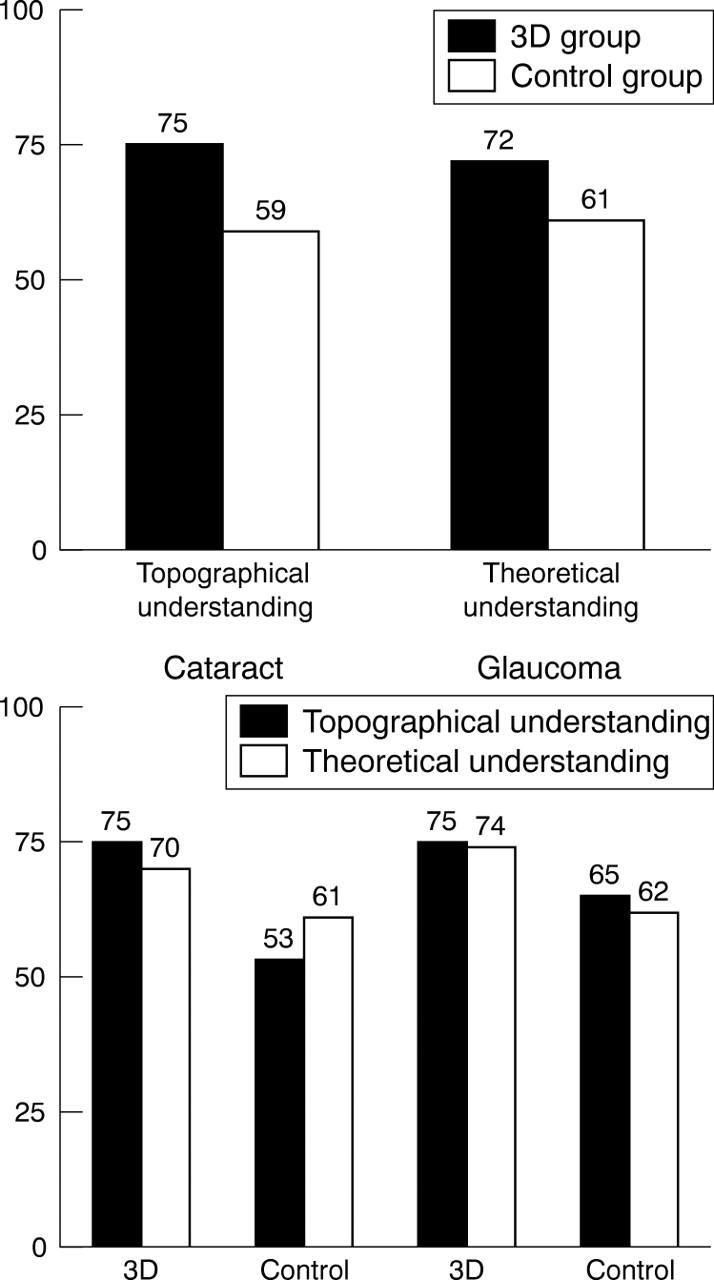
Method: Set in the Medical University of Vienna, Department of Ophthalmology, 172 students were randomised into two groups: a 3D group (n=90), that saw the 3D animations and video sequences, and a control group (n=82), that saw only the surgical videos. The narrated text was identical for both groups. After the presentation, students were questioned and tested using multiple choice questions.
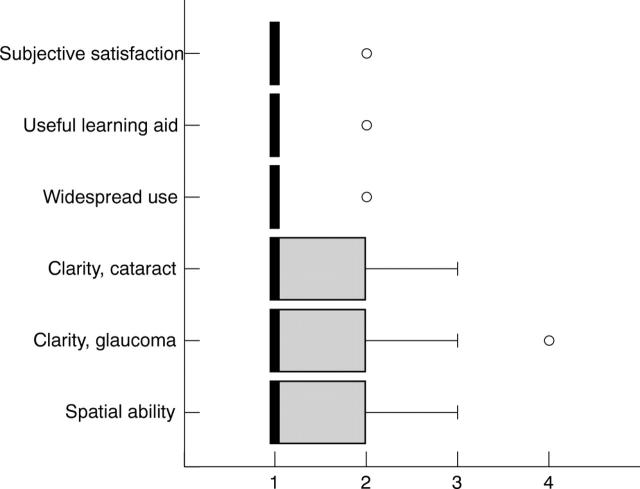
Results: Students in the 3D group found the interactive multimedia teaching methods to be a valuable supplement to the conventional surgical videos. The 3D group outperformed the control group not only in topographical understanding by 16% (p<0.0001), but also in theoretical understanding by 7% (p<0.003). Women in the 3D group gained most by 19% over the control group (p<0.0001).
Conclusions: The use of 3D animations lead to a better understanding of difficult surgical topics among medical students, especially for female users. Gender related benefits of using multimedia should be further explored.
Figures
References
-
- Mehrabi A, Gluckstein C, Benner A, et al. A new way for surgical education-development and evaluation of a computer-based training module. Computers in Biology and Medicine 2000;30:97–109. - PubMed
-
- Giezendanner FD. Nouvelles technologies E’ducatives multimedia au service de nouvelles strategies pedagogiques. Schweizerische medizinische Wochenschrift 1990;120:1843–57. - PubMed
-
- Glittenberg CG, Binder S. Computer-assisted 3D design software for teaching neuro-ophthalmology of the oculomotor system and training new retinal surgery techniques. Proc SPIE 2004;5314:275–85.
-
- Sandroni C, Bocci M, Damiani F, et al. O-2 Multimedia teaching of BLS in medical students. Resuscitation 1996;31:S2.
-
- Garg AX, Norman G, Sperotable L. How medical students learn spatial anatomy. Lancet 2001;357:363–4. - PubMed
Publication types
MeSH terms
LinkOut - more resources
Full Text Sources