


Hepatitis C virus infection in former commercial plasma/blood donors in rural Shanxi Province, China: the China Integrated Programs for Research on AIDS
- PMID: 16235166
- PMCID: PMC2730763
- DOI: 10.1086/497148
Hepatitis C virus infection in former commercial plasma/blood donors in rural Shanxi Province, China: the China Integrated Programs for Research on AIDS
Abstract
Background: Unsafe practices during illegal plasma donation in the late 1980s and early 1990s spread bloodborne infections in central China.
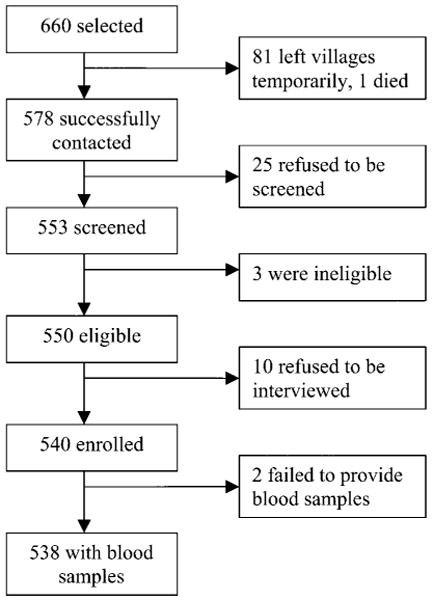
Methods: A cross-sectional survey of a random sample of 538 adult residents of 12 villages in rural Shanxi Province, where there had been an illegal commercial plasma-collection center, was conducted in 2003. Structured questionnaires were administered, and blood samples were tested for hepatitis C virus (HCV) antibodies.
Results: HCV seroprevalence rates were 8.2% in all subjects, 27.7% in former commercial plasma/blood donors, and 2.6% in nondonors. Selling blood or plasma was the strongest independent predictor of HCV seropositivity (odds ratio [OR], 14.4 [95% confidence interval {CI}, 7.1-31.6]). A history of blood transfusion was also independently associated with HCV seropositivity (OR, 8.3 [95% CI, 2.1-32.0]). Plasma donors had a higher risk of being HCV seropositive than did whole-blood donors (OR, 7.6 [95% CI, 2.9-20.9]), and female donors had a lower risk than did male donors (OR, 0.32 [95% CI, 0.12-0.80]). The strength of the association between selling blood and HCV seropositivity was weaker when plasma donors were excluded (OR, 8.0 vs. 14.4).
Conclusions: Unsafe practices during illegal plasma donation led to a high risk of HCV seropositivity for donors during the 1980s and 1990s. Failure to screen for HCV increased the risk of seropositivity for transfusion recipients during this same period. China has taken steps to halt illegal plasma collection and to improve blood-banking methods. However, there will be an ongoing challenge to care for patients with HCV infection, even as its incidence decreases.
Conflict of interest statement
Potential conflicts of interest: none reported.
Figures
Comment in
-
Plasma collection and donor safety in rural China.J Infect Dis. 2005 Nov 15;192(10):1681-2. doi: 10.1086/497154. Epub 2005 Oct 6. J Infect Dis. 2005. PMID: 16235163 No abstract available.
References
-
- Koff RS, Hepatitis C. In: Infectious diseases. 2nd. Gorbach SL, Bartlett JG, Blacklow NR, editors. Philadelphia: W. B. Saunders; 1998. pp. 864–71.
-
- Liu CB. Epidemic and risk factors of viral hepatitis in general population in China. Zhongguo Gan Bing Za Zhi. 1998;6:67–70.
-
- Garten RJ, Lai S, Zhang J, et al. Rapid transmission of hepatitis C virus among young injecting heroin users in southern China. Int J Epidemiol. 2004;33:182–8. - PubMed
-
- US Centers for Disease Control and Prevention. National Hepatitis C prevention strategy. [1 May 2005]. Available at: http://www.cdc.gov/ncidod/diseases/hepatitis/c/plan/HCV_infection.htm.
Publication types
MeSH terms
Substances
Grants and funding
LinkOut - more resources
Full Text Sources
Medical
