


Atovaquone-proguanil for treating uncomplicated malaria
- PMID: 16235366
- PMCID: PMC6532621
- DOI: 10.1002/14651858.CD004529.pub2
Atovaquone-proguanil for treating uncomplicated malaria
Update in
-
Atovaquone-proguanil for treating uncomplicated Plasmodium falciparum malaria.Cochrane Database Syst Rev. 2021 Jan 15;1(1):CD004529. doi: 10.1002/14651858.CD004529.pub3. Cochrane Database Syst Rev. 2021. PMID: 33459345 Free PMC article.
Abstract
Background: Many conventional treatments for uncomplicated malaria are failing because malaria parasites develop resistance to them. One way to combat this resistance is to treat people with a combination of drugs, such as atovaquone-proguanil.
Objectives: To compare atovaquone-proguanil with other antimalarial drugs (alone or in combination) for treating children and adults with uncomplicated Plasmodium falciparum malaria.
Search strategy: We searched the Cochrane Infectious Diseases Group Specialized Register (June 2005), CENTRAL (The Cochrane Library Issue 2, 2005), MEDLINE (1966 to June 2005), EMBASE (1980 to June 2005), LILACS (1982 to June 2005), reference lists, and conference abstracts. We also contacted relevant pharmaceutical manufacturers and researchers.
Selection criteria: Randomized controlled trials comparing atovaquone-proguanil with other antimalarial drugs for treating children and adults confirmed to have uncomplicated P. falciparum malaria.
Data collection and analysis: Three authors independently assessed trial eligibility and methodological quality, and extracted data for an intention-to-treat analysis (where possible). We used relative risk (RR) and 95% confidence intervals (CI) for dichotomous data. We contacted trial authors for additional information where needed.
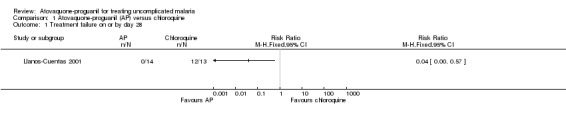
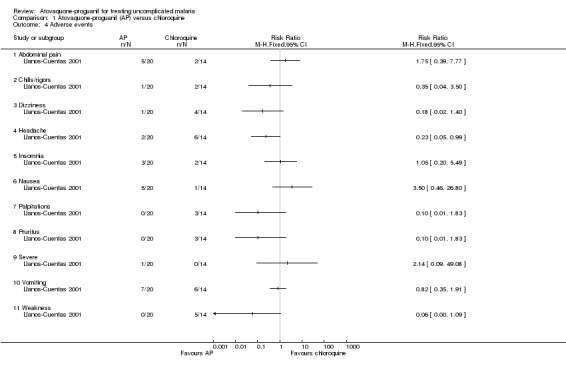
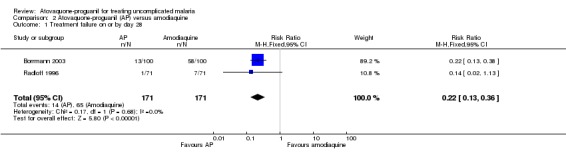
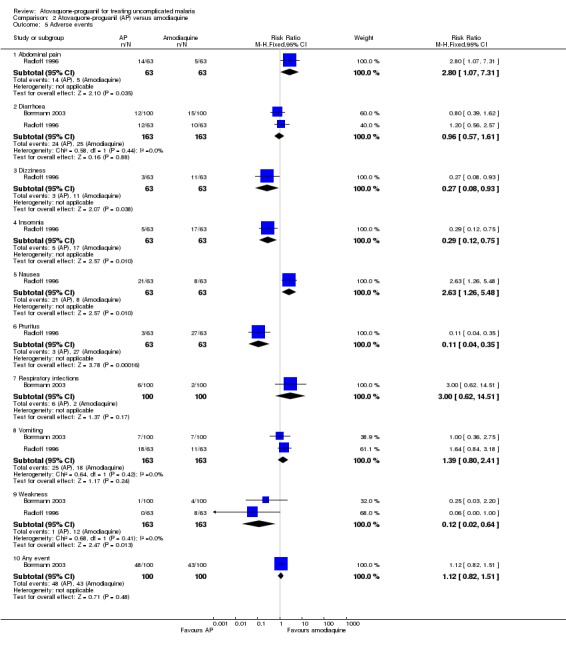
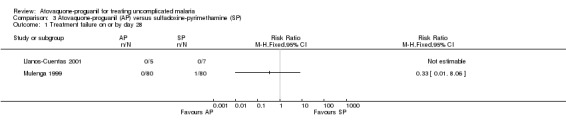
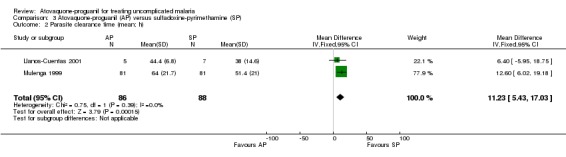
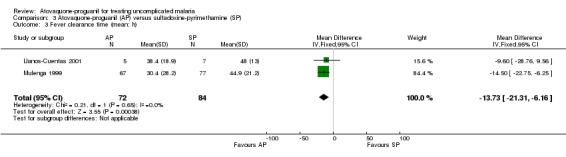
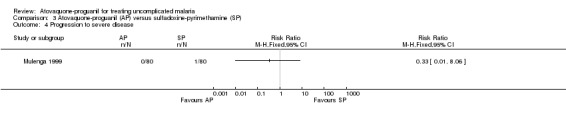
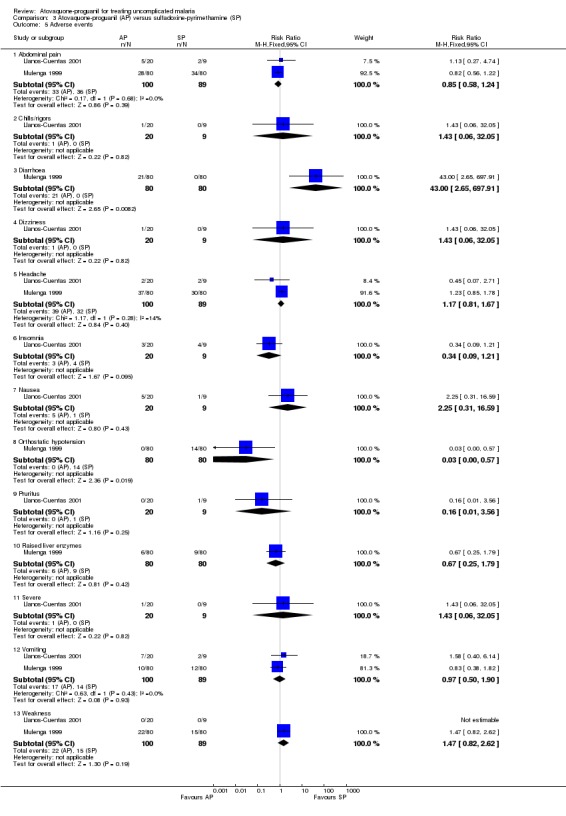
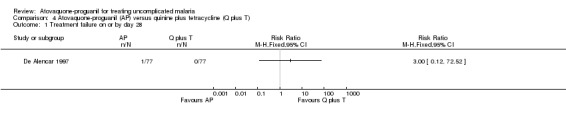
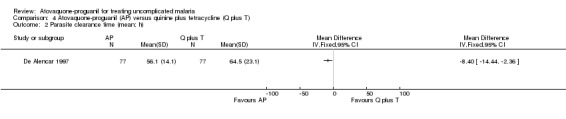
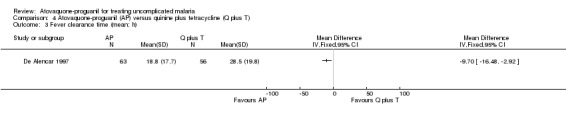
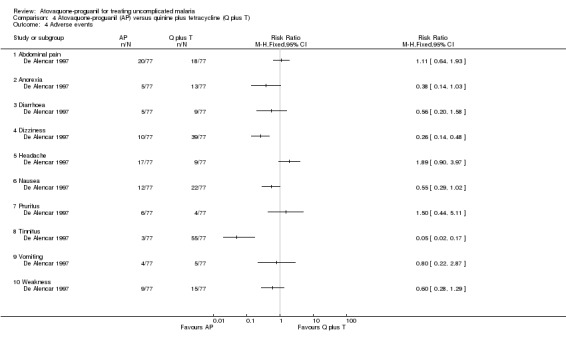
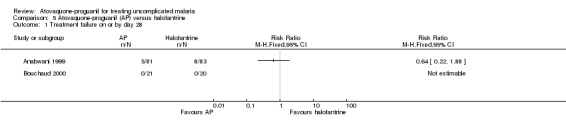
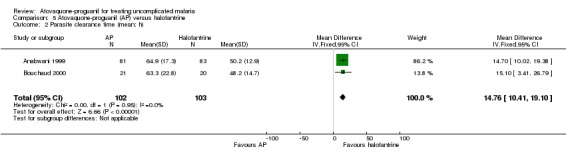
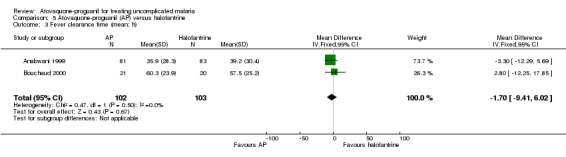
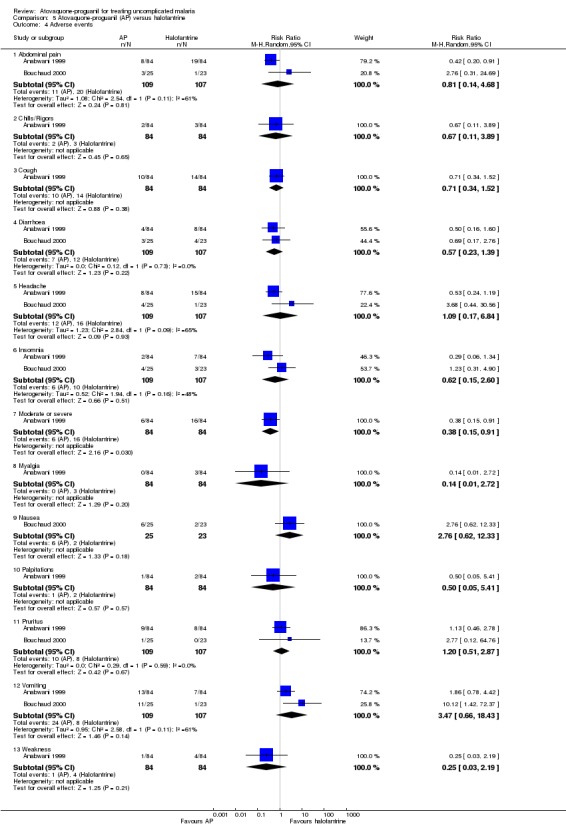
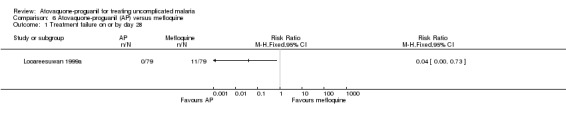
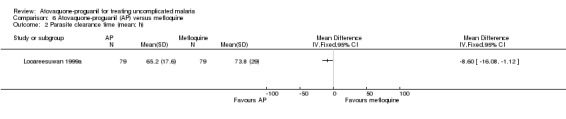
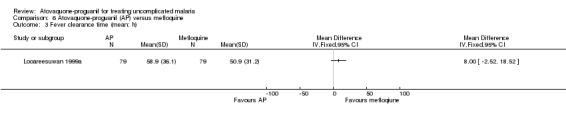
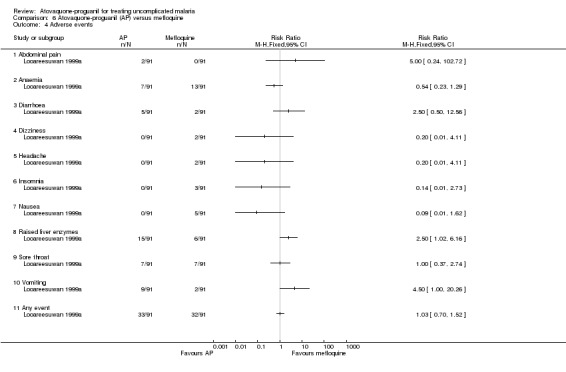
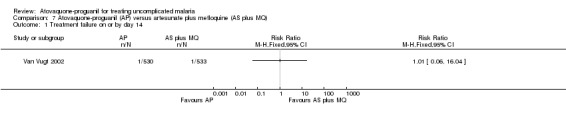
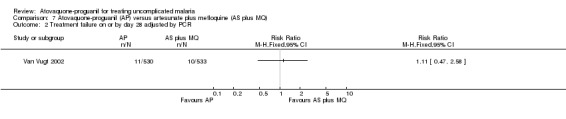
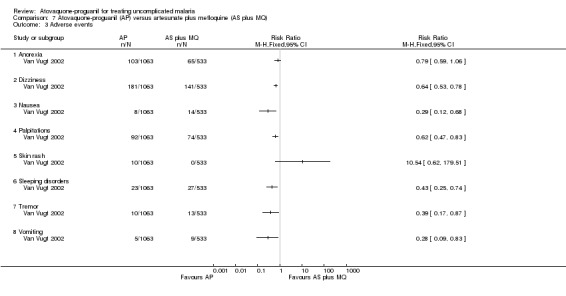
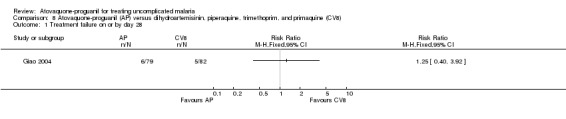
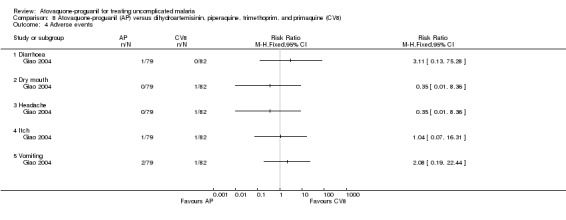
Main results: Ten trials, with a total of 2345 participants, met the inclusion criteria. The trials were conducted in four geographical regions and were often small, but they included comparisons across eight drugs. Nine trials were funded by a pharmaceutical company, only three carried out an intention-to-treat analysis, and allocation concealment was unclear in seven. Atovaquone-proguanil had fewer treatment failures by day 28 than chloroquine (RR 0.04, 95% CI 0.00 to 0.57; 27 participants, 1 trial), amodiaquine (RR 0.22, 95% CI 0.13 to 0.36; 342 participants, 2 trials), and mefloquine (RR 0.04, 95% CI 0.00 to 0.73; 158 participants, 1 trial). There were insufficient data to draw a conclusion for this outcome from comparisons with sulfadoxine-pyrimethamine (172 participants, 2 trials), halofantrine (205 participants, 1 trial), artesunate plus mefloquine (1063 participants, 1 trial), quinine plus tetracycline (154 participants, 1 trial), and dihydroartemisinin-piperaquine-trimethoprim-primaquine (161 participants, 1 trial). Adverse events were mainly common symptoms of malaria and did not differ in frequency between groups.
Authors' conclusions: Data are limited but appear to suggest that atovaquone-proguanil is more effective than chloroquine, amodiaquine, and mefloquine. There are insufficient data for comparisons against sulfadoxine-pyrimethamine, halofantrine, artesunate plus mefloquine, quinine plus tetracycline, and dihydroartemisinin-piperaquine-trimethoprim-primaquine in treating malaria. There are not enough data to assess safety, but a number of adverse events were identified with all drugs. Large trials comparing atovaquone-proguanil with other new combination therapies are needed.
Conflict of interest statement
None known.
Figures
References
References to studies included in this review
Anabwani 1999 {published data only}
-
- Anabwani G, Canfield CJ, Hutchinson DB. Combination atovquone and proguanil hydrochloride vs. halofantrine for treatment of acute Plasmodium falciparum malaria in children. Pediatric Infectious Disease Journal 1999;18(5):456‐61. - PubMed
Borrmann 2003 {published data only}
-
- Borrmann S, Faucher J‐F, Bagaphou T, Missinou MA, Binder RK, Pabisch S, et al. Atovaquone and proguanil versus amodiaquine for the treatment of Plasmodium falciparum malaria in African infants and young children. Clinical Infectious Diseases 2003;37(11):1441‐7. - PubMed
Bouchaud 2000 {published data only}
-
- Bouchaud O, Monlun E, Muanza K, Fontanet A, Scott T, Goetschel A, et al. Atovaquone plus proguanil versus halofantrine for the treatment of imported acute uncomplicated Plasmodium falciparum malaria in non‐immune adults: a randomized comparative trial. American Journal of Tropical Medicine and Hygiene 2000;63(5‐6):274‐9. - PubMed
De Alencar 1997 {published data only}
-
- Alencar FE, Cerutti C Jr, Durlacher RR, Boulos M, Alves FP, Milhous W, et al. Atovaquone and proguanil for the treatment of malaria in Brazil. Journal of Infectious Diseases 1997;175(6):1544‐7. - PubMed
Giao 2004 {published data only}
-
- Giao PT, Vries PJ, Hung le Q, Binh TQ, Nam NV, Kager PA. CV8, a new combination of dihydroartemisinin, piperaquine, trimethoprim and primaquine, compared with atovaquone‐proguanil against falciparum malaria in Vietnam. Tropical Medicine and International Health 2004;9(2):209‐16. - PubMed
Llanos‐Cuentas 2001 {published data only}
-
- Llanos‐Cuentas A, Campos P, Clendenes M, Canfield CJ, Hutchinson DB. Atovaquone and proguanil hydrochloride compared with chloroquine or pyrimethamine/sulfadoxine for treatment of acute Plasmodium falciparum malaria in Peru. Brazilian Journal of Infectious Diseases 2001;5(2):67‐72. - PubMed
Looareesuwan 1999a {published data only}
-
- Looareesuwan S, Wilairatana P, Chalermarut K, Rattanapong Y, Canfield CJ, Hutchinson DB. Efficacy and safety of atovaquone/proguanil compared with mefloquine for treatment of acute Plasmodium falciparum malaria in Thailand. American Journal of Tropical Medicine and Hygiene 1999;60(4):526‐32. - PubMed
Mulenga 1999 {published data only}
-
- Mulenga M, Sukwa TY, Canfield CJ, Hutchinson DB. Atovaquone and proguanil versus pyrimethamine/sulfadoxine for the treatment of acute falciparum malaria in Zambia. Clinical Therapeutics 1999;21(5):841‐52. - PubMed
Radloff 1996 {published data only}
-
- Radloff PD, Philipps J, Nkeyi M, Hutchinson D, Kremsner PG. Atovaquone and proguanil for Plasmodium falciparum malaria. Lancet 1996;347(9014):1511‐4. - PubMed
Van Vugt 2002 {published data only}
-
- Vugt M, Leonardi E, Phaipun L, Slight T, Thway KL, McGready R, et al. Treatment of uncomplicated multidrug‐resistant falciparum malaria with artesunate‐atovaquone‐proguanil. Clinical Infectious Diseases 2002;35(12):1498‐504. - PubMed
References to studies excluded from this review
Bustos 1999 {published data only}
-
- Bustos DG, Canfield CJ, Canete‐Miguel E, Hutchinson DB. Atovaquone‐proguanil compared with chloroquine‐sulfadoxine‐pyrimethamine for treatment of acute Plasmodium falciparum malaria in the Philippines. The Journal of Infectious Diseases 1999;179(6):1587‐90. - PubMed
Additional references
Beerahee 1999
-
- Beerahee M. Clinical pharmacology of atovaquone and proguanil hydrochloride (http://www.malarone.com/hcp/clinical.html). Journal of Travel Medicine 1999; Vol. 6 Suppl 1. - PubMed
Blanchard 1994
-
- Blanchard TJ, Mabey DC, Hunt‐Cooke A, Edwards G, Hutchinson DB, Benjamin S, et al. Multiresistant falciparum malaria cured using atovaquone and proguanil. Transactions of the Royal Society of Tropical Medicine and Hygiene 1994;88(6):693. - PubMed
Bloland 1997
-
- Bloland PB, Kazembe PN, Watkins WM, Doumbo OK, Nwanyanwu OC, Ruebush TK 2nd. Malarone‐donation programme in Africa. Lancet 1997;350(9091):1624‐5. - PubMed
Brockman 1999
-
- Brockman A, Paul RE, Anderson TJ, Hackford I, Phaiphun L, Looareesuwan S, et al. Application of genetic markers to the identification of recrudescent Plasmodium falciparum infections on the northwestern border of Thailand. American Journal of Tropical Medicine and Hygiene 1999;60(1):14‐21. - PubMed
Canfield 1995
-
- Canfield CJ, Pudney M, Gutteridge WE. Interactions of atovaquone with other antimalarial drugs agaist Plasmodium falciparum in vitro. Experimental Parasitology 1995;80(3):373‐81. - PubMed
Dollery 1991
-
- Dollery C, editor. Poguanil hydrochloride. Therapeutic Drugs. 2nd Edition. Vol. 2, New York: Churchill Livingstone, 1991:247‐51.
Foege 1997
-
- Foege WH. Malarone‐donation programme. The Lancet 1997;350:1628‐9. - PubMed
Fry 1992
-
- Fry M, Pudney M. Site of action of the antimalarial hydroxynaphttoquinone, 2‐[trans‐4‐(4'‐chlophenyl) cyclohexyl]‐3‐hydroxy‐1, 4 naphthoquinone (566C80). Biochemical Pharmarmacology 1992;43(7):1545‐53. - PubMed
Higgins 2005
-
- Higgins J, Green S, editors. Highly sensitive search strategies for identifying reports of randomized controlled trials in MEDLINE. Cochrane Handbook for Systematic Reviews of Interventions 4.2.5 [updated May 2005]; Appendix 5b. http://www.cochrane.org/resources/handbook/index.htm (accessed 10 August 2005).
Hogh 2000
-
- Hogh B, Clarke PD, Camus D, Nothdurft HD, Overbosch D, Gunther M, et al. Malarone International Study Team. Atovaquone‐proguanil versus chloroquine‐proguanil for malaria prophylaxis in non‐immune travellers: a randomised, double‐blind study. Lancet 2000;356(9245):1888‐94. - PubMed
Jüni 2001
Kamya 2002
-
- Kamya MR, Bakyaita NN, Talisuna AO, Were WM, Staedke SG. Increasing antimalarial drug resistance in Uganda and revision of the national drug policy. Tropical Medicine and International Health 2002;7(12):1031‐41. - PubMed
Looareesuwan 1996
-
- Looareesuwan S, Viravan C, Webster HK, Kyle DE, Hutchinson DB, Canfield CJ. Clinical studies of atovaquone, alone or in combination with other antimalarial drugs, for treatment of acute uncomplicated malaria in Thailand. American Journal of Tropical Medicine and Hygiene 1996;54(1):62‐6. - PubMed
Looareesuwan 1999b
-
- Looareesuwan S, Chulay JD, Canfield CJ, Hutchinson DB. Malarone (atovaquone and proguanil hydrochloride): a review of its clinical development for treatment of malaria. Malarone Clinical Trials Study Group. American Journal of Tropical Medicine and Hygiene 1999;60(4):533‐41. - PubMed
Ohrt 1997
-
- Ohrt C, Mirabelli‐Primdahl L, Karnasuta C, Chantakulkij S, Kain KC. Distinguishing Plasmodium falciparum treatment failures from reinfections by restriction fragment length polymorphism and polymerase chain reaction genotyping. American Journal of Tropical Medicine and Hygiene 1997;57(4):430‐7. - PubMed
Overbosch 2001
-
- Overbosch D, Schilthuis H, Bienzle U, Behrens RH, Kain KC, Clarke PD, et al. Atovaquone‐proguanil versus mefloquine for malaria prophylaxis in nonimmune travelers: results from a randomized, double‐blind study. Clinical Infectious Diseases 2001;33(7):1015‐21. - PubMed
Oyediran 2002
Partnerships 2002
-
- Initiative on Public‐Private Partnerships for Health. Malarone Donation Program (Historical). www.ippph.org/data/abstract.cfm?id=28 (accessed 16 July 2002).
RBM 2001a
-
- Global Partnership to Roll Back Malaria. The use of antimalarial drugs: report of an WHO informal consultation, 13‐17 November 2000. Geneva: World Health Organization, 2001:17.
RBM 2001b
-
- Global Partnership to Roll Back Malaria. The use of antimalarial drugs: report of an WHO informal consultation, 13‐17 November 2000. Geneva: World Health Organization, 2001:32.
RBM 2005
-
- Global Partnership to Roll Back Malaria. World malaria report: 2005. Geneva: World Health Organization, 2005.
Review Manager 5 [Computer program]
-
- The Nordic Cochrane Centre, The Cochrane Collaboration. Review Manager (RevMan). Version 5.0. Copenhagen: The Nordic Cochrane Centre, The Cochrane Collaboration, 2008.
Ringwald 1998
-
- Ringwald P, Basco LK. Malarone‐donation programme in Africa. Lancet 1998;351(9103):673‐4. - PubMed
Sabchareon 1998
-
- Sabchareon A, Attanath P, Phanuaksook P, Chanthavanich P, Poonpanich Y, Mookmanee D, et al. Efficacy and pharmacokinetics of atovaquone and proguanil in children with multidrug‐resistant Plasmodium falciparum malaria. Transactions of the Royal Society of Tropical Medicine and Hygiene 1998;92(2):201‐6. - PubMed
Shretta 2000
-
- Shretta R, Brugha R, Robb A, Snow RW. Sustainability, affordability, and equity of corporate drug donations: the case of Malarone. Lancet 2000;355(9216):1718‐20. - PubMed
Shretta 2001
-
- Shretta R, Walt G, Brugha R, Snow RW. A political analysis of corporate drug donations: the example of Malarone in Kenya. Health Policy and Planning 2001;16(2):161‐70. - PubMed
Stepniewska 2004
Sukwa 1999
-
- Sukwa TY, Mulenga M, Chisdaka N, Roskell NS, Scott TR. A randomised, double‐blind, placebo‐controlled field trial to determine the efficacy and safety of Malarone (atovaquone/proguanil) for prophylaxis of malaria in Zambia. American Journal of Tropical Medicine and Hygiene 1999;60(4):521‐5. - PubMed
WHO 1999
WHO 2000
-
- World Health Organization. Severe falciparum malaria. Transactions of the Royal Society of Tropical Medicine and Hygiene 2000;94(1):1‐10. - PubMed
WHO 2001
-
- World Health Organization. Training manual for management of malaria at district level, facilitator's guide. Harare: World Health Organization (Regional Office for Africa), 2001:4‐6.
WHO 2003
-
- World Health Organization. Malaria Control Unit. The Africa malaria report 2003. Geneva: World Health Organization, 2003:19.
Publication types
MeSH terms
Substances
LinkOut - more resources
Full Text Sources
Miscellaneous
