


Artesunate plus mefloquine versus mefloquine for treating uncomplicated malaria
- PMID: 16235367
- PMCID: PMC6532646
- DOI: 10.1002/14651858.CD004531.pub2
Artesunate plus mefloquine versus mefloquine for treating uncomplicated malaria
Abstract
Background: Multiple-drug-resistant malaria is widespread, and in South-East Asia resistance is high against nearly all single therapy antimalarial drugs. Here, and in other areas with low malaria transmission, the combination of artesunate and mefloquine may provide an effective alternative.
Objectives: To compare artesunate plus mefloquine with mefloquine alone for treating uncomplicated Plasmodium falciparum malaria.
Search strategy: We searched the Cochrane Infectious Diseases Group Specialized Register (May 2005), CENTRAL (The Cochrane Library Issue 2, 2005), MEDLINE (1966 to May 2005), EMBASE (1988 to May 2005), LILACS (May 2005), BIOSIS (1985 to June 2005), conference proceedings, and reference lists. We also contacted researchers, organizations, and pharmaceutical companies.
Selection criteria: Randomized and quasi-randomized controlled trials comparing artesunate plus mefloquine with mefloquine alone for treating uncomplicated malaria.
Data collection and analysis: Two authors independently applied the inclusion criteria, extracted data, and assessed methodological quality. The primary outcome was treatment failure by day 28, defined as evidence of parasitaemia with or without clinical failure between days zero (start of treatment) and 28. For dichotomous data we calculated relative risks (RR) and 95% confidence intervals (CI).
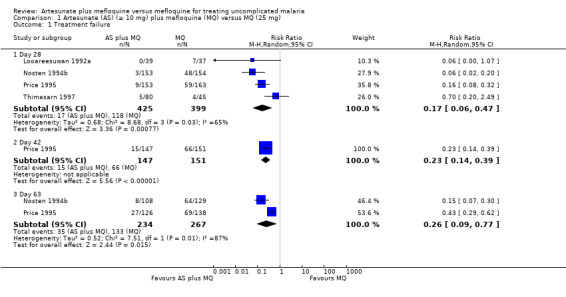
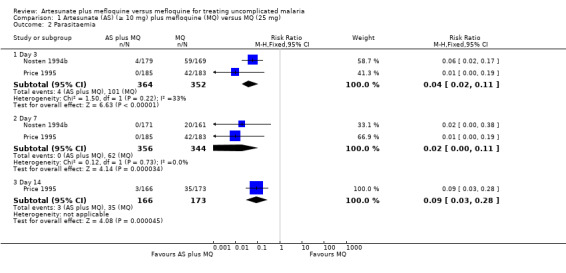
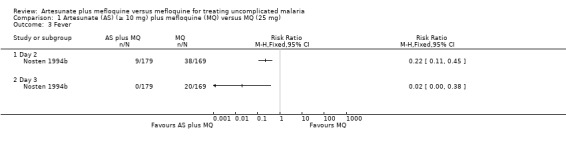
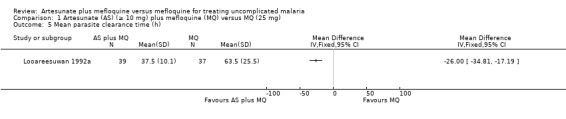
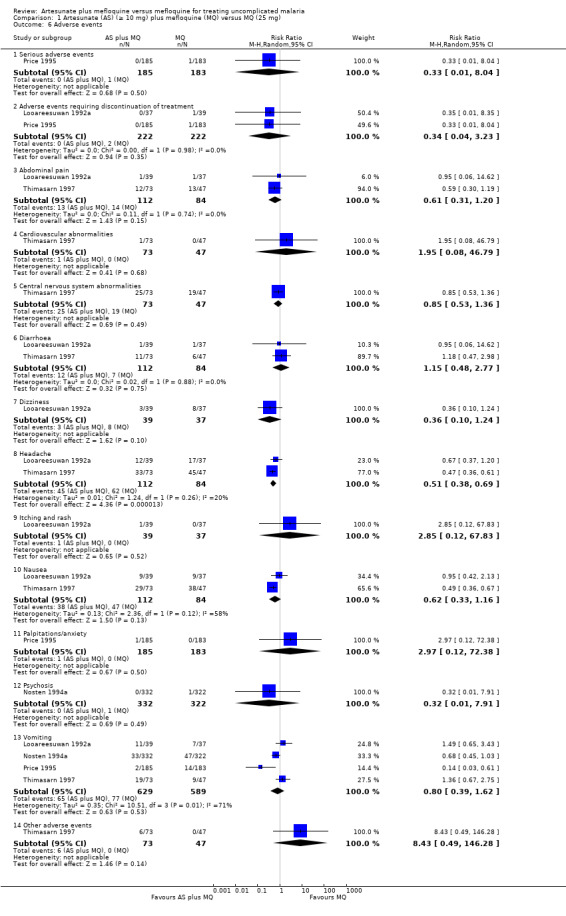
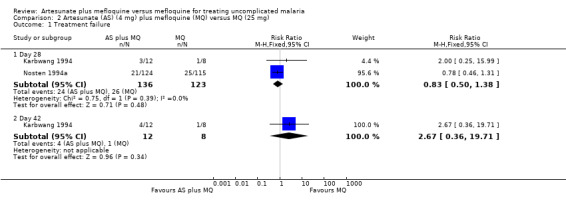
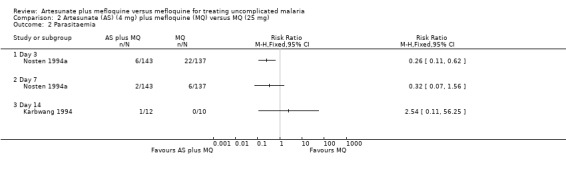
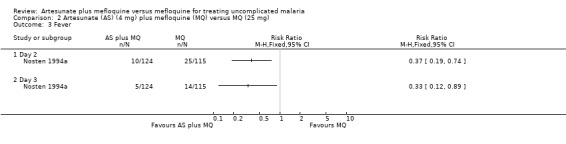
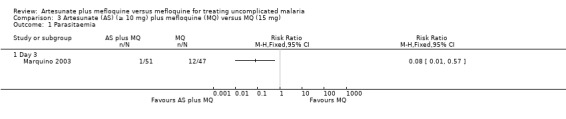
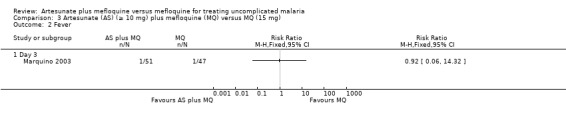
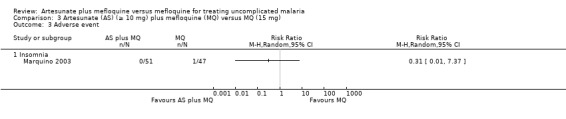
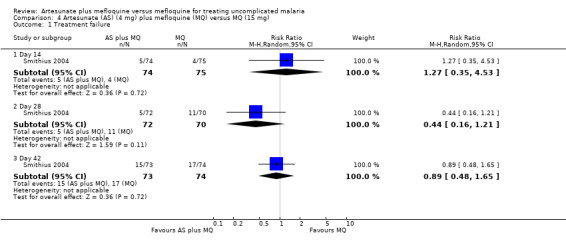
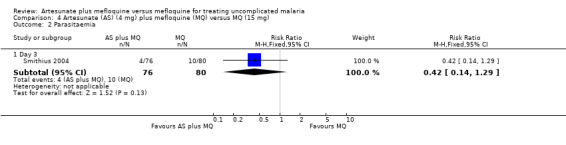
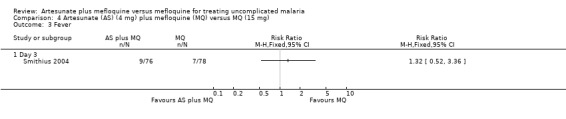
Main results: Eight trials involving 1996 participants met the inclusion criteria. All were conducted in areas with low malaria transmission, seven in South-East Asia and one in the Peruvian Amazon. The doses and dosing regimens of artesunate and mefloquine varied across trials. The trials using a total dose of 25 mg/kg mefloquine and 10 mg artesunate reported fewer treatment failures with the combination at all time points: day 28 (RR 0.17, 95% CI 0.06 to 0.47; 824 participants, 4 trials), day 42 (RR 0.23, 95% CI 0.14 to 0.39; 298 participants, 1 trial), and day 63 (RR 0.26, 95% CI 0.09 to 0.77; 501 participants, 2 trials). The results for parasitaemia showed a similar trend. Trials using a lower dose of artesunate tended to favour the artesunate plus mefloquine combination. Overall, adverse events were similar across treatment arms.
Authors' conclusions: Artesunate plus mefloquine performs better than mefloquine alone for treating uncomplicated falciparum malaria in areas with low malaria transmission. A total dose of 25 mg/kg mefloquine and at least 10 mg artesunate leads to higher cure rates. Better reporting of methods and standardisation of outcomes would help the interpretation of future trials.
Conflict of interest statement
None known.
Figures
Update of
References
References to studies included in this review
Karbwang 1994 {published data only}
Looareesuwan 1992a {published data only}
-
- Looareesuwan S, Viravan C, Vanijanonta S, Wilairatana P, Suntharasamai P, Charoenlarp P, et al. Randomised trial of artesunate and mefloquine alone and in sequence for acute uncomplicated falciparum malaria. Lancet 1992;339(8797):821‐4. - PubMed
Marquino 2003 {published data only}
-
- Marquino W, Huilca M, Calampa C, Falconi E, Cabezas C, Naupay R, et al. Efficacy of mefloquine and mefloquine‐artesunate combination therapy for the treatment of uncomplicated Plasmodium falciparum malaria in the Amazon Basin of Peru. American Journal of Tropical Medicine and Hygiene 2003;68(5):608‐12. - PubMed
-
- Pillai DR, Hijar G, Montoya Y, Marouino W, Ruebush TK 2nd, Wongsrichanalai C, et al. Lack of prediction of mefloquine and mefloquine‐artesunate treatment outcome by mutations in the Plasmodium falciparum multidrug resistance 1 (pfmdr1) gene for P. falciparum malaria in Peru. American Journal of Tropical Medicine and Hygiene 2003;68(1):107‐10. - PubMed
Nosten 1994a {published data only}
-
- Nosten F, Luxemburger C, ter Kuile FO, Woodrow C, Pah Eh J, Chongsuphajaisiddhi T, et al. Treatment of multidrug‐resistant Plasmodium falciparum malaria with 3‐day artesunate‐mefloquine combination. Journal of Infectious Diseases 1994;170(4):971‐7. - PubMed
Nosten 1994b {published data only}
-
- Nosten F, Luxemburger C, ter Kuile FO, Woodrow C, Pah Eh J, Chongsuphajaisiddhi T, et al. Treatment of multidrug‐resistant Plasmodium falciparum malaria with 3‐day artesunate‐mefloquine combination. Journal of Infectious Diseases 1994;170(4):971‐7. - PubMed
Price 1995 {published data only}
-
- Price RN, Nosten F, Luxemburger C, Kham A, Brockman A, Chongsuphajaisiddhi T, et al. Artesunate versus artemether in combination with mefloquine for the treatment of multidrug‐resistant falciparum malaria. Transactions of the Royal Society of Tropical Medicine and Hygiene 1995;89(5):523‐7. - PubMed
Smithius 2004 {published data only}
-
- Smithuis F, Shahmanesh M, Kyaw MK, Savran O, Lwin S, White NJ. Comparison of chloroquine, sulfadoxine/pyrimethamine, mefloquine and mefloquine‐artesunate for the treatment of falciparum malaria in Kachin State, North Myanmar. Tropical Medicine and International Health 2004;9(11):1184‐90. - PubMed
Thimasarn 1997 {published data only}
-
- Thimasarn K, Sirichaisinthop J, Chanyakhun P, Palananth C, Rooney W. A comparative study of artesunate and artemether in combination with mefloquine on multidrug resistant falciparum malaria in Eastern Thailand. SouthEast Asian Journal of Tropical Medicine and Public Health 1997;28(3):465‐71. - PubMed
References to studies excluded from this review
Adam 2005 {published data only}
-
- Adam I, A‐Elbasit IE, Elbashir MI. Efficacies of mefloquine alone and of artesunate followed by mefloquine, for the treatment of uncomplicated, Plasmodium falciparum malaria in eastern Sudan. Annals of Tropical Medicine and Parasitology 2005;99(2):111‐7. - PubMed
Cardoso 1996 {published data only}
-
- Cardoso Bda S, Dourado HV, Pinheiro Mda C, Crescente JA, Amoras WW, Baena J, et al. An efficacy and tolerance study of oral artesunate alone and in combination with mefloquine in the treatment of umcomplicated falciparum malaria in an endemic area of Para, Brazil [Estudo da eficacia e tolerancia do artesunato oral isolado e em associacao com mefloquina, no tratamanto da malaria falciparum nao complicada em area endemica do Para, Brasil]. Revista da Sociedade Brasileira de Medicina Tropical 1996;29(3):251‐7. - PubMed
Looareesuwan 1993 {published data only}
-
- Looareesuwan S, Vanijanonta S, Viravan C, Wilairatana P, Charoenlarp P, Andrial M. Randomized trial of mefloquine alone and artesunate followed by mefloquine for the treatment of acute uncomplicated falciparum malaria. Annals of Tropical Medicine and Parasitology 1994;88(2):131‐6. - PubMed
Luxemburger 1991 {published data only}
-
- Luxemburger C, ter Kuile FO, Nosten F, Dolan G, Bradol JH, Phaipun L, et al. Single day mefloquine‐artesunate combination in the treatment of multi‐drug resistant falciparum malaria. Transactions of the Royal Society of Tropical Medicine and Hygiene 1994;88(2):213‐7. - PubMed
Price 1998 {published data only}
-
- Price R, Luxemburger C, Vugt M, Nosten F, Kham A, Simpson J, et al. Artesunate and mefloquine in the treatment of uncomplicated multidrug‐resistant hyperparasitaemic falciparum malaria. Transactions of the Royal Society of Tropical Medicine and Hygiene 1998;92(2):207‐11. - PubMed
Additional references
Angus 2001
-
- Angus BJ, Thaiaporn I, Chanthapadith K Suputtamongkol Y, White NJ. Oral artesunate dose‐response relationship in acute falciparum malaria. Journal of the Medical Association of Thailand 2001;84(9):1289‐99.
Bethell 1997
-
- Bethell DB, Teja‐Isavadharm P, Cao XT, Pham TT, Ta TT, Tran TN, et al. Pharmacokinetics of oral artesunate in children with moderately severe Plasmodium falciparum malaria. Transactions of the Royal Society of Tropical Medicine and Hygiene 1997;91(2):195‐8. - PubMed
Brewer 1994
-
- Brewer GT, Peggins OJ, Grate JS, Petras JM, Levine BS, Weina PJ, et al. Neurotoxicity in animals due to arteether and artemether. Transactions of the Royal Society of Tropical Medicine and Hygiene 1994;88 Suppl 1:33‐6. - PubMed
Gilles 2000
-
- Gilles HM. Management of severe malaria: a practical handbook. 2nd Edition. Geneva: World Health Organization, 2000.
Higgins 2005
-
- Higgins J, Green S, editors. Highly sensitive search strategies for identifying reports of randomized controlled trials in MEDLINE. Cochrane Handbook for Systematic Reviews of Interventions [updated March 2005]; Appendix 5b. www.cochrane.org/resources/handbook/hbook.htm (accessed 18 April 2005).
Hoshen 2000
-
- Hoshen MB, Na‐Bangchang K, Stein WD, Ginsburg H. Mathematical modelling of the chemotherapy of Plasmodium falciparum malaria with artesunate: Postulation of "dormancy" a partial cystostatic effect of the drug, and its implication of treatment regimens. Parasitology 2000;121(3):237‐46. - PubMed
Jüni 2001
Kain 1995
-
- Kain KC. Chemotherapy and prevention of drug‐resistant malaria. Wilderness & Environmental Medicine 1995;6(3):307‐24. - PubMed
Looareesuwan 1992b
-
- Looareesuwan S, Harinasuta T, Chongsuphajaisiddhi T. Drug resistant malaria, with special reference to Thailand. Southeast Asian Journal of Tropical Medicine and Public Health 1992;23(4):621‐34. - PubMed
Looareesuwan 1998
-
- Looareesuwan S, Wilairatana P, Chokejindachai W, Viriyavejakul P, Krudsood S, Singhasivanon P. Research on new antimalarial drugs and the use of drugs in combination at the Bangkok Hospital for Tropical Diseases. Southeast Asian Journal of Tropical Medicine and Public Health 1998;29(2):344‐54. - PubMed
McIntosh 1999
McIntosh 2000
Olliaro 1996
-
- Olliaro O, Cattani J, Wirth D. Malaria, the submerged disease. JAMA 1996;275(3):230‐3. - PubMed
Price 1996
-
- Price RN, Nosten F, Luxemburger C, ter Kuile FO, Paiphun L, Chongsuphajaisiddhi T, et al. Effects of artemisinin derivatives on malaria transmissibility. Lancet 1996;347(9016):1654‐8. - PubMed
RBM 2001a
-
- Global Partnership to Roll Back Malaria. Combination therapy with antimalarial drugs. Antimalarial drug combination therapy: report of a WHO technical consultation, 4‐5 April 2001. Geneva: World Health Organization, 2001:7‐8.
RBM 2001b
-
- Global Partnership to Roll Back Malaria. 2.2 Rationale for the use of combination therapy & 2.3 Artemisinin‐based combination therapy. The use of antimalarial drugs: report of a WHO informal consultation, 13‐17 November 2000. Geneva: World Health Organization, 2001:17‐9.
RBM 2001c
-
- Global Partnership to Roll Back Malaria. Artemisinin‐based combinations. The use of antimalarial drugs: Report of a WHO informal consultation, 13‐17 November 2000. Geneva: World Health Organization, 2001:12‐5.
Review Manager 5 [Computer program]
-
- The Nordic Cochrane Centre, The Cochrane Collaboration. Review Manager (RevMan). Version 5. Copenhagen: The Nordic Cochrane Centre, The Cochrane Collaboration, 2008.
Trung 2001
-
- Trung TN, Davis TM, Hewitt S, Thuan LK, Quang HH, Anh CV, et al. Treatment of falciparum malaria in Vietnamese children: the need for combination therapy and optimized dosage regimens. Annals of Tropical Paediatrics 2001;21(4):307‐12. - PubMed
Weinke 1991
-
- Weinke T, Trautmann M, Helh T, Weber G, Eichenlaub D, Fleischer K, et al. Neuropsychiatric side effects after the use of mefloquine. American Journal of Tropical Medicine and Hygiene 1991;45(1):86‐91. - PubMed
White 1996
-
- White NJ. Can amodiaquine be resurrected?. Lancet 1996;348(9036):1184‐5. - PubMed
White 1997
White 1999
-
- White NJ, Nosten F, Looareesuwan S, Watkins WM, Marsh K, Snow RW, et al. Averting a malaria disaster. Lancet 1999;353(9168):1965‐7. - PubMed
WHO 2001
-
- World Health Organization/AFRO. Malaria. www.afro.who.int/malaria/bulletins/2001 (accessed 12 March 2003).
WHO 2002
-
- World Health Organization. Regional Office for Western Pacific. Report: meeting on antimalarial drug development / convened by: World Health Organization, Regional Office for the Western Pacific, Shanghai, China 16‐17 November 2001. Manila: WHO Regional Office for the Western Pacific, 2002.
WHO 2006
-
- World Health Organization, Roll Back Malaria Dept. Guidelines for the treatment of malaria [WHO/HTM/MAL/2006.1108]. Geneva: World Health Organization, 2006.
WHO/UNICEF 2003
-
- World Health Organization. Malaria Control Unit, UNICEF. The Africa Malaria Report 2003. Geneva: World Health Organization, 2003.
Wongsrichanalai 2002
-
- Wongsrichanalai C, Picjard AL, Wersdorfer WH, Meshnick SR. Epidemiology of drug resistant malaria. Lancet Infectious Diseases 2002;2(4):209‐18. - PubMed
Publication types
MeSH terms
Substances
LinkOut - more resources
Full Text Sources
Miscellaneous
