


The natural history of EGFR and EGFRvIII in glioblastoma patients
- PMID: 16236164
- PMCID: PMC1298339
- DOI: 10.1186/1479-5876-3-38
The natural history of EGFR and EGFRvIII in glioblastoma patients
Abstract
Background: The epidermal growth factor receptor (EGFR) is over expressed in approximately 50-60% of glioblastoma (GBM) tumors, and the most common EGFR mutant, EGFRvIII, is expressed in 24-67% of cases. This study was designed to address whether over expressed EGFR or EGFRvIII is an actual independent prognostic indicator of overall survival in a uniform body of patients in whom gross total surgical resection (GTR; > or = 95% resection) was not attempted or achieved.
Methods: Biopsed or partially/subtotally resected GBM patients (N = 54) underwent adjuvant conformal radiation and chemotherapy. Their EGFR and EGFRvIII status was determined by immunohistochemistry and Kaplan-Meier estimates of overall survival were obtained.
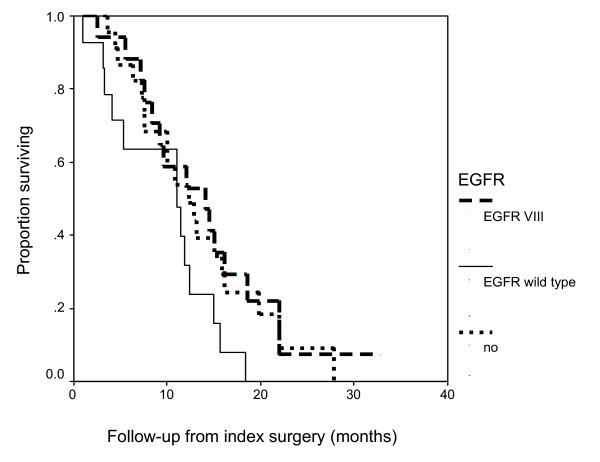
Results: In our study of GBM patients with less than GTR, 42.6% (n = 23) failed to express EGFR, 25.9% (n = 14) had over expression of the wild-type EGFR only and 31.5 % (n = 17) expressed the EGFRvIII. Patients within groups expressing the EGFR, EGFRvIII, or lacking EGFR expression did not differ in age, Karnofsky Performance Scale (KPS) score, extent of tumor resection. They all had received postoperative radiation and chemotherapy. The median overall survival times for patients with tumors having no EGFR expression, over expressed EGFR only, or EGFRvIII were 12.3 (95% CI, 8.04-16.56), 11.03 (95% CI, 10.18-11.89) and 14.07 (95% CI, 7.39-20.74) months, respectively, log rank test p > 0.05). Patients with tumors that over expressed the EGFR and EGFRvIII were more likely to present with ependymal spread, 21.4% and 35.3% respectively, compared to those patients whose GBM failed to express either marker, 13.0%, although the difference was not statistically significant. There was no significant difference in multifocal disease or gliomatosis cerebri among EGFR expression groups.
Conclusion: The over expressed wild-type EGFR and EGFRvIII are not independent predictors of median overall survival in the cohort of patients who did not undergo extensive tumor resection.
Figures
References
-
- Kallio M, Sankila R, Jaaskelainen J, Karjalainen S, Hakulinen T. A population-based study on the incidence and survival rates of 3857 glioma patients diagnosed from 1953 to 1984. Cancer. 1991;68:1394–1400. - PubMed
-
- Davis FG, Freels S, Grutsch J, Barlas S, Brem S. Survival rates in patients with primary malignant brain tumors stratified by patient age and tumor histological type: an analysis based on Surveillance, Epidemiology, and End Results (SEER) data, 1973-1991. J Neurosurg. 1998;88:1–10. - PubMed
-
- Curran WJJ, Scott CB, Horton J, Nelson JS, Weinstein AS, Fischbach AJ, Chang CH, Rotman M, Asbell SO, Krisch RE, et al. Recursive partitioning analysis of prognostic factors in three Radiation Therapy Oncology Group malignant glioma trials. J Natl Cancer Inst. 1993;85:704–710. - PubMed
-
- Lacroix M, Abi-Said D, Fourney DR, Gokaslan ZL, Shi W, DeMonte F, Lang FF, McCutcheon IE, Hassenbusch SJ, Holland E, Hess K, Michael C, Miller D, Sawaya R. A multivariate analysis of 416 patients with glioblastoma multiforme: prognosis, extent of resection, and survival. J Neurosurg. 2001;95:190–198. - PubMed
-
- Winger MJ, Macdonald DR, Cairncross JG. Supratentorial anaplastic gliomas in adults. The prognostic importance of extent of resection and prior low-grade glioma. J Neurosurg. 1989;71:487–493. - PubMed
LinkOut - more resources
Full Text Sources
Other Literature Sources
Research Materials
Miscellaneous
