


Tumor microsatellite instability in early onset gastric cancer
- PMID: 16237216
- PMCID: PMC1888489
- DOI: 10.1016/S1525-1578(10)60577-6
Tumor microsatellite instability in early onset gastric cancer
Abstract
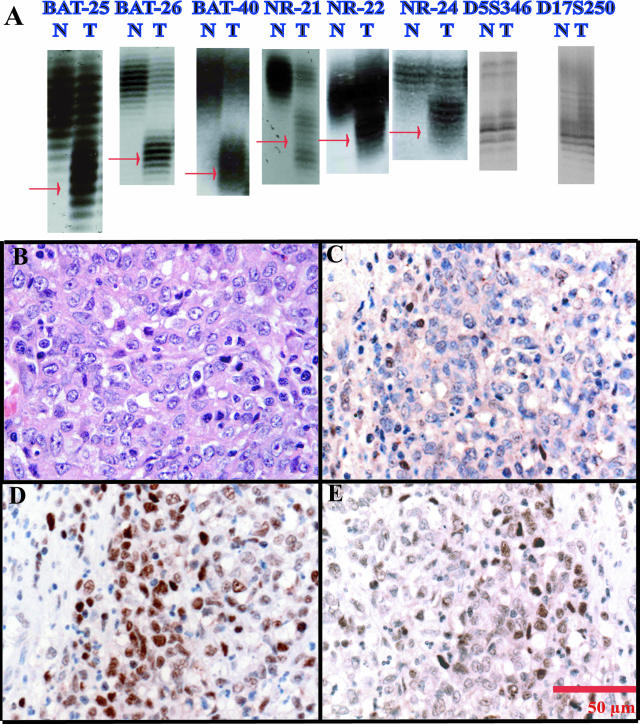
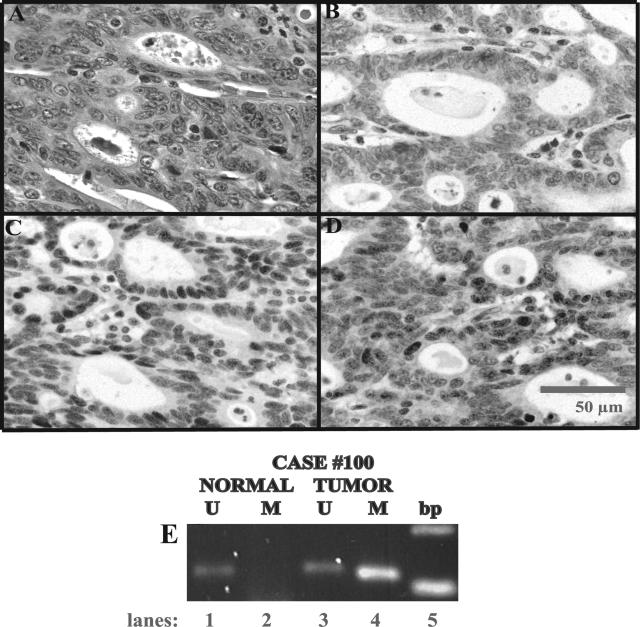
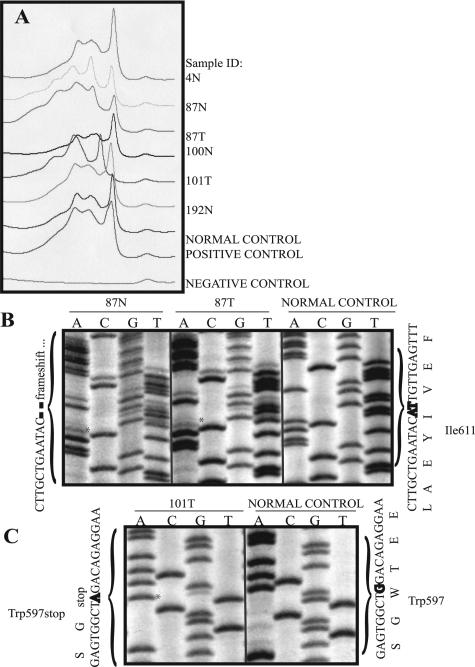
Gastric cancer (GC) remains a leading cause of cancer mortality worldwide. Genetic factors are implicated, including DNA mismatch repair (MMR) deficiency manifested as tumor microsatellite instability (MSI). However, a standardized panel of markers and a definition of low-versus-high level MSI in GC are lacking. We examined a population-based cohort of early onset (<or=50 yrs) gastric cancer. We identified 211 cases of early onset gastric cancer in Central-East Ontario from 1989 to 1993, with archival material available for 139 cases. Testing included a six-mononucleotide marker panel and a three-MMR immunohistochemical panel. Overall, 30% (41 of 139) of GC were MSI+, with allelic shifts at one to eight markers. An unexpected discordance between the BAT-25, BAT-26, and BAT-40 markers was observed in the MSI+ cases. Six cases showing multiple loci instability (>or=3 markers MSI+/MSI-high) demonstrated MMR protein deficiency. Three novel hMLH1 mutations (two germline frameshift and one somatic nonsense) were also found. The only significant clinicopathological associations were increased tumor size in MSI+ cases (P=0.04) and Lauren histotype (P=0.006) and tumor grade (P=0.007) in MSI-high cases. Tumor size, location, depth, nodal status, and Ming subtype were significant prognostic variables. Therefore, we propose a new definition of high-level MSI based on unifying characteristics of instability of more than or equal to three of six mononucleotide markers and loss of MMR protein expression.
Figures
References
-
- Bevan S, Houlston RS. Genetic predisposition to gastric cancer. Q J Med. 1999;92:5–10. - PubMed
-
- Leach FS, Nicolaides NC, Papadopoulos N, Liu B, Jen J, Parsons R, Peltomaki P, Sistonen P, Aaltonen LA, Nystrom-Lahti M, Guan XY, Zhang J, Meltzer PS, Yu JW, Kao FT, Chen DJ, Cerosaletti KM, Fournier REK, Todd S, Lewis T, Leach RJ, Naylor SL, Weissenbach J, Mecklin JP, Järvinen H, Petersen GM, Hamilton SR, Green J, Jass J, Watson P, Lynch HT, Trent JM, de la Chapelle A, Kinzler KW, Vogelstein B. Mutations of a mutS homolog in hereditary nonpolyposis colorectal cancer. Cell. 1993;75:1215–1225. - PubMed
-
- Wang Q, Lasset C, Desseigne F, Saurin JC, Maugard C, Navarro C, Ruano E, Descos L, Trillet-Lenoir V, Bosset JF, Puisieux A. Prevalence of germline mutations of hMLH1, hMSH2, hPMS1, hPMS2, and hMSH6 genes in 75 French kindreds with nonpolyposis colorectal cancer. Hum Genet. 1999;105:79–85. - PubMed
-
- Papadopoulos N, Nicolaides NC, Wei YF, Ruben SM, Carter KC, Rosen CA, Haseltine WA, Fleischmann RD, Fraser CM, Adams MD, Venter JC, Hamilton SR, Petersen GM, Watson P, Lynch HT, Peltomaki P, Mecklin JP, de la Chapelle A, Kinzler KW, Vogelstein B. Mutation of a mutL homolog in hereditary colon cancer. Science. 1994;263:1625–1629. - PubMed
-
- Akiyama Y, Sato H, Yamada T, Nagasaki H, Tsuchiya A, Abe R, Yuasa Y. Germ-line mutation of the hMSH6/GTBP gene in an atypical hereditary nonpolyposis colorectal cancer kindred. Cancer Res. 1997;57:3920–3923. - PubMed
Publication types
MeSH terms
Substances
LinkOut - more resources
Full Text Sources
Medical
Miscellaneous
