. 2005 Nov 1;102(44):16102-6.
doi: 10.1073/pnas.0506870102. Epub 2005 Oct 20.

pH sensing in the two-pore domain K+ channel, TASK2

Affiliations

pH sensing in the two-pore domain K+ channel, TASK2

Michael J Morton et al. Proc Natl Acad Sci U S A. .

Abstract

TASK2 is a member of the two-pore domain K(+) channel family that plays a role in acid-base homeostasis; TASK2 knockout animals have plasma electrolyte patterns typical of the human clinical condition of renal tubular acidosis. It is expressed preferentially in epithelia, including the proximal tubules of the kidney. In common with the other TASK channels, TASK2 is sensitive to changes in extracellular pH, although the molecular mechanism of such pH sensing is not understood. We have examined the role of charged residues in the extracellular domains in pH sensing using a mutational approach. Mutant channels were expressed in CHO cells and studied by whole-cell and single-channel patch clamp. Neutralization of no single amino acid in isolation gave complete loss of pH sensitivity. However, the combined removal of five charged amino acids in the large extracellular loop linking the first transmembrane and pore domains, the M1-P1 loop, resulted in an essentially pH-insensitive channel, stabilized in the open state. Wild-type channels contain two such loops, but a concatemeric construct, comprised of one wild-type subunit and one containing the five mutations, was fully pH-sensitive, indicating that only one M1-P1 loop is required to yield a fully pH-sensitive channel, demonstrating a regulatory role of this distinctive structure in two-pore domain K(+) channels. Thus, pH sensing in TASK2 channels is conferred by the combined action of several charged residues in the large extracellular M1-P1 loop.


Figures
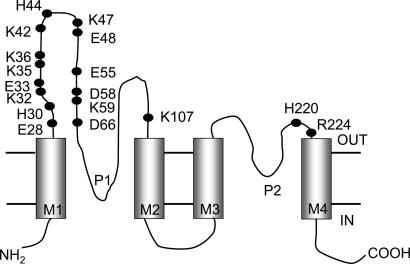
Fig. 1.
Fig. 1.
Topology of TASK2 and location of mutated residues. Diagrammatic representation of TASK2 structure showing four transmembrane domains (M1–M4) and two pore-domains (P1 and P2). OUT and IN refer to extracellular and intracellular compartments, respectively, and the cell membrane is delimited by the parallel, horizontal lines. Solid circles identify the charged residues in the extracellular domains, all of which were mutated in this study.
Fig. 2.
Fig. 2.
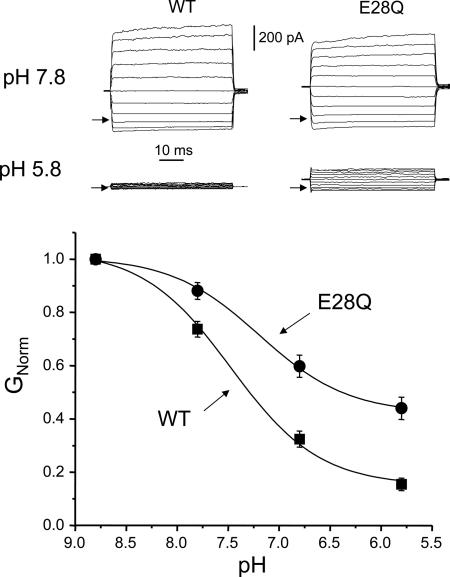
pH sensitivity of WT and mutant E28Q TASK2 channels. (Upper) Raw current–voltage (I–V) traces of WT and E28Q TASK2 at pH 7.8 and pH 5.8. Voltage was held at 0 mV, then clamped from -100 mV to +100 mV in 20-mV steps. Arrows indicate zero current level. (Lower) pH dose–response curves of WT (n = 14) and E28Q mutant. Solid curves are best fits to the Langmuir equation. GNorm = conductance normalized to that at pH 8.8.
Fig. 3.
Fig. 3.
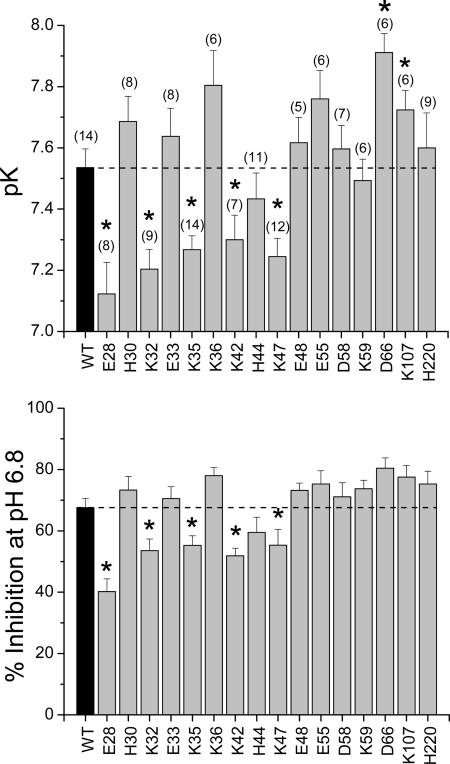
pH sensitivity of WT and mutant channels. pK (Upper) and percentage inhibition (Lower) at pH 6.8 relative to pH 8.8 for WT and mutant channels. Numbers on abscissa correspond to amino acid number. The number of determinations for each channel is given in brackets. *, Statistical significance compared with WT (P < 0.05).
Fig. 4.
Fig. 4.
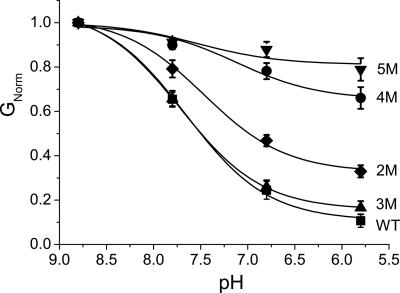
Effect of combined mutations on TASK2 pH sensitivity. pH dose–response curves of WT (▪, n = 14), 2M (E28Q and K47N; ♦, n = 8), 3M (K32N, K35N, and K42N triple mutant; ▴, n = 8), 4M (E28Q, K32N, K35N, and K42N quadruple mutant; •, n = 7), and 5M (E28Q, K32N, K35N, K42N, and K47N quintuple mutant; ▾, n = 8). Solid curves are best fits to the Langmuir equation. GNorm = conductance normalized to that at pH 8.8.
Fig. 5.
Fig. 5.
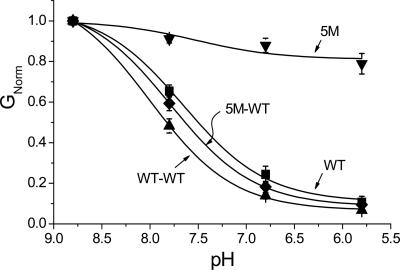
pH sensitivity of TASK2 concatemers. pH dose–response curves of the WT-WT concatemer (▴, n = 8) and 5M-WT concatemer (♦, n = 8). WT (▪, n = 14) and 5M (▾, n = 8) monomer results are shown for comparison. Solid curves are best fits to the Langmuir equation. GNorm = conductance normalized to that at pH 8.8.
Fig. 6.
Fig. 6.
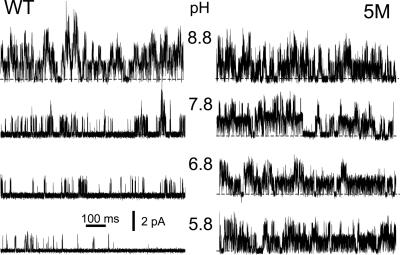
pH sensitivity of WT and 5M-TASK2 channels in outside-out patches. Recordings were made at 0 mV at the indicated bath pH values, with an outwardly directed K+ gradient, from patches obtained from cells expressing either WT (Left) or 5M mutant (Right) channels. Closed channel current level is indicated by the dotted lines, and openings are upward deflections.

References

    1. Hille, B. (2001) Ion Channels of Excitable Membranes (Sinauer, Sunderland, MA).
    1. Reyes, R., Duprat, F., Lesage, F., Fink, M., Salinas, M., Farman, N. & Lazdunski, M. (1998) J. Biol. Chem. 273, 30863-30869. - PubMed
    1. Warth, R., Barriere, H., Meneton, P., Bloch, M., Thomas, J., Tauc, M., Heitzmann, D., Romeo, E., Verrey, F., Mengual, R., et al. (2004) Proc. Natl. Acad. Sci. USA 101, 8215-8220. - PMC - PubMed
    1. Morton, M. J., Chipperfield, S., Abohamed, A., Sivaprasadarao, A. & Hunter, M. (2004) Am. J. Physiol. 288, F162-F169. - PubMed
    1. Niemeyer, M. I., Cid, L. P., Barros, L. F. & Sepulveda, F. V. (2001) J. Biol. Chem. 276, 43166-43174. - PubMed

Publication types

Substances

LinkOut - more resources