. 2005 Nov;73(11):7142-50.
doi: 10.1128/IAI.73.11.7142-7150.2005.

Pathogenesis of Yersinia pestis infection in BALB/c mice: effects on host macrophages and neutrophils

Affiliations

Pathogenesis of Yersinia pestis infection in BALB/c mice: effects on host macrophages and neutrophils

Roman A Lukaszewski et al. Infect Immun. 2005 Nov.

Abstract

The pathogenesis of infection with Yersinia pestis, the causative agent of plague, was examined following subcutaneous infection of BALB/c mice with a fully virulent strain expressing green fluorescent protein. Plate culturing, flow cytometry, and laser confocal microscopy of spleen homogenates throughout infection revealed three discernible stages of infection. The early phase was characterized by the presence of a small number of intracellular bacteria mostly within CD11b+ macrophages and Ly-6G+ neutrophils. These bacteria were not viable, as determined by plate culturing of spleen homogenates, until day 2 postinfection. Between days 2 and 4 postinfection, a plateau phase was observed, with bacterial burdens of 10(3) to 10(4) CFU per spleen. Flow cytometric analysis revealed that there was even distribution of Y. pestis within both CD11b+ macrophage and Ly-6G+ neutrophil populations on day 2 postinfection. However, from day 3 postinfection onward, intracellular bacteria were observed exclusively within splenic CD11b+ macrophages. The late phase of infection, between days 4 and 5 postinfection, was characterized by a rapid increase in bacterial numbers, as well as escape of bacteria into the extracellular compartment. Annexin V staining of spleens indicated that a large proportion of splenic neutrophils underwent rapid apoptosis on days 1 and 2 postinfection. Fewer macrophages underwent apoptosis during the same period. Our data suggest that during the early stages of Y. pestis infection, splenic neutrophils are responsible for limiting the growth of Y. pestis and that splenic macrophages provide safe intracellular shelters within which Y. pestis is able to grow and escape during the later stages of infection. This macrophage compliance can be overcome in vitro by stimulation with a combination of gamma interferon and tumor necrosis factor alpha.


Figures

FIG. 1.
FIG. 1.
Growth of Y. pestis(pACGFP) in the spleens of BALB/c mice following subcutaneous infection with approximately 100 MLD. Mice were infected subcutaneously in the hind thigh. Spleens were removed from groups of five mice at 6, 12, 24, 48, 72, 96, and 120 h postinfection. Log dilutions of each sample were plated in duplicate on Congo red agar plates containing kanamycin (kanamycin+) and not containing kanamycin (kanamycin−) and then incubated at 28°C for 2 days. The data are geometric means and standard deviations.
FIG. 2.
FIG. 2.
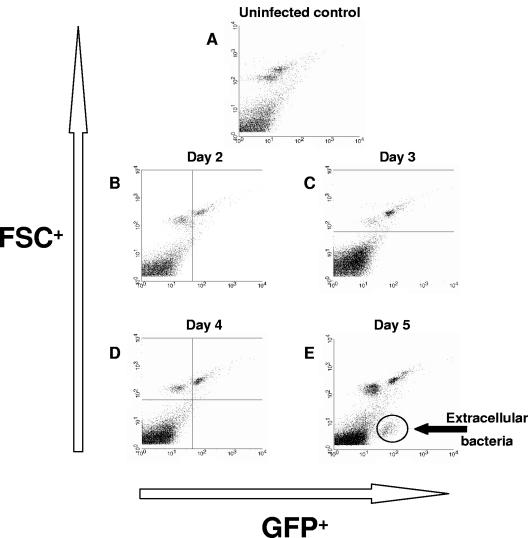
Presence of Y. pestis(pACGFP) in the spleens of BALB/c mice from day 2 postinfection onward. Groups of five BALB/c mice were infected with approximately 100 MLD of Y. pestis(pACGFP), and their spleens were removed from day 2 postinfection onward. At each time spleens were removed, and cell suspensions were prepared and fixed in 4% paraformaldehyde. Cells were acquired after 24 h of incubation at 4°C in the dark. The y axis indicates cell size (FSC), while the x axis indicates green fluorescence.
FIG. 3.
FIG. 3.
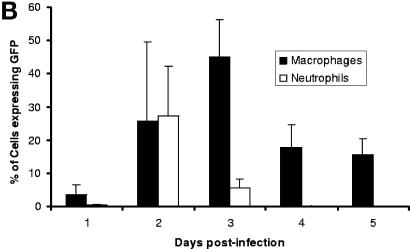
Dissemination of Y. pestis(pACGFP) into cells of the innate immune system following subcutaneous infection of BALB/c mice. The spleens from groups of five BALB/c mice were removed on days 1, 2, 3, 4, and 5 postinfection. Neutrophils (Ly-6G+ cells) and macrophages (CD11b+ cells) were isolated using Minimacs beads, stained for the presence of Ly-6G and CD11b, fixed in 4% paraformaldehyde for 24 h at 4°C, and analyzed by flow cytometry. (A) Dot plots from CD11b+ and Ly-6G+ populations on each day postinfection, indicating the presence of GFP fluorescence. Regions from which CD11b+ and Ly-6G+ cell data were gated are also indicated. (B) Percentages of CD11b+ (solid bars) and Ly-6G+ (open bars) cells expressing GFP over the course of infection. The data are means with 95% confidence limits.
FIG. 3.
FIG. 3.
Dissemination of Y. pestis(pACGFP) into cells of the innate immune system following subcutaneous infection of BALB/c mice. The spleens from groups of five BALB/c mice were removed on days 1, 2, 3, 4, and 5 postinfection. Neutrophils (Ly-6G+ cells) and macrophages (CD11b+ cells) were isolated using Minimacs beads, stained for the presence of Ly-6G and CD11b, fixed in 4% paraformaldehyde for 24 h at 4°C, and analyzed by flow cytometry. (A) Dot plots from CD11b+ and Ly-6G+ populations on each day postinfection, indicating the presence of GFP fluorescence. Regions from which CD11b+ and Ly-6G+ cell data were gated are also indicated. (B) Percentages of CD11b+ (solid bars) and Ly-6G+ (open bars) cells expressing GFP over the course of infection. The data are means with 95% confidence limits.
FIG. 4.
FIG. 4.
Laser confocal microscope images of day 5 and 6 postinfection CD11b+ cell fractions from the spleens of BALB/c mice infected with Y. pestis(pACGFP). (A to D) Extended views of macrophages containing a number of single (C and D) or replicating (A and B) intracellular bacteria isolated on day 5 (A and B) and day 6 (C and D) postinfection. (E) Single view from panel D, accompanied by horizontal and vertical Z-projections indicating the presence of a bacterium within the macrophage and not on its surface. Bars = 10 μm.
FIG. 5.
FIG. 5.
Apoptosis in splenic macrophages (A) and neutrophils (B) following infection of BALB/c mice with Y. pestis. BALB/c mice were infected subcutaneously with approximately 100 MLD of Y. pestis GB. Groups of five mice were humanely culled on days 1, 2, and 3 postinfection. Spleens were removed and stained for the presence of Annexin V (an early cell surface-expressed marker of apoptosis) on CD11b+ (A) or Ly-6G+ (B) cells (open bars). In addition, the vital dyes propidium iodide (PI) (for CD11b+ cells) and 7AA-D (for Ly-6G+ cells) were added to assess cell necrosis (solid bars). Following staining, cells were washed and fixed in 4% paraformaldehyde overnight and acquired the next day. The bars indicate mean percentages of target cells (CD11b+ or Ly-6G+), and the error bars indicate standard deviations. An asterisk indicates that there is a significant difference between apoptosis on day 0 and apoptosis following infection.
FIG. 6.
FIG. 6.
Synergistic effect of IFN-γ and TNF-α on intracellular killing of Y. pestis GB by J774 macrophages. Approximately 106 J774 macrophages were pretreated with 50 μg IFN-γ (striped bars), 40 μg TNF-α (dotted bars), both IFN-γ and TNF-α (open bars), or medium alone (solid bars) 12 h before infection with 107 Y. pestis (multiplicity of infection, 10:1) for 30 min. Cells were washed and maintained in gentamicin media with the relevant cytokine treatments and were lysed at 0, 3, 5, and 24 h postinfection. The bars indicate the geometric means for plate counts, and the error bars indicate the standard errors of the means.

References

    1. Andrew, P. W., J. P. S. Jackett, and D. B. Lowrie. 1985. Killing and degradation of microorganisms by macrophages, p. 311-335. In R. T. Dean, W. Jessop, and J. W. Dean (ed.), Mononuclear phagocytes: physiology and pathology. Elsevier Biomedical Press, Amsterdam, The Netherlands.
    1. Bohn, E., J. Heesemann, S. Ehlers, and I. B. Autenrieth. 1994. Early gamma interferon mRNA expression is associated with resistance of mice against Yersinia enterocolitica. Infect. Immun. 62:3027-3032. - PMC - PubMed
    1. Boland, A., and G. R Cornelis. 1998. Role of YopP in suppression of tumor necrosis factor alpha release by macrophages during Yersinia infection. Infect. Immun. 66:1878-1884. - PMC - PubMed
    1. Brubaker, R. 1991. Factors promoting acute and chronic disease caused by yersinae. Clin. Microbiol. Rev. 4:309-324. - PMC - PubMed
    1. Cavanaugh, D., and R. Randall. 1959. The role of multiplication of Pasteurella pestis in mononuclear phagocytes in the pathogenesis of flea-borne plague. J. Immunol. 83:348-363. - PubMed

Substances