Review
. 2005 Dec;17(6):617-25.
doi: 10.1016/j.ceb.2005.10.001. Epub 2005 Oct 21.

Life in the balance: how BH3-only proteins induce apoptosis

Affiliations
Review

Life in the balance: how BH3-only proteins induce apoptosis

Simon N Willis et al. Curr Opin Cell Biol. 2005 Dec.

Abstract

BH3-only members of the Bcl-2 intracellular protein family, which include Bim, Bmf, Bik, Bad, Bid, Puma, Noxa and Hrk, mediate many developmentally programmed and induced cytotoxic signals. They have key roles in development, tissue homeostasis, immunity and tumor suppression, and compounds mimicking them are promising anti-cancer agents. Their activity is normally constrained by transcriptional and/or diverse post-transcriptional controls. When activated, these death ligands engage pro-survival Bcl-2-like proteins via the BH3 domain, inactivating their function. Bim and Puma bind all the pro-survival proteins, whereas others, such as Noxa and Bad, engage distinct subsets and exhibit complementary killing. Hence, multiple pro-survival proteins must be inactivated to unleash Bax and Bak, which drive apoptosis. Whether certain BH3-only proteins also directly activate Bax/Bak remains controversial.


Figures
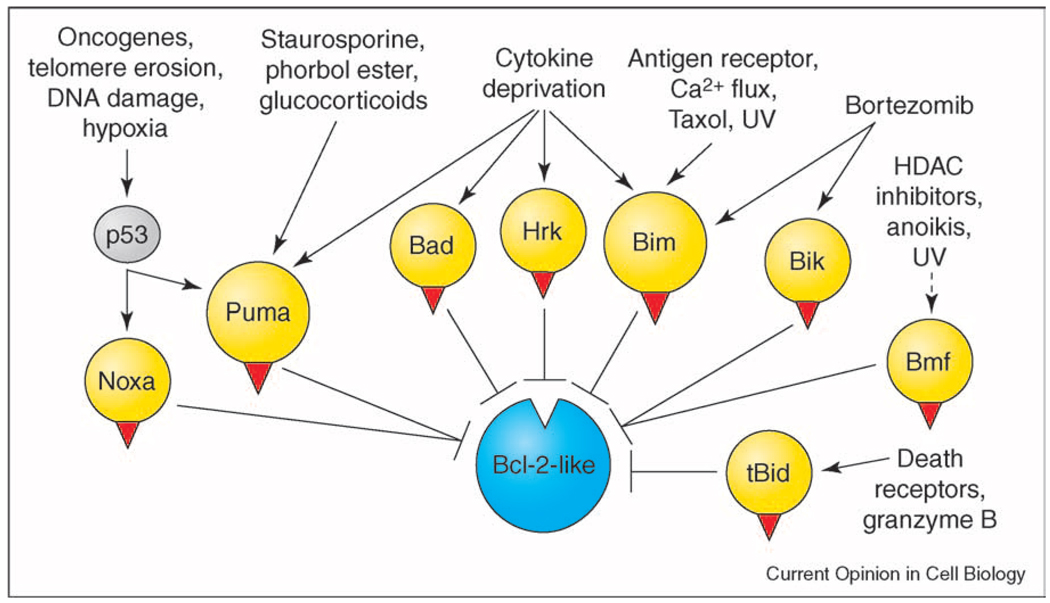
Figure 1
Figure 1
BH3-only proteins monitor cellular wellbeing. BH3-only proteins are activated by a variety of cellular stresses. Once activated, they initiate apoptosis by binding and neutralizing Bcl-2 pro-survival proteins via their BH3 domain (red triangle). Bid, which is typically activated following caspase cleavage, amplifies the apoptotic response by engaging the Bcl-2 pro-survival proteins. Potentially tBid may also engage Bax (or Bak) (see text).
Figure 2
Figure 2
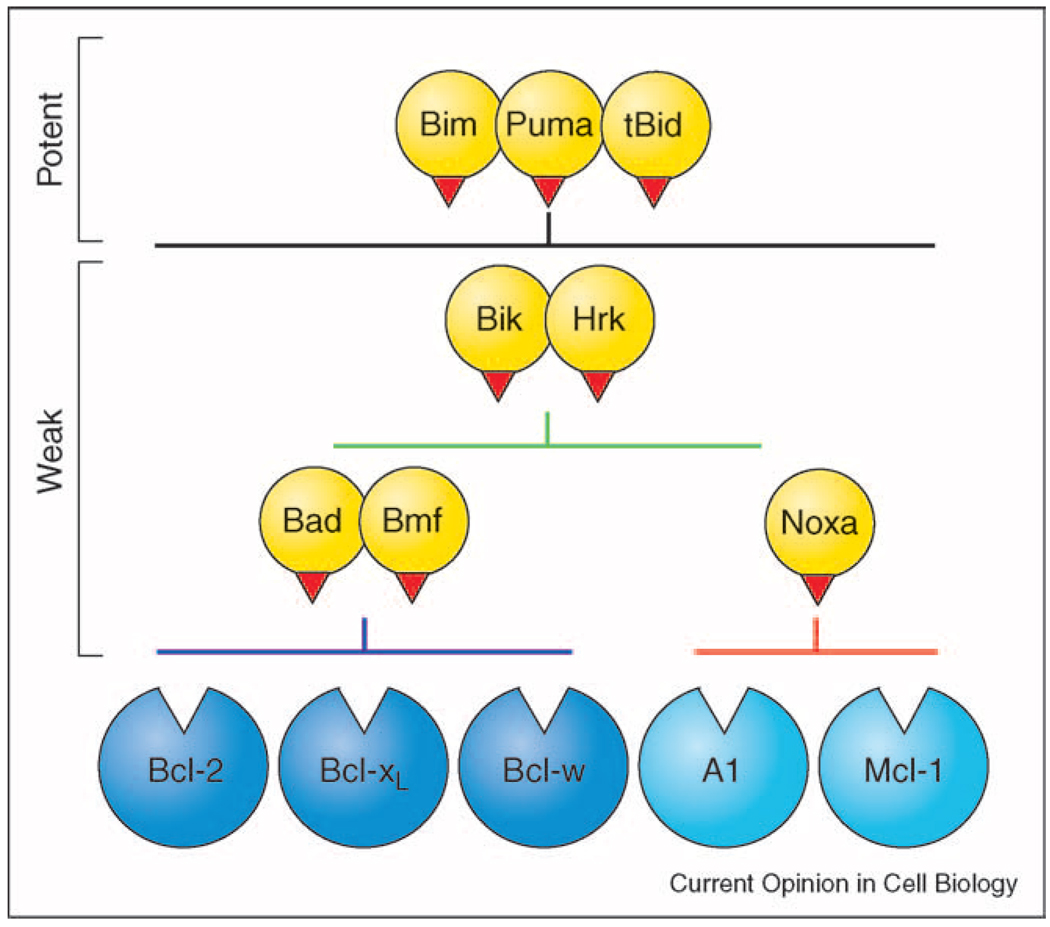
BH3-only proteins bind promiscuously or selectively to Bcl-2 pro-survival proteins. BH3-only proteins such as Bim, Puma and tBid engage all Bcl-2 pro-survival proteins and thus are potent killers. All other BH3-only proteins bind selectively to subsets of the Bcl-2 pro-survival proteins and hence are weaker killers [13••].
Figure 3
Figure 3
Displacement model for Bak regulation. The model [14••] proposes that both Mcl-1 and Bcl-xL, but not other pro-survival family members (e.g. Bcl-2), sequester Bak in healthy cells until cytotoxic signals activate a combination of BH3-only proteins that can displace Bak. While Noxa can readily displace Bak from Mcl-1 and promote Mcl-1 degradation, another BH3-only protein that can bind Bcl-xL (e.g. Bad) is also required for Bak liberation [14••]. The Bak BH3 (red triangle) is required both for Bak regulation and for formation of Bak oligomers, but their structure is unknown. Some of the Bak molecules in healthy cells, like cytosolic Bax [40], may have a ‘receptor’ conformation and be in equilibrium with the BH3-exposed ‘ligand’ conformation bound by Mcl-1 and Bcl-xL.
Figure 4
Figure 4
Models for how BH3-only proteins activate Bax and Bak. (a) Direct binding model. BH3-only proteins are proposed to constitute both ‘sensitizers’ (e.g. Bad) that bind only to the pro-survival proteins and ’activators’ (e.g. tBid) that can also bind Bax and Bak. The sensitizers are proposed to liberate the activators from Bcl-2-like proteins, so that they can directly engage Bax (or Bak) to induce cell death [16]. (b) Displacement model. BH3-only proteins are proposed to activate Bax and Bak by displacing them from the Bcl-2 pro-survival proteins that sequester their active forms [14••]. For Bak activation, BH3-only proteins must liberate Bak from both Mcl-1 and Bcl-xL [14••] (see Figure 3). It is proposed that an active form of Bax, located on the mitochondrial membrane, must be similarly released from pro-survival guards. The structure of the oligomers of Bax and Bak is unknown.

References

    1. Cory S, Huang DCS, Adams JM. The Bcl-2 family: roles in cell survival and oncogenesis. Oncogene. 2003;22:8590–8607. A useful review on the Bcl-2 family and its role in cancer.

    1. Danial NN, Korsmeyer SJ. Cell death: critical control points. Cell. 2004;116:205–219. A good recent overview of apoptosis.

    1. Cheng EH, Wei MC, Weiler S, Flavell RA, Mak TW, Lindsten T, Korsmeyer SJ. BCL-2, BCL-xL sequester BH3 domain-only molecules preventing BAX- and BAK-mediated mitochondrial apoptosis. Mol Cell. 2001;8:705–711. - PubMed
    1. Zong WX, Lindsten T, Ross AJ, MacGregor GR, Thompson CB. BH3-only proteins that bind pro-survival Bcl-2 family members fail to induce apoptosis in the absence of Bax and Bak. Genes Dev. 2001;15:1481–1486. - PMC - PubMed
    1. Green DR, Kroemer G. The pathophysiology of mitochondrial cell death. Science. 2004;305:626–629. - PubMed

Publication types

MeSH terms

Substances