


Does neostigmine administration produce a clinically important increase in postoperative nausea and vomiting?
- PMID: 16243993
- PMCID: PMC1458621
- DOI: 10.1213/01.ANE.0000180992.76743.C9
Does neostigmine administration produce a clinically important increase in postoperative nausea and vomiting?
Abstract
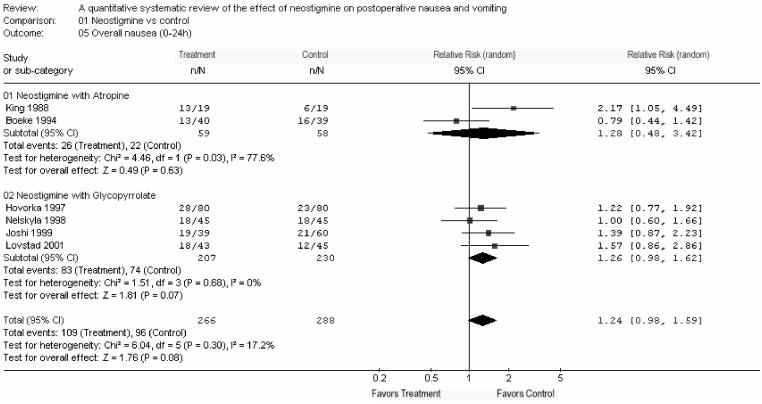
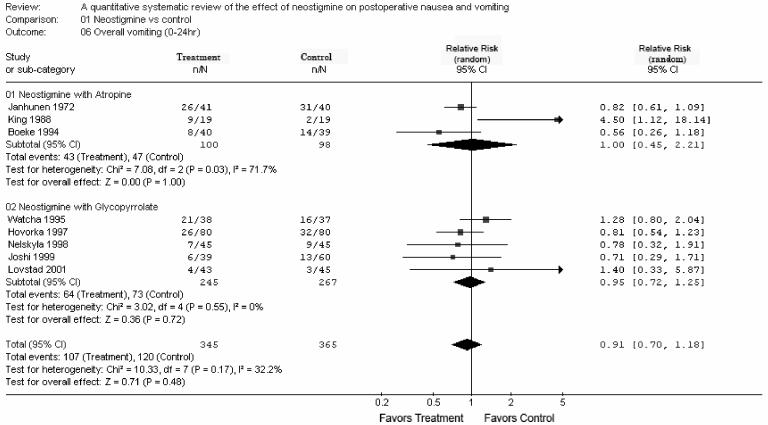
Neostigmine is used to antagonize neuromuscular blocker-induced residual neuromuscular paralysis. Despite the findings of a previous meta-analysis, the effect of neostigmine on postoperative nausea and vomiting remains unresolved. We reevaluated the effect of neostigmine on postoperative nausea and vomiting while considering the different anticholinergics as potentially confounding factors. We performed a systematic literature search using MEDLINE, Embase, Cochrane library, reference listings, and hand searching with no language restriction through December 2004 and identified 10 clinical, randomized, controlled trials evaluating neostigmine's effect on postoperative nausea and vomiting. Data on nausea or vomiting from 933 patients were extracted for the early (0-6 h), delayed (6-24 h), and overall (0-24 h) postoperative periods and analyzed with RevMan 4.2 (Cochrane Collaboration, Oxford, UK) and multiple logistic regression analysis. The combination of neostigmine with either atropine or glycopyrrolate did not significantly increase the incidence of overall (0-24 h) vomiting (relative risk, 0.91; 95% confidence interval, 0.70-1.18; P = 0.48) or nausea (relative risk, 1.24; 95% confidence interval, 0.98-1.59; P = 0.08). Multiple logistic regression analysis indicated that there was not a significant increase in the risk of vomiting with large compared with small doses of neostigmine. Contrasting a previous analysis, we conclude that there is insufficient evidence to conclude that neostigmine increases the risk of postoperative nausea and vomiting.
Figures
References
-
- Watcha MF, White PF. Postoperative nausea and vomiting. Its etiology, treatment, and prevention. Anesthesiology. 1992;77:162–84. - PubMed
-
- Kovac AL. Prevention and treatment of postoperative nausea and vomiting. Drugs. 2000;59:213–43. - PubMed
-
- Gan TJ, Meyer T, Apfel CC, et al. Consensus guidelines for the management of postoperative nausea and vomiting. Anesthesia and Analgesia. 2003;97:62–71. - PubMed
-
- Apfel CC, Kranke P, Eberhart LHJ, et al. A comparison of predicting models for postoperative nausea and vomiting. British Journal of Anaesthesia. 2002;88:234–40. - PubMed
-
- Apfel CC, Kranke P, Katz MH, et al. Volatile anaesthetics may be the main cause of early but not delayed postoperative vomiting: a randomized controlled trial of factorial design. Br J Anaesth. 2002;88:659–68. - PubMed
Publication types
MeSH terms
Substances
Grants and funding
LinkOut - more resources
Full Text Sources
Medical
